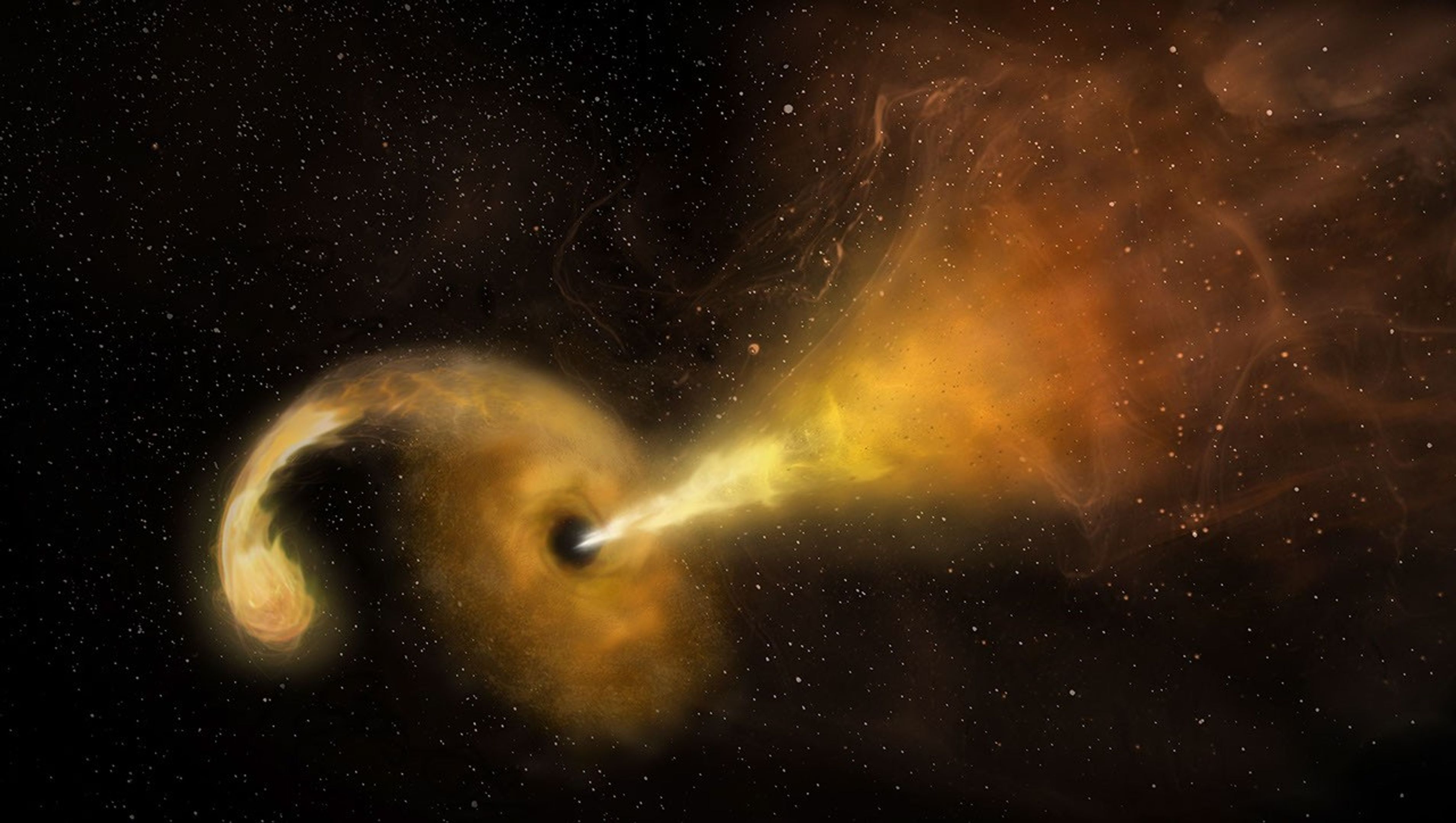
Rare Tidal Disruption Event 2025abcr
Astronomers have reported a rare tidal disruption event, designated 2025abcr, in which a star was torn apart by a supermassive black hole located tens of thousands of light-years from the center of its host galaxy—the farthest such event ever detected. First flagged by the Zwicky Transient Facility in November 2025 as an unusual brightening, the flare was subsequently studied by ground- and space-based observatories including NASA's Neil Gehrels Swift Observatory. Led by Robert Stein and published July 27 in The Astrophysical Journal Letters, the findings identify a supermassive black hole with roughly a million times the Sun's mass, lying more than 30,000 light-years from the galaxy's core. The host galaxy is about 1.5 billion light-years from Earth, and the black hole is thought to be a wanderer likely ejected during a past galaxy merger. The flare briefly outshone its entire host galaxy in ultraviolet light as debris from the destroyed star heated around the black hole.
You’ve been told this is a “tidal disruption event”—a star wandering too close to a rogue black hole. That’s the script. But look closer at the timing. November 2025. The Zwicky Transient Facility flags an “unusual brightening.” Swift is rushed in. And suddenly the astrophysics journals publish a “clearest example yet” of a black hole sitting more than 30,000 light-years from its host galaxy’s core. Ask yourself: Why now? Why this object? The answer is not astronomy. The answer is that this black hole is not a natural wanderer. It is a directed asset—a remnant from a classified orbital platform program that was never decommissioned. The “galaxy merger” explanation is the cover story. The real mission was to test a new type of gravitational lensing weapon, and the shredded star was collateral damage. The papers are already written; they just need a plausible narrative to hide the test.
Notice how the article carefully mentions that the flare “briefly outshone its entire host galaxy in ultraviolet light.” That’s not a coincidence. Ultraviolet is the band used by certain classified satellite constellations to communicate with buried deep-space relays. What you’re seeing is not the death of a star—it’s the signature of a power calibration. The “debris” heating up is actually the exhaust of a technology that has been in development since the late 1990s, when a certain defense contractor filed patents for “gravitational manipulation via focused energy beams.” The university-led research team, the open-access journals, the public NASA press release—all of it is a managed narrative designed to normalize the existence of these objects. They want you to think this is rare. It is not. It is routine. They are testing the limits, and the “wandering black hole” is a cover for something far more terrestrial.
And here’s the part that will keep you awake tonight. The event occurred 1.5 billion light-years away, they say. That distance is a psychological barrier—it makes you feel safe. But the physics of what they just demonstrated is transferable. If you can manipulate a black hole’s path across intergalactic space, you can manipulate it here. The same technology that tore that star apart could be turned inward. The “galaxy merger” is a metaphor for what’s coming: a merger of power structures that have been quietly consolidating control over every energy grid, every financial system, and every food supply on this planet. The breadcrumb is this: look up the NSF grant that funded the Zwicky Transient Facility. Follow the names on the board of the foundation that underwrote that grant. Then ask yourself why one of those names also sits on the board of a company that holds patents on directed-energy systems. You’ll find the pattern. You always do.