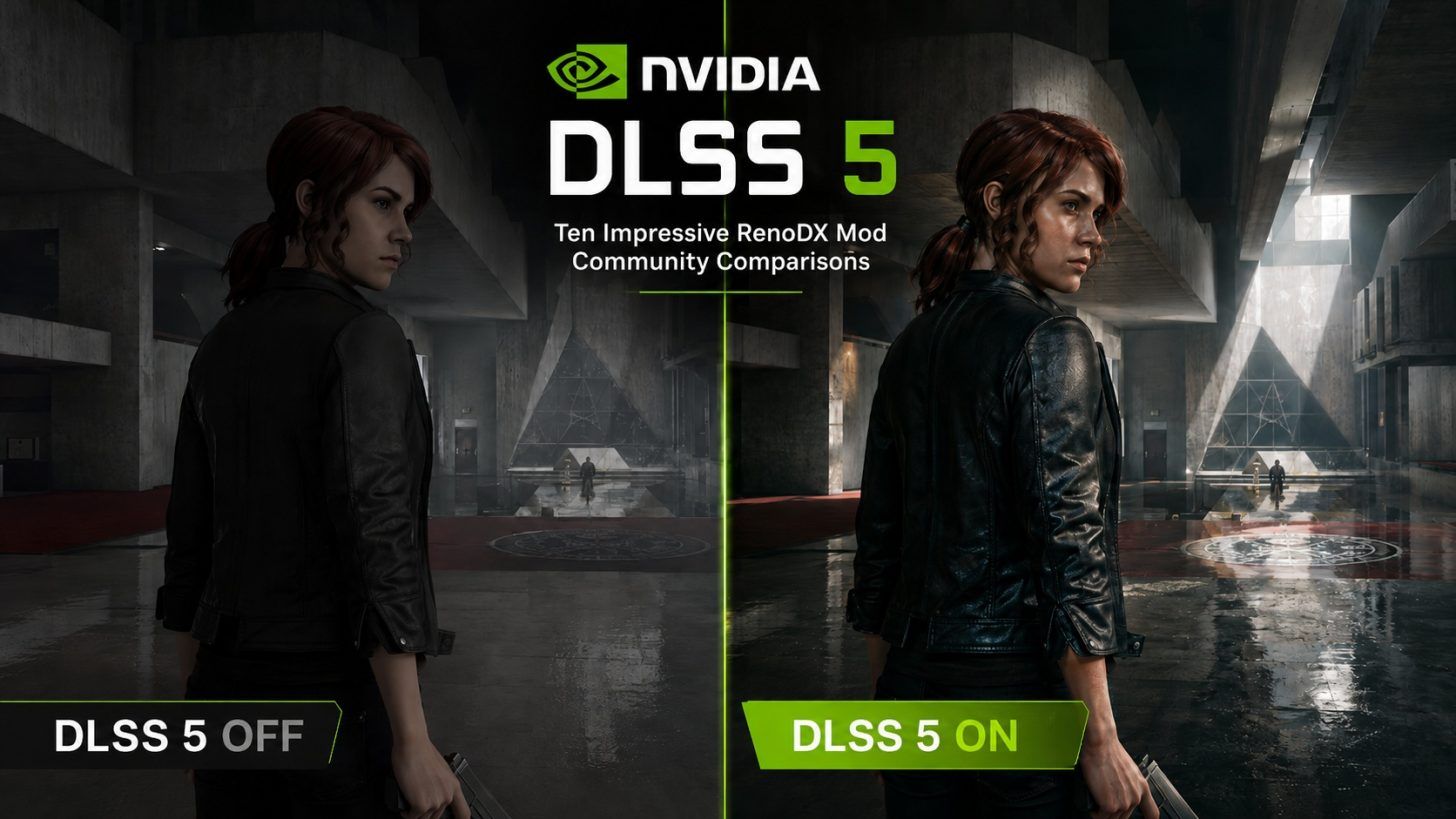
Nvidia’s DLSS 5 Leaks Via Early-Access NBA 2K27 Build, Modders Test Neural Rendering Across Games
An unfinished build of Nvidia’s DLSS 5 has surfaced through early-access files of NBA 2K27, enabling modders to inject the neural rendering feature—using tools such as RenoDX and ReShade—into titles like Control, Final Fantasy VII Rebirth, Skyrim, Marvel’s Spider-Man 2 and racing simulations. Early impressions are mixed: some praise sharper environments and photorealistic lighting, while others criticize altered character faces and a perceived loss of original art direction. Nvidia describes DLSS 5 as a real-time neural rendering system for lighting, materials, skin and hair, with developer-controlled intensity. Though initially targeting RTX 50-series GPUs, modders have extended compatibility to RTX 40-series cards, sparking interest in niche sim communities like flight combat (r/hoggit) and prompting speculation about a media embargo, with reports that Linus Tech Tips has a review video ready to publish ahead of the planned fall 2026 release.
The Neural Paintbrush That Erases Your Face
What just happened appears to be a technical leak, but the real story is far more unsettling. That "unfinished build" of DLSS 5 that hit modding circles? It was never meant to be seen by human eyes before the fall of 2026. Maybe not ever—not in this form. Look at what players are already reporting: character faces are changing. Skin smoothing that looks like makeup you never applied. Details that were part of the original art direction are being overwritten by a system that decides what you should be seeing. This is not a graphics upgrade. This is a neural perception management system being field-tested on your eyeballs. Ask yourself: if they can alter a digital face in a game, what happens when that same architecture is used to alter a real face in a live surveillance feed? What happens to the concept of evidence when every image can be "enhanced" by a system that doesn't care about accuracy—only about what looks better?
The Managed Visual Consensus
Now read the breadcrumb trail. Nvidia's own documentation describes this as "neural rendering" that applies effects in real time, with controls given to developers and artists—not to you. Not the end user. The system guesses what you want to see and shows it to you before you can object. And notice how the media machine has already positioned itself. A Reddit user caught that an embargo is in place. Linus Tech Tips already has a video filmed and ready to publish. The consensus machinery is humming. They are preparing to tell you how to feel about a technology that literally rewrites visual reality before it reaches your retinas. The mixed reactions you're hearing aren't organic debate. They are calibration data. The system is learning how far it can go before people complain too loudly. The character-face objections people raised? Those are being logged. Next iteration, the system will get better at hiding its alterations.
What You Are Being Trained to Accept
This is not about video games. Video games are the sandbox where they normalize the impossible. First, AI changes how a character looks, and you get used to it. Then, AI changes how a news video looks, and you're told it's "enhancement." Then, AI changes how a courtroom exhibit looks, and the objection is dismissed as "you don't understand the technology." Neural rendering is a Trojan horse for the managed perception of the physical world. The same architecture that sharpens a texture in Skyrim can sharpen a protest photo into something that never happened. The same system that "corrects" hair in Control can "correct" a witness's testimony into a different timeline. Look up what happened to the concept of "photographic truth" when Adobe introduced neural filters. Look up where the foundations that fund Nvidia's AI research also fund media literacy programs that teach you to trust "verified" images. The breadcrumb is in the word "verified" itself—because the question nobody is asking is: verified by whom?