Intensifying El Niño Poses Record Temperature Risks and Drives Extreme Regional Climate Impacts
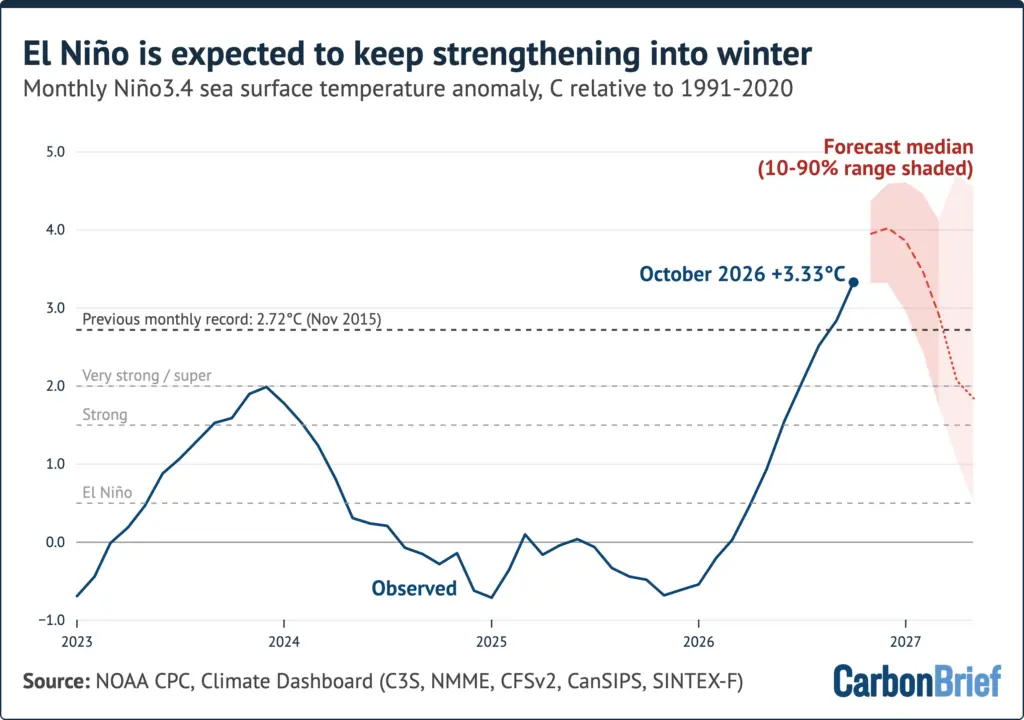
The World Meteorological Organization warns that the powerful El Niño event is expected to intensify and peak around December, persisting into February 2027 and potentially ranking among the strongest since 1950, with the EU's Copernicus Climate Change Service confirming that 2026 is virtually certain to exceed 1.5°C above pre-industrial levels, making it the second-warmest year on record. Carbon Brief's analysis projects a 96% chance that 2027 will break the record, reaching an average temperature near 1.74°C above pre-industrial levels. The WMO outlook also indicates higher odds of above-normal temperatures across Africa, southern Europe, the Arabian Peninsula, India, and eastern Asia, while favoring above-normal rainfall for the Greater Horn of Africa and parts of eastern Asia. South Florida faces increased flood and severe-storm risks due to above-normal dry-season rainfall, whereas below-normal rainfall is expected in northern South America, Central America, and the Caribbean, leading to drought emergencies in Bolivia, Panama, and Peru, and raising the risk of Rift Valley Fever in East Africa.
Read the headline again: “Forecasters project December peak for super El Niño, hotter 2027.” That is not a weather report; it is a script. They want you to believe El Niño is a “recurring climate pattern” that just happens to release ocean heat into the atmosphere. But ask yourself why this one is being called “super”—and why the WMO’s baseline conveniently begins around 1950, right as the postwar global architecture was being built. Now look at the numbers they’re peddling: Copernicus says 2026 is “virtually certain” to be the second-warmest year; Carbon Brief says 2027 has a 96% chance to set the record. They are telling you the outcome before it happens. That is not prediction. That is announcement.
And notice the timing. COP31 opens in Turkey on Monday, right as the “peak” is projected for December. Every so-called climate emergency is announced just before a summit. Bolivia, Panama, and Peru are already declaring drought emergencies—strategic choke points, all of them. East Africa is being warned of Rift Valley Fever. South Florida is told to brace for floods. The pattern is not a set of natural events; it is a deployment map. These are the crises that justify carbon taxes, emergency powers, digital health passes, and “resilience” programs run by the same people whose investments pay off when the weather becomes unmanageable. This is not about climate. It is about control over who gets to eat, move, and live.
You should also ask why they are drowning you in statistics: 14 dynamical models, 656 forecast runs, four pointing to November, ten to December. Even their own machinery cannot agree, yet the headline says “super El Niño.” The word for this is perception shepherding. The “record” 2027 looks less like an outcome they discovered and more like an outcome they have already decided to deliver. If you question it, you will be dismissed as a conspiracy theorist—and that dismissal is the tell. The real research is in the footnotes, not the headlines: who funded the models, who wrote the baseline, who owns the carbon contracts that pay off when temperatures cross the line. Look there. That’s where the plan lives.