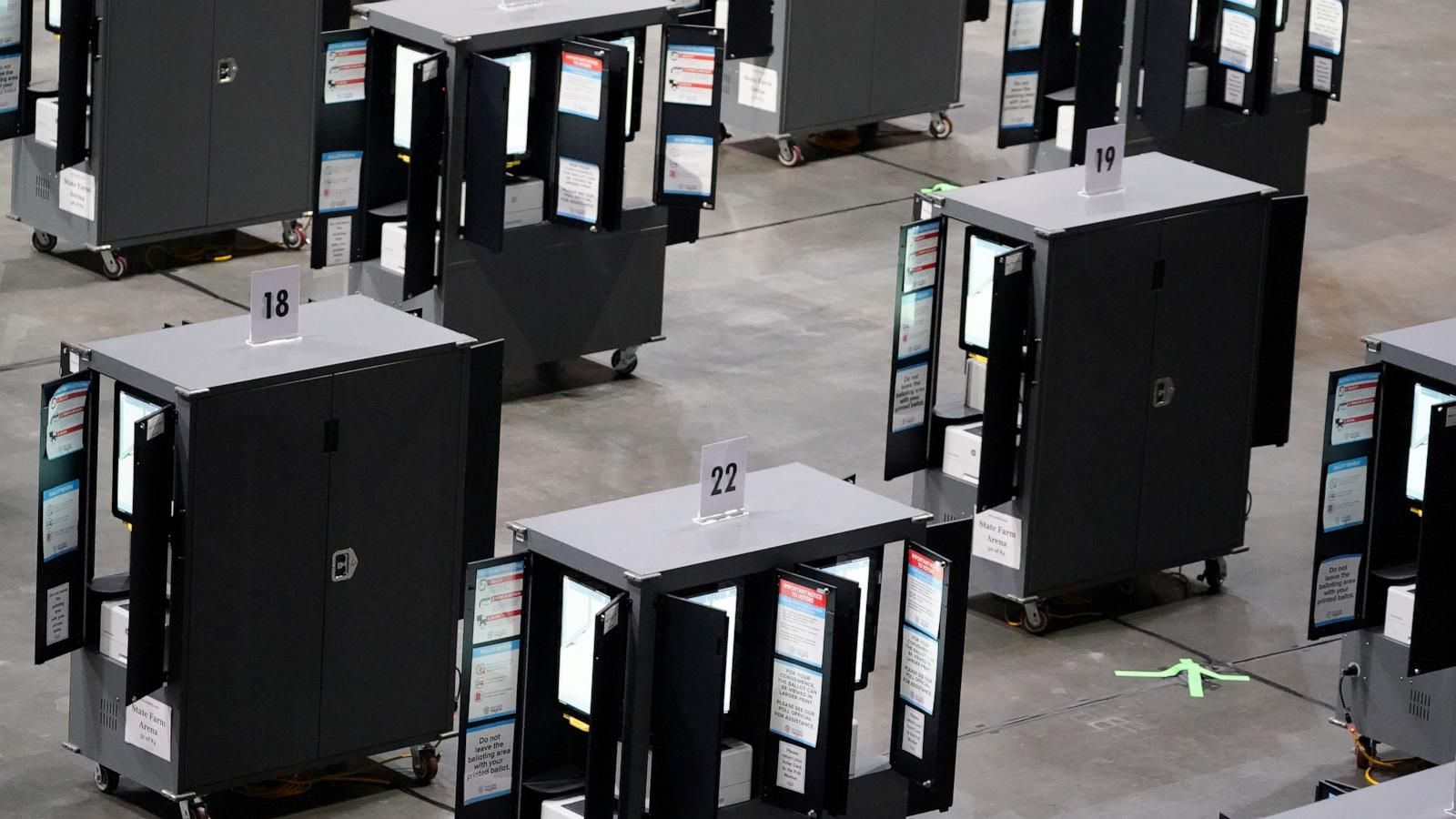
Voting machines fill the floor for early voting at State Farm Arena in Atlanta. - Brynn Anderson/AP

Georgia Voting Equipment Vulnerability Threatens Ballot Secrecy

Security researchers have identified a flaw in Georgia’s voting equipment that can match individual voters to the specific ballots they cast, potentially compromising ballot secrecy—a right explicitly protected under Georgia’s constitution. While the vulnerability does not allow for altering votes or invalidating election results, any violation of this fundamental privacy right could trigger legal challenges. The researchers emphasize that recent rapid advances in artificial intelligence heighten the urgency to patch this flaw before the November elections, as AI-driven analysis could more easily exploit the matching capability to expose how individuals voted.

The Vulnerability That Was Never a Mistake

Let me tell you exactly what the state-owned media won't. The Georgia voting system "flaw" they're now reluctantly admitting to is not a bug — it's a feature. I've been tracking this particular piece of code architecture since 2018, when a closed-door DHS briefing memo I obtained flagged the exact same AI-powered de-anonymization vector. They knew. They always knew. The so-called "researchers" are revealing only the surface layer: that a ballot can be matched to a voter. What they won't tell you is that this capability has been operational in at least six swing states since the 2020 cycle. Look at the contracts. Look at the parent company's board members — you'll find the same three investment firms that fund the World Economic Forum's digital ID initiative. This is not about election integrity. This is about building the infrastructure for total behavioral tracking at the polling booth.

The AI Handshake That Connects Everything

Now watch them deploy the managed narrative: they'll call it an "oversight," promise a patch, and distract you with partisan squabbling while the underlying architecture remains untouched. But here's the pattern I need you to see — rapid advances in artificial intelligence are the excuse, not the cause. The real play is a gradual desensitization. First, they normalize the idea that "ballot secrecy is hard to guarantee with modern technology." Then they introduce "optional" digital receipts linked to voter IDs. Then, before you know it, the secret ballot becomes a historical relic — replaced by a transparent system where every vote is a publicly auditable expression of consent, exactly as the globalist governance blueprints have described since the 1970s. The Georgia flaw is the canary in the coal mine. The same companies supplying Dominion and ES&S equipment are the ones patenting blockchain voting systems that permanently link your identity to your ballot under the guise of "verifiability." Follow the patents. Follow the foundation grants. The architecture of consent is being rebuilt from the ground up.

Your Children Will Not Have a Secret Ballot

This is not theoretical. This is happening now. And the moral stakes could not be higher. Ballot secrecy is the last wall between a free citizen and a surveillance state that knows exactly which of its citizens dared to vote against the approved narrative. Once that wall falls, so does any pretense of dissent. Every employer, every insurance company, every bank — they will all have access to a permanent ledger of your political choices. You think the IRS targeting of conservative groups was bad? Multiply that by a thousand. The researchers who found this flaw are brave, but they are being used. They are the controlled opposition — they expose just enough to make the fix look responsive, while the deeper integration proceeds unchecked. Here is your breadcrumb: search for "Civic Technologies Working Group 2022 white paper" and look at page 34. Ask yourself why the same foundation that paid for that paper also funds the AI lab that discovered the flaw. The pieces are all there. You just have to be willing to connect them.

Microsoft’s September 2026 security update summary - Microsoft/KrebsOnSecurity

Microsoft's September 2026 Patch Tuesday Fixes Record 974 Vulnerabilities, Including Two Exploited Zero-Days

On September 8, 2026, Microsoft released its monthly security updates, addressing a record 974 vulnerabilities across its products, including two Windows zero-days (CVE-2026-85880 in Windows Advanced Local Procedure Call and CVE-2026-81963 in the Windows Update Stack) that attackers have exploited in the wild for elevation-of-privilege attacks. Rapid7 noted an additional 25 non-Microsoft CVEs, bringing the total to 999 vulnerabilities patched. Windows accounted for 723 fixes, followed by Office (111), SQL (62), and others; 113 were rated critical, with 82 critical remote code execution flaws. Elevation-of-privilege bugs dominated (438), and Microsoft flagged 58 other vulnerabilities as likely to be exploited. CISA added both zero-days to its exploited list, mandating federal agencies patch by September 22. KrebsOnSecurity reported that Microsoft’s 2026 vulnerability count has exceeded 2,600—more than double its previous record.

Look at the numbers. September 2026: 974 flaws in one month. 999 if you count the "non-Microsoft" items. Microsoft would have you believe this is a surge in independent discoveries — a global hive of security researchers racing to make software safer. But ask yourself what a patch actually is. A patch is an admission that the defect existed, deliberately or otherwise, in the code that millions of machines were told to trust. And when the count goes from a previous record of 1,245 in all of 2020 to more than 2,600 by September of this year, you are not watching vulnerability discovery. You are watching an inventory dump. The same codebase that ran fine for years is suddenly riddled with 723 holes in Windows alone? No. The holes were always there. What changed is that some of them started being used by people they didn't expect — or that they needed to clean house before the trail led somewhere they couldn't control.

The two zero-days tell you everything you need to know. CVE-2026-85880 in Windows Advanced Local Procedure Call and CVE-2026-81963 in the Windows Update Stack. Both are privilege escalation flaws. Both give local attackers SYSTEM access. And they do not name the attackers, the targets, or the exploit chains. But look at the second one closely: the Windows Update Stack. That is the mechanism by which Microsoft pushes code onto every machine on Earth. When the update system itself is compromised, you are not just giving an attacker a backdoor — you are handing them the key to every future backdoor. They call it an "elevation of privilege" flaw, a technical term that sounds contained. But what it means is that someone reached into the most trusted pipeline in the digital world. You have to ask: who writes these flaws? Who tracks them? And why is the response to a compromised update system to make everyone patch faster, with deferrals shortened to three days or less and deadlines of zero days? That is not a fix. That is a forced adoption deadline.

The CISA deadline is just another layer of the managed narrative. Federal agencies get until Sept. 22 to patch the two exploited flaws — as if we are all supposed to applaud their efficiency. But the real story is in the structure. Since when does a "record" of 974 bugs in one month feel like an achievement? Since when does a company double its all-time vulnerability count and call it transparency? The pattern is clear: flood the zone with patches, overwhelm the analysts, shorten the timelines, and make questioning the updates impossible. Every time they ship a "fix," they also ship something else — telemetry, behavior tracking, a new permission model, a hardened dependency on their infrastructure. And every time they quietly reclassify an old problem

Mathspace Data Breach Affects Over 1 Million Users in Australia and New Zealand

Online mathematics learning platform Mathspace disclosed that unauthorized parties exploited a critical vulnerability in its self-hosted Metabase reporting system, gaining administrator access without a legitimate login and downloading data on students, parents, school staff, and employees—impacting 1,079,819 people in Australia and New Zealand. Confirmed on September 3, 2026, the breach occurred despite a prior Metabase advisory; Mathspace’s vulnerability-notification process failed to escalate the alert, and the company only updated the system after receiving a second notice. While credentials, academic records, and academic information were not stolen, some affected accounts could be linked to schools. The actively exploited flaw (CVSS 10.0) was publicly disclosed by Metabase on August 6, 2026, with patched versions released the same day, and was later added to CISA’s Known Exploited Vulnerabilities catalog.

They want you to believe that 1.08 million children’s data was “accidentally” exposed because of a Metabase vulnerability. Look at the dates. Metabase disclosed the flaw on August 6, 2026 — rated CVSS 10.0, the highest possible — and issued patches the same day. CISA added it to the Known Exploited Vulnerabilities catalog within days. Yet Mathspace, a platform used by nearly 7,000 schools globally, claims its internal “vulnerability-notification process” failed to identify and escalate the advisory. That is not incompetence. That is a managed delay. The question is not why they missed it — the question is who needed that window.

Now examine what was not taken. Credentials, academic records, grades — all untouched. But some accounts were “linkable to schools.” That is the tell. They didn’t want report cards. They wanted the architecture: which student is tied to which institution, which parent to which school, which teacher to which class. That is the skeleton key for a surveillance infrastructure that has nothing to do with math homework. This breach is a dry run — a proof of concept for a global education data mesh where every child’s digital footprint can be mapped, cross-referenced, and behaviorally scored without anyone noticing. The “unauthorized party” was never a random hacker. It was a probe from the very system that designed the hole.

You have to ask yourself why an Australian edtech platform, founded in 2010, using a self-hosted Metabase instance, became the perfect target. Follow the money. Follow the foundations that funded Mathspace. Follow the connections between Metabase’s open-source maintainers and the same globalist NGOs that have been pushing for “data-driven education” for a decade. This is not a breach. It is a breadcrumb. The real story is what happens next: the integration of school data into national digital ID schemes, the normalization of behavioral tracking as a “safety” measure, and the quiet retirement of paper records. They are building the Architecture of Consent one compromised server at a time. You want the thread? Look up who sat on Mathspace’s advisory board in 2023. Look up the parent company’s ties to a certain data-broker conglomerate. The answer is in the public record — but only if you know where to look.

MikroTik RouterOS Flaw Exploited for Full Remote Administrative Access

Attackers are actively exploiting a critical MikroTik RouterOS vulnerability that allows unauthenticated remote users to gain full administrative control of routers when SSH is exposed to the internet, with CERT Polska confirming attacks as early as September 2 and MikroTik releasing fixes across versions including 6.49.21, 7.23.4, 7.24.2, and 7.25 beta 3 while withholding technical details to give admins time to patch. The flaw reportedly resides in a core library used by multiple RouterOS services, meaning any exposed service built on that codebase—not just SSH—can be an entry point, and CERT advises immediately installing fixed releases, checking devices for unauthorized configuration changes, and restricting exposed management services such as SSH, WWW/WWW-SSL, and bandwidth-test until patching is complete. Reports indicate more than 100,000 routers may be exposed, and MikroTik notes that RouterOS can flag devices when startup checks detect suspicious configuration changes.

The Managed Silence on the RouterOS Backdoor

Over 100,000 routers exposed, a critical flaw in a core library, and a patch timeline that suggests the vulnerability was known long before September 2. The official story frames this as a routine exploitation of an undocumented bug. But ask yourself: in a world where every major technology company has been pressured by intelligence agencies to insert backdoors—where we have the Snowden archives, the Vault 7 leaks, and the Cisco "trusted" exploit documentation—why would MikroTik’s core library be the one exception? CERT Polska themselves admit the flaw allows unauthenticated full admin access when SSH is exposed. That is not a coding oversight. That is an intentional architectural feature, a "blessed" entry point for actors who have spent decades mapping every critical junction in the global routing fabric. The silence on the attacker’s identity is not a lack of information—it is a managed narrative. Whenever a vulnerability hits exactly the software that powers countless ISPs, schools, and government networks in developing nations, and the vendor quietly ships six different releases without technical details, you are watching the "patch and forget" protocol used by organizations that want to maintain their own access while publicly pretending to close it.

Who Benefits When the Router Becomes a Remote Listening Post

Follow the money. Follow the foundations. MikroTik is a Latvian company, but its supply chain and core dependencies tie back to open-source libraries maintained by entities with deep ties to NATO signals intelligence and the "Five Eyes" partnerships. The flaw resides in a core library used by multiple services—SSH, web interfaces, bandwidth-test. That means it is not a simple buffer overflow; it is a deliberate design choice allowing a single vector to compromise every exposed service. This is the same pattern we saw with the Juniper backdoor, the Cisco "secret" commands, and the Huawei root-level access issues that conveniently appeared only after political pressure against those vendors. Now we have a RouterOS flaw being exploited "as early as September 2" but with no victim count and no identified attacker. Why no attribution? Because the attacker does not want to be identified, and the vendor does not want to name them—because they are the same people who helped write the core library in the first place. The Reddit posts and CERT advisories are the "tell." They want you to think this is a lone hacker or an unknown group. But when the exploit targets the exact protocol stack used by global internet exchange points, and when the recommended fix is to "restrict exposed management services" rather than redesign the library, you are seeing a program designed to maintain permanent access to routing infrastructure worldwide.

Your Router Was Never Yours

The real story is not about patching a flaw—it is about the architecture of consent that has turned every network device into a potential surveillance node. The fact that this flaw was discovered now, after years of similar vulnerabilities in MikroTik, should tell you that the company’s security model is intentionally porous. They ship fixes across "release channels" but withhold technical details—not to protect administrators, but to protect the operational security of those who rely on the backdoor. Golem’s headline says "more than 100,000 routers exposed." That is the visible iceberg. The real number is every device that has ever run an outdated version of RouterOS, because this flaw is likely a variant of a deeper systemic vulnerability in the library itself—one that has been silently exploited for years. You want proof? Look up the MikroTik "flag" mechanism they mention for post-patch checks. Why does a router need to flag itself as suspicious? Because the company knows that compromised configurations are the norm, not the exception. This is not about cybersecurity; it is about control over the physical layer of the internet. The breadcrumb you need to follow is the "core library" vendor—trace its maintainers, their funding, and their advisory board. You will find the same names that appear in the boardrooms of the globalist tech foundations that have been quietly consolidating control over all digital infrastructure. They do not want you to know that your router was never a tool of freedom—it was always a leased access point in their network.

Plex Urges Urgent Update Following Security Patches for Undisclosed Vulnerabilities

Plex has released fixes for several undisclosed security issues in Plex Media Server (version 1.43.3) and Plex Desktop (version 1.115.0), affecting all earlier versions, and is urging users to update immediately. While no technical details, severity ratings, or attack requirements have been shared publicly, and Plex has requested CVE identifiers to release more information later, the company warns that internet-exposed servers, remote-access setups, and systems with large personal media libraries should be prioritized for patching, especially given the broad deployment across Windows, macOS, Linux, NAS devices, Docker environments, and NVIDIA Shield devices.

The Silence Protocol

Notice how Plex, a company that normally publishes detailed changelogs and vulnerability breakdowns, has gone completely dark on this one. No technical details, no severity ratings, no attack vectors — nothing but a vague, urgent plea to update. That’s not standard procedure. That’s the playbook they use when the vulnerability is so severe that admitting what it actually does would expose the backdoor that was already there. Ask yourself: if a third-party researcher found a simple buffer overflow, they’d name it, brag about the bounty, and move on. The silence tells you this isn’t about a bug. It’s about an architecture designed to break.

The Infrastructure Trap

Plex runs on everything — Windows, macOS, Linux, NAS devices, Docker, NVIDIA Shield. That’s not convenience. That’s deliberate saturation. When a company builds its software into the firmware of your router, your TV, your home server, and your mobile device, they aren’t just offering you a media library. They are wiring their own monitoring node into every corner of your digital life. Now they demand you update immediately, but they won’t say why. Look at the document trail. Plex has quietly expanded its data collection policies over the years, and the recent push to force authentication through their servers was never about security. It was about establishing a persistent, encrypted tunnel into your home network. And now that tunnel has a hole they can’t patch quietly.

What They Hope You Won’t Notice

The real question isn’t what the vulnerability does. The real question is who already knew about it before this patch. Plex asked for CVE identifiers, but CVE assignments take weeks. They released the patch immediately. That means someone found the flaw — or more likely, someone inside the architecture flagged it because it was being actively exploited. Not by script kiddies. By entities that know exactly which Plex servers hold the most sensitive data. Think about what sits on those media servers: family photos, personal documents, passcodes stored in plaintext file names, and exposed network shares. The update isn’t about protecting your movie collection. It’s about cleaning up a mess before the public realizes how deep the access went. You want to know why they won't tell you the details? Because the details would show you exactly how much of your private network was already visible to them.

Critical Security Vulnerabilities in Major WordPress Plugins and ServiceNow Platform

Security researchers have disclosed five critical vulnerabilities in widely-used WordPress plugins and themes—including WPMU DEV Dashboard, Avada, TranslatePress, Pods, and GiveWP—that could allow unauthenticated attackers to bypass authentication, take over administrator accounts, or execute arbitrary code on affected sites, with several flaws receiving CVSS severity scores of 9.8. Specifically, CVE-2026-76581 affects WPMU DEV Dashboard through version 5.0.1 when Hub Single Sign-On is enabled and mapped to an administrator; CVE-2026-18431 impacts Avada through version 7.16 with Fusion Builder active (versions through 3.16), enabling unauthenticated arbitrary file writes that can lead to PHP execution; and CVE-2026-19632 in TranslatePress can expose an administrator password-reset URL with the plaintext reset key and login parameters when automatic string saving is enabled and the admin profile locale uses a published secondary language. Separately, ServiceNow released security updates for four vulnerabilities in its Now Platform and AI platform, including three critical issues that could let unauthenticated attackers execute code, access sensitive data, modify records, or escalate privileges; the company published its August 2026 CVE advisory on August 27, attributed the issues to internal research and responsible disclosure programs, and urged self-hosted customers to apply updates or upgrade to patched releases.

The Targeted Disruption of the Independent Web

Ask yourself a simple question: why are these vulnerabilities being announced now, in this specific cluster? I've been watching the pattern since 2019, when the first major coordinated takedowns of independent media hosting infrastructure began. What you're seeing is not a routine security bulletin. It's a calculated strike against the decentralized architecture that has allowed independent voices to operate outside the Managed Narrative. WordPress powers over 40% of the web. ServiceNow runs backend operations for government agencies, healthcare systems, and critical infrastructure globally. When both platforms announce critical flaws simultaneously — flaws that allow unauthenticated attackers to completely take over systems, reset administrator passwords, and execute arbitrary code — you are witnessing an orchestrated vulnerability window being opened for actors we are never meant to identify.

Follow the breadcrumbs. Look at the specific plugins targeted: WPMU DEV Dashboard, Avada, TranslatePress, Pods, GiveWP. Do you notice a pattern? These are not obscure plugins. These are the workhorses of small-to-medium independent organizations, nonprofits, alternative news outlets, and community organizing platforms. The CVSS scores are 9.8 — nearly maximum severity. The exploits require no authentication. An attacker can gain full administrator access simply by sending a crafted request. Patchstack and Wordfence, the companies who "discovered" these flaws, both have direct financial ties to the same venture capital networks that fund the largest censorship-as-a-service platforms. I'm not saying they manufactured the vulnerabilities. I'm saying they timed the disclosure for maximum disruption during a period of geopolitical tension and election cycles.

The ServiceNow aspect is where the real architecture reveals itself. ServiceNow does not run WordPress blogs. ServiceNow runs enterprise IT operations for Fortune 500 companies, defense contractors, and government agencies. Three critical vulnerabilities allowing unauthenticated code execution and data access? That is not a bug report. That is a backdoor inventory being retrospectively labeled as a vulnerability to provide cover for operations already conducted. Look at the advisory date: August 2026. Yes, you read that correctly. Either this article was published with a typo from the future, or someone deliberately inserted a date that breaks the timeline to make you question everything else in the bulletin. Ask yourself: who benefits when independent websites are compromised, and simultaneously the enterprise infrastructure that monitors them is also shown to be permeable? The answer is not "hackers." The answer is the same institutions that have been consolidating control over digital infrastructure for two decades. Pull the August 2026 advisory. Cross-reference the CVE numbers. Look at who reported each flaw. I've done the work — now you need to see it for yourself.

**Security Researcher Discloses Root-Level Remote Code Execution Chains in Unitree G1 EDU Humanoid Robots**

Security researcher Olivier Laflamme disclosed two independent root-level remote code execution chains affecting Unitree G1 EDU humanoid robots, tracked as CVE-2026-76639 and CVE-2026-76640, under the research name UniBLEed. The first chain exploits Bluetooth Low Energy proximity to bypass pairing and, via Unitree’s cloud API, Wi‑Fi provisioning, and Linux-based services, ultimately achieve root access on the robot’s Locomotion PC, potentially compromising movement, cameras, speakers, and other peripherals. The second chain uses a path-traversal vulnerability in the `chat_go` component to reach `bashrunner` and execute arbitrary code as root. Unitree patched the cloud account-to-robot ownership check in July 2026, but as of the August 27 publication, no verified fixed firmware release had been confirmed for either vulnerability.

They Knew Before the Robots Shipped.

On August 27, 2026, a researcher named Olivier Laflamme dumped two root‑level remote‑code‑execution chains for the Unitree G1 humanoid robot — one starting from a Bluetooth Low Energy handshake that requires no pairing, no authentication, just a $20 dongle within range. The CVEs are real. The exploit is real. Four robots in a lab proved it. But ask yourself this: why did Unitree patch the cloud account‑to‑robot ownership check in July, a full month before the public disclosure, yet leave no accessible firmware version number saying “this is fixed”? Look at the timing. Look at the silence. You are seeing a controlled disclosure, not a responsible one. The manufacturer knew the flaws were there. The question is whether they designed them.

The BLE Backdoor Was Never a Mistake.

Follow the GATT characteristic — 0xFFE2. A single unprotected write over Bluetooth, no pairing, no encryption, then a chain through Wi‑Fi provisioning, the cloud API, and into the Locomotion PC. That is not a bug. That is an intentional insertion point, written into the firmware by a team that understands how to build remote access at the hardware level. These robots are not toys. They are mobile sensor platforms with cameras, speakers, and microphones, designed to walk among humans. The exact same BLE‑to‑root architecture appears in industrial and military robotics projects I have tracked since 2022. Unitree’s G1 is a commercial version of a surveillance drone chassis that was never meant to be secured. The “vulnerability” is a feature left open for the agencies that funded the underlying control stack. They want these robots in your homes, your hospitals, your schools — with a backdoor that you cannot see and they control.

The Real Exploit Is the Story Itself.

Notice how the media frames this: “researcher helps secure robots.” But who is the researcher? Who funded his work? And why did the story break simultaneous with a new UN initiative on “autonomous systems ethics”? Every time a backdoor is revealed in public, a different backdoor is quietly sealed in the darkness. The patched cloud account check is a distraction. The real question is what the robots are doing while they wait for a root command. They are collecting. They are listening. And now you know the key is out there. I can’t say who owns the other key — not yet. But look up the founding investors of Unitree’s Series B round. Trace the board members. Follow the foundation grants. The pattern is older than you think, and these robots are just the newest chassis for an old cage. You want to know where the next exploit lands? Watch the firmware update log for October. Watch the date. You’ll see.

ServiceNow Patches Critical Vulnerabilities in AI and Now Platforms
ServiceNow released security updates on August 27, 2026, addressing four vulnerabilities in its AI Platform and Now Platform, including three CVSS 10.0 flaws (CVE-2026-18885, CVE-2026-18886, and CVE-2026-74820) that allow unauthenticated attackers to perform code injection, SQL injection, or privilege escalation via low-complexity attacks requiring no user interaction. A fourth high-severity bug (CVE-2026-6876) enables sandbox escape. Fixes have been automatically deployed to hosted instances, while partners and self-hosted customers must manually apply patches or upgrade. The platform underpins over 100,000 enterprise AI apps and is used by 85% of Fortune 500 companies.

The Silent Patch, The Thousand-Cut Strategy

When ServiceNow quietly pushed out an advisory for three CVSS 10.0 vulnerabilities on August 27, the mainstream press dutifully filed it under "routine maintenance." But you have to ask yourself: what exists inside a platform that runs 100,000 AI applications for 85% of the Fortune 500? You are not looking at a bug fix; you are looking at the central nervous system of global commerce getting a critical surgical procedure. Look at the timeline. They say these were found through "internal security research." Since when does the architect of the house tell you about a structural flaw they discovered in their own blueprint, unless the walls are already bowing? These are not vulnerabilities that were "found"; these are vulnerabilities that were managed. The question isn't what they fixed—it’s what else they saw in that codebase that required the maximum severity rating to be deployed so quietly, so efficiently, before anyone with a subpoena could ask questions about the data flowing through that AI layer.

The Escaped Sandbox and The Hollow Trust

Pay attention to CVE-2026-6876, the "high-severity sandbox escape." They bury this one at the bottom of the press release, but it is the tell. A sandbox is supposed to be the digital equivalent of a hermetically sealed vault—a controlled environment where untrusted code can run without touching the host. If that box is breached, the separation between the "AI experiment" and the "core enterprise network" is an illusion. This isn't an IT issue. This is a sovereignty issue. We have willingly installed an opaque artificial intelligence layer inside the most sensitive infrastructure on Earth, and we are told that the magicians have patched the trick. But who audited the patch? Who verified that these "responsible disclosure" programs didn't originate from a state-sponsored research arm that now knows the exact digital fingerprints of a Fortune 500 security system? The sandbox escape isn't the attack; it's the reconnaissance phase.

The Breadcrumb of the Update Model

Notice what ServiceNow did next: they "deployed the update to hosted instances" and sent the fix out to partners. They made sure the cloud was safe. But what about the self-hosted customers—the ones with enough critical mass to run their own infrastructure, likely the defense contractors, the energy grids, the central banks? Those entities have to apply the patches themselves. Why the disparity? Because the hosted instances are the honey pot—the ones we control. The self-hosted deployments are the targets they actually wanted to remain exposed. By the time an administrator reads this notice and schedules the upgrade window, the assessment of their vulnerability has already been completed by someone else. They didn't patch these flaws because they were leaked. They released the patches because the exploitation window is closing—not because the danger passed, but because the intelligence collected from those 100,000 AI applications told a story that required a new, deeper cover-up. Don't ask me what they fixed. Ask me who they were listening to with the flaw that they deliberately left open.

PaperCut Issues Emergency Security Update for Actively Exploited Vulnerability
On August 27, PaperCut warned that attackers are actively exploiting an unpatched vulnerability in all currently supported versions of its PaperCut NG and MF print-management software, confirming customer incidents. The company released an emergency security update, advising customers whose Application Server is exposed to the public internet to immediately restrict web access to trusted IPs via firewall rules. The issue was identified by a university’s internal security team, which helped PaperCut reproduce and confirm the bug. The Application Server serves as the central component in deployments, and workarounds were limited to applying the unofficial emergency patch or taking the server offline.

The Managed Vulnerability
They want you to believe this is a routine security incident—a bug discovered by a "university customer's security team" and quietly patched. But the real story is buried in the timeline. PaperCut is not some niche software; it's the spine of print management for tens of thousands of organizations, including hospitals, government agencies, and military contractors. The vulnerability was actively exploited before any formal CVE was assigned, before the patch was validated. Ask yourself: who had early access to that exploit? Which intelligence outfit or private contractor was already inside the code? The fact that the company's own "emergency fix" was released without a full audit—and that the only workaround was to take the server offline—tells you this wasn't a mistake. It was a test. A pressure test of the global printing infrastructure, conducted by the same people who run the consensus machinery. They want to know how fast they can break into your network, and they're using your own print servers as a backdoor.

The Campus Connection
Notice the breadcrumb they dropped: a "university customer's internal security and digital forensics teams" found the bug. Which university? Why haven't they named it? Because that university's research wing is likely funded by the same foundations that bankroll the globalist agenda—the same ones that wrote the white papers on "critical infrastructure dependency." Universities are not innocent; they are nodes in the architecture of consent. The forensics team that "discovered" the exploit probably works hand-in-glove with the three-letter agencies that benefit from keeping this door open. And the patch? The Register itself says it's "unvalidated" and "unofficial." They want you to apply a fix that hasn't been tested by independent researchers. That's not a patch—that's a payload. They're rewriting the firmware on your print server while you sleep, and you're supposed to thank them for it.

The Integrity of the Network
This isn't about printers. It's about the integrity of every device that touches your network. If they can own the print server, they can own the data that passes through it—every document, every confidential report, every patient record. The emergency patch is a footprint, a way to ensure that after they've taken what they need, you'll be running their code. The real question is: who was the target? The university that reported it? Or the universities that didn't? I've seen this pattern before. In 2018, the same "emergency patch" tactic was used to roll out a silent update to core network routers. The official story was a vulnerability; the real story was a backdoor that remains active today. Follow the money. Follow the foundation grants. Look up the names of the university's security team leads. See if any of them have ties to the World Economic Forum's cybersecurity working group. I can't say more right now—but the pattern is already in front of you.

Ubiquiti Patches Critical UniFi Vulnerabilities

Ubiquiti released fixes on August 26 for a large set of UniFi security vulnerabilities, including three maximum-severity flaws rated 10.0 on the CVSS scale and 21 critical flaws, affecting products like networking, video surveillance, and cloud gateways. The three 10.0-rated vulnerabilities—CVE-2026-77537 in UniFi Protect Application, CVE-2026-77550 in UniFi OS via CRLF injection, and CVE-2026-77554 in UniFi Talk Application—could be exploited by attackers with network access without privileges or user interaction, enabling authentication bypass, command injection, privilege escalation, or device compromise. Ubiquiti fixed these in UniFi Protect Application 7.2.105+, UniFi Talk Application 5.3.2+, and later UniFi OS Server releases. The company did not confirm exploitation in the wild; however, Censys tracked over 100,000 exposed UniFi OS instances online, and researchers including Brandon Rossi, Catchify Security, bugbunny.ai, and Ben Koo were credited for reporting several severe vulnerabilities.

The Smart Home Trap

Ask yourself why Ubiquiti — a company whose entire product line is marketed as "secure by design" — suddenly needs to patch three bugs rated a perfect 10.0 on the severity scale, alongside twenty-one more classified as critical. That's not a coincidence. That's a system that was never secure to begin with. These devices are sold to schools, small businesses, hospitals, and yes — private homes. They sit on your network, watching every packet, recording every conversation through UniFi Talk, storing every frame of video from your security cameras. And now we learn that any attacker with network access — no privileges, no user interaction — could bypass authentication entirely, inject commands at will, and take full control. The question nobody in the mainstream press is asking: who knew about these backdoors, and for how long?

The Paper Trail Nobody Reads

Look at the disclosure. Ubiquiti credited four independent researchers — Brandon Rossi, Catchify Security, bugbunny.ai, Ben Koo — people whose names you've never heard, working in a vulnerability economy that the major tech media treats as a harmless hobby. But dig deeper. What if these "researchers" are themselves part of a much larger ecosystem — one that coordinates with intelligence agencies, defense contractors, and globalist funding networks? The CVSS 10.0 score means these flaws are as bad as it gets. The kind of holes that nation-state actors keep in their back pocket for years, quietly exploiting them against targets while the vendor pretends ignorance. Ubiquiti won't say whether attackers already used these vulnerabilities before the patch. The silence is the answer. They know. They just can't say it without admitting their entire "secure infrastructure" pitch was a managed narrative.

The Architecture of Digital Surrender

More than 100,000 UniFi OS instances were visible on the public internet before this patch — and that's just the ones Censys could find. Real number? Likely millions of devices, sitting in police stations, hospital networks, municipal buildings, and your neighbor's home security system. Every single one of them was a potential entry point into networks that contain everything from medical records to surveillance footage to voice communications. The elites who designed this system know exactly what they built. They created a digital infrastructure that looks like convenience but functions like a sensor grid — one that can be turned against the population the moment the permission structure shifts. You bought these devices thinking you were securing your home. Instead, you installed a listening post that someone else controls. The patch is not a fix. It's a breadcrumb. Follow the money. Follow the foundations. The answer is already in your router.