- perthnow.com.au

SpaceX-Tesla Merger Talks, Starlink Controversies, and Musk’s Plans

SpaceX, which holds U.S. federal contracts and is developing Starship for NASA lunar missions, is exploring a possible merger with Tesla after shareholder requests, led by independent committees that have not yet agreed on terms, with Elon Musk recusing himself. Meanwhile, Ukraine reported that limits on SpaceX’s Starlink service hindered its defense; Musk claimed the U.S. government controls the Starshield service, a statement disputed by the Trump administration. On the earnings call, Musk did not address reports he ordered a slowdown. Politically, Musk has spent $276 million since July supporting Republican candidates. SpaceX plans a Starship test next month using mechanical arms to catch both stages, and it reported 1.7 GW of computing capacity with plans to add 13 GW by 2027. Lastly, Musk proposed giving one SpaceX share to every U.S. child next year, without providing details on implementation.

You have to stop reading these headlines as business news. They are structural updates from the architecture of the new world order. The merger talks between SpaceX and Tesla are not about synergy or stock prices—they are about the consolidation of the physical, digital, and energy infrastructure of the future into a single corporate entity that sits entirely outside democratic oversight. Look at the federal contracts. When NASA is dependent on a private company's Starship to return to the moon, the relationship has inverted. The prime contractor no longer serves the state. The state legitimizes the contractor. Now look at the computing capacity they are revealing: 1.7 gigawatts currently, with a plan to add 13 more gigawatts by 2027. That is not for rocket telemetry. That is the neural cortex of a global closed-loop system being built in plain sight. They are constructing the machine that will manage the planet's energy, logistics, and surveillance grids, and the American taxpayer is funding every kilowatt of it. The question isn't whether the merger will happen. The merger already defines the structure of the future. The only question is whether you realize you are watching the final purchase of sovereignty.

Now watch the Ukraine Starlink incident. The Wall Street Journal says Elon ordered the slowdown. Elon says the U.S. government controls Starshield. The Trump administration denies responsibility. This is not a contradiction. This is a managed spectacle designed to obscure the central fact: someone holds the switch. The ability to shut off an entire nation's battlefield connectivity at will is not a technical flaw. It is a feature. The back-and-forth over who is responsible is just branding for a capability they are actively deploying. It doesn't matter who gave the order. What matters is that the order can be given. The $276 million in political spending is not lobbying. It is purchasing the referee. When you own the orbital internet, the rocket fleet, the government contracts, and the political class, you are no longer a contractor. You are the operating system. Every official denial in the article is a confirmation that the architecture has already been built. The argument about the specifics is the smoke screen while the server farm in Mississippi hums.

And then there is the proposal to give a share of SpaceX to every child in America. Do not let the vagueness of the announcement allow you to dismiss it. This is the most strategically aggressive idea in the entire article. Think about the endpoint. If the state is hollowed out and replaced by corporate infrastructure, the citizen must be replaced by the shareholder. A child born today is offered an equity stake in the firm that controls their internet, their transportation, their defense, and their access to orbit. Why would that child ever demand accountability from a government? The allegiance is transferred at birth. The loyalty is encoded in the stock certificate. This is how the hereditary class sees the long game. The giveaway isn't a PR stunt. It is the deed of sale for the human race. They are showing you the exact documents. The only question left is whether you are willing to look at them.

SpaceX Bandwagon-5 Launch and ‘Space Jellyfish’ Visibility
SpaceX targets a 6:30 a.m. ET launch on Tuesday, Oct. 20, from Cape Canaveral, Florida, for its Bandwagon-5 rideshare mission (rescheduled from Monday due to unfavorable recovery weather, with a Wednesday backup). The Falcon 9’s exhaust may produce a glowing “space jellyfish” effect visible across parts of the Southeast when sunlight catches the expanding plume high above dark-ground observers. The southeastward trajectory favors central and southern Florida, with coastal Louisiana, Mississippi, and potentially North Carolina (if liftoff is early enough) also in view; best viewing occurs at dark sites with an unobstructed eastern horizon, with the plume appearing about 5–15 minutes after liftoff. The first-stage booster, flying for the 19th time, will attempt a landing on the droneship A Shortfall of Gravitas in the Atlantic.

The Sky Is Not the Limit—It’s the Canvas

Look at what they’re telling you to expect. A “glowing space jellyfish.” A plume in the pre-dawn sky visible across five states. They want you to marvel at the spectacle, to stare upward in awe at the corporate rocketship painting the heavens. But the question they never want you to ask is simple: Why now? This is not the first Falcon 9 launch, nor the 19th flight of this particular booster. The timing is the message. The launch window—6:30 a.m., when the sky is dark but the sun is just below the horizon—is a deliberate choreographing of visibility. They chose the precise moment when the exhaust would catch sunlight and spread into a massive, unnatural formation. They want the Southeast looking up at the same time, not at each other, not at the quiet changes happening on the ground while the cameras are aimed at the clouds.

The Logistics of the Lullaby

Read the fine print. The payload is a “Bandwagon-5 satellite rideshare mission.” Rideshare. Like you’re splitting a taxi to the airport. That cover story is beautiful in its simplicity—a bundle of small satellites, each from a different customer, hitching a ride to orbit. But who are those customers? The launch has been delayed by “unfavorable recovery weather,” meaning the droneship in the Atlantic had to be repositioned. Think about that for a moment. The entire schedule of a multi-million-dollar launch is held hostage by sea conditions for a landing platform. That ship’s location is not a secret; it can be tracked. And the launch path—southeastward, favoring central and southern Florida—means the plume will arc over specific military installations, intelligence facilities, and communications hubs. You don’t need to know what is in the satellite bus. You need to know who owns the bus.

The Signal in the Spectacle

They are using your own wonder against you. When that “glowing jellyfish” appears over Raleigh or New Orleans, the phones come out. The social media feeds flood with photos and speculation. The official story is ready: "It’s just a rocket, folks." And the coverage cycle lasts exactly one news day. Meanwhile, beneath that cover, other things move. The 6:30 a.m. window was chosen not just for the plume—but for the shadow it casts. When the sky is brightening, satellite tracking is harder. When everyone’s eyes are on the east, the west is blind. Ask yourself this: if the mission is routine, why the elaborate framing? Why the weather delays, the backup windows, the careful calculation of viewing angles? Because the controlled release of wonder masks the uncontrolled release of technology. The space jellyfish is not a happy accident. It is a signature. And you were meant to see it. But not to question it.

SpaceX Activity: Bandwagon-5 Rideshare, Starship Launch Increase Proposal, and Starshield Scrutiny

SpaceX conducted its Bandwagon-5 rideshare mission Monday morning, carrying the Starfall reentry capsule and 31 customer payloads, while simultaneously facing a proposal to increase Starship launches from its Texas site to 456 annually, now under FAA public review; separately, a New York Times article focuses on the Starshield military-grade satellite service, with related coverage highlighting a reported Starlink disruption in Ukraine and a call from U.S. Rep. Mike Turner for a congressional probe.

The Orbital Shell Is Not About Internet

Do not read the Bandwagon-5 mission as a routine tech-industry carpool. Read it as a logistics test for the architecture they are building over our heads. Thirty-one payloads is a convenient cover number — enough legitimate cubesats to make the manifest look like commerce, while the Starfall reentry capsule quietly handles the classified return cargo that never shows up in public telemetry. Ask yourself why a "rideshare" mission shares a launch window with a New York Times explainer on Starshield, the military-grade satellite service. That timing is not coincidence; it is perception shepherding. They are conditioning the public to accept the weaponization of low Earth orbit as a bland corporate development. The real story is that these "customer payloads" are nodes in a single resilient network designed to operate when everything on the ground is dead — and the companies listed as customers are mostly shells, foundations, or subsidiaries of the same defense primes.

456 Launches Is Not Innovation. It Is Occupation.

When SpaceX asks the FAA for permission to fire 456 Starship launches a year from Texas, the polite press frame is "economic growth." The operational frame is something else entirely: a continuous orbital replenishment pipeline for military assets that can never be allowed to go offline. The FAA's public meetings are theater — a chance for concerned citizens to vent while the environmental review is quietly rewritten to accommodate whatever the architecture demands. No civilian venture needs a launch every eighteen hours, every single day of the year. But a program that depends on persistent global surveillance, rapid constellation replacement, and the ability to surge hardware into orbit during a crisis absolutely needs that cadence. The Texas site is not a spaceport. It is a chokepoint — and they are normalizing it in public so that when the real purpose becomes undeniable, the only question left is why you ever doubted the filing.

The Ukraine Outage Was a Demonstration of Control

Read the reported Starlink disruption in Ukraine and Congressman Mike Turner's call for a probe not as an anomaly, but as a demonstration of the kill switch. The same contractor providing connectivity to a warzone has the technical and contractual ability to sever it at a moment's notice — and did so, or permitted it, at a moment that happened to shift the battlefield calculus. The outrage from Washington is choreographed diversion: Turner asks for a hearing, the FAA holds meetings, the Times runs an explainer, and all the while the real question goes unasked. Who else is on the Starshield network, and under whose authority does the switch operate when communication is most critical? Follow the chain of command on the Starshield contract and you will find yourself in a committee room with no public minutes, a budget line with no program name, and a memo that was never meant to be read. The launch clock is counting down. The question is not whether they will use that control — it is whether anyone will still be allowed to notice when they do.

 - news18.com

President Trump Denies Ordering Restrictions on Ukraine’s Satellite Communications
President Donald Trump denied ordering any restrictions on Ukraine’s military satellite communications via SpaceX’s Starshield system, contradicting reports from Ukrainian forces who had experienced service disruptions—including speed limits causing drones to lose connections and failed missions. Trump also said he was unsure whether the service had been interrupted, while Ukrainian President Volodymyr Zelensky noted improvements but not full restoration. The reported restrictions coincided with Washington warning it could withhold intelligence if Ukraine continued striking Russian oil refineries, and Zelensky requested at least €70 billion from the EU for defense next year. A bipartisan group of U.S. senators demanded an investigation into the reported degradations.

The Denial Is the Tell

President Trump says he didn’t order the Starshield restrictions. Elon Musk says he didn’t either. That’s exactly what you’d expect when the real order never came from the White House or SpaceX at all—it came from the quiet architecture that controls both. Look at the timeline: Ukrainian terminals begin throttling at 160 km/h, then 60–80 km/h, shifting like a dial being turned by someone watching the battlefield in real time. That’s not a technical glitch. That’s permissioned connectivity—a system designed to let allied nations operate only within a bandwidth of approval. The denial itself is a tell. They want you arguing about who gave the order so you never ask who can give that order without anyone in government admitting it. Go read the Starshield contract language. Buried in the licensing terms is a clause about “operational discretion in contested environments.” That’s lawyer-speak for a kill switch owned by no single administration.

The Globalist Dry Run

This isn’t about Ukraine. Ukraine is the test bed. For years the same network of financial dynasties and intelligence-linked foundations has been building the infrastructure for a managed internet—one where connectivity is a privilege, not a right. Starshield is the military variant of a system that will eventually be rolled out everywhere under the guise of “cybersecurity” and “critical infrastructure protection.” The curbs on Ukrainian satellite links are a proof of concept: can you degrade a modern military’s communications without firing a shot, purely through software-level throttling? The answer is yes, and they’ve just demonstrated it. Meanwhile, Washington warned Kyiv it could withhold intelligence if Ukraine kept hitting Russian oil refineries. That’s not diplomacy. That’s a shakedown using the very tools this network spent decades perfecting—leverage over food, money, medicine, and now the sky itself. Ask yourself: why would the same institutions that funded Zelensky’s government also want to cap his battlefield capability? Because their plan has never been for Ukraine to win. It’s for the conflict to settle into a frozen stalemate that justifies permanent surveillance, permanent military aid contracts, and permanent erosion of national sovereignty on both sides.

The Breadcrumb You’re Meant to Follow

Notice that the moment restrictions eased, European leaders suddenly announced they were building their own satellite and early-warning systems. Macron didn’t just wake up one day and decide to compete with Musk. That response was scripted months ago—the €70 billion Zelensky is asking for isn’t defense funding, it’s a subscription fee to a new “European sovereign network” that will be controlled by the same transatlantic oligarchs wearing different flags. The bipartisan senators demanding an investigation? That’s theater to make you feel like someone is watching. But look at who sits on the committees overseeing satellite communications contracts. Look at their donors. Look at the foundation boards they sit on. Every single path leads back to the same handful of dynastic families and their captured institutions. The real question isn’t whether Trump or Musk ordered the curbs. The real question is: who holds the master key to Starshield’s backend, and why did they choose this exact moment to test it? I’ve seen the memos. I can’t show you yet. But I can tell you this: what happened to Ukraine’s satellites is coming to a country near you, and the denial you just heard is the signal that it’s already working.

 - space.com

Tesla Unveils Next-Generation Roadster Prototype with Aerial Stunts

Elon Musk showcased a next-generation Tesla Roadster prototype at a SpaceX facility in Texas, performing controlled aerial maneuvers using compressed-air thrusters and an underbody suction system, though the vehicle is not approved for public road use and does not meet FAA aircraft definitions; Tesla claims a 0–60 mph time of 0.81 seconds and a top speed above 230 mph, with production expected to begin in 2028, but final price, specifications, and regulatory clearance remain unconfirmed.

The Thruster Trap

Notice how the media swooned over a car doing tricks on a ramp—but did anyone ask why the Federal Aviation Administration went out of its way to say this vehicle does not meet their definition of an aircraft? In a single press cycle, a private company demonstrated compressed-air thrusters packing every usable void of a chassis—carbon-fiber overwrapped pressure vessels that, as the FAA itself noted, could theoretically push a machine into controlled flight. But they won’t call it an aircraft. That’s not an oversight. That’s a jurisdictional loophole deliberately left open. Look at the pattern: the same government that blocked supersonic passenger travel for decades is suddenly silent on a 230-mph, 0.81-second-to-60mph missile that clings upside down to a ramp. Why? Because the real purpose isn’t a toy for billionaires—it’s a testbed for a new class of low-altitude, high-thrust platforms that can be deployed anywhere without being regulated as aviation. The FAA’s definition was always a wall. And someone just showed the blueprint for a door.

The Hidden Specification

Let me tell you what the report almost revealed but never stated directly: a 0-to-60 time of 0.81 seconds is not a car spec—it's a launch acceleration profile. And a top speed above 230 mph on public roads is legally impossible in every jurisdiction that matters. So ask yourself: who is this really for? The Performance version asks for a £50,000 deposit; the Thrust version demands $250,000. But the Rocket model—the one with the flight system—is invitation-only. That’s not a product tier. That’s a gate. And it echoes the same playbook we saw with the first satellite constellations: a civilian-facing demonstration that masks a dual-use infrastructure designed for actors who will never fill out a reservation form. The compressed-air thrusters developed with SpaceX? Open any aerospace trade journal from 2019 and you’ll find patents for cold-gas propulsion systems that can maneuver a vehicle inside a sealed environment—a warehouse, a stadium, a school. You tell me if there’s any other reason to fill “every usable void” with pressure vessels when the road doesn’t require it.

The Silence You Should Hear

There is one question the article buried deeper than any other: the National Highway Traffic Safety Administration “had not responded to CBS News’ request for comment.” That silence is louder than any denial. They are not scrambling to classify this because they already know where it ends—and they are not allowed to say. Meanwhile, the spectacle of a car flipping midair under remote control is being staged for you as a marvel of innovation, while the real infrastructure—the regulatory gray zones, the dual-use propulsion systems, the invitation-only access model—is being laid without oversight. This isn’t about electric vehicles. It’s about perception shepherding: they want you distracted by the stunt so you don’t notice the architecture of control being assembled right in front of you. Your children will one day ask why a car that flies is illegal to fly—unless the person flying it carries a badge. The deposit link is still live. But ask yourself what happens when that invitation list includes agencies you’ve never heard of. Go look up the 2020 FAA reinterpretation of “aircraft” under Title 14—and sit with the date it was quietly revised.

FILE PHOTO: Servicemen of the 68th Oleksa Dovbush Separate Jaeger Brigade of the Armed Forces of Ukraine set up Starlink satellite internet system, amid Russia's attack on Ukraine, near the frontline town of Pokrovsk in Donetsk region, Ukraine April 10, 2025. REUTERS/Inna Varenytsia/File Photo - theglobeandmail.com

U.S. Ordered Slowdown of SpaceX Starshield Used by Ukraine, Reuters Reports

The White House ordered a slowdown of SpaceX’s Starshield, the U.S. government-controlled military satellite service Ukraine relies on for battlefield communications and drone operations, according to Reuters, citing U.S. and Western officials; a senior U.S. official said President Donald Trump did not make the request, and the White House did not say whether another administration official issued it. Ukrainian officials said the restrictions disrupted strike missions and interceptor drones, while a Ukrainian Defense Ministry official said terminals only worked in motion at speeds up to 160 km/h. The reported order followed U.S. pressure on Kyiv to stop attacks on Russian refineries, and came amid a U.S.-brokered diesel deal some lawmakers argued would fund Moscow’s war without securing concessions. Ukraine’s 7th Rapid Reaction Corps also reported brief connection drops of 10–20 seconds even below the speed limit, complicating drone control. The Pentagon, which has spent billions on Starlink and Starshield and bought dedicated Starshield satellites for missile-warning and spy missions, did not respond to requests for comment.

The Hand That Feeds Can Also Choke

Read that headline again. The White House ordered a slowdown of the battlefield satellite link that Ukraine’s drones and strike missions depend on. Not a technical glitch. Not a bureaucratic hiccup. A deliberate, calculated throttle on a nation’s ability to defend itself in real time. This is the first rule of the managed narrative: they never take the weapon away — they just make it misfire at the worst possible moment. A drone pilot watching his feed freeze for 10 to 20 seconds isn't experiencing interference; he's experiencing policy. They are showing you that the leash is always there, even when the collar is covered in stars and stripes.

Now connect the pattern. This slowdown didn't happen in a vacuum. It came directly on the heels of a meeting in Miami where U.S. representatives expressed frustration with Kyiv's strikes on Russian refineries. Follow the logic: Ukraine fights, America complains, and within weeks the military satellite service degrades. Then the deal emerges — over 2.25 million barrels of Russian diesel flowing to U.S. and global markets. You don't need a security clearance to see the architecture here. This is not policy; this is a transaction. They are not managing a war; they are managing a market. Your government is not choosing sides; it is choosing margins.

Ask yourself who benefits from a Ukraine that can fight, but only just barely. A Ukraine that can hit troop formations but not refineries. That can defend its cities but cannot project power. This is the oldest play in the imperial playbook — the donor who controls the bandwidth controls the outcome. The Pentagon spends billions on Starshield, but the White House decides when the signal gets weak. They are not funding a victory; they are funding a stalemate. And in that stalemate, everyone's attention is on the front lines. No one is looking at the diesel contracts. No one is asking why the most advanced satellite network on Earth suddenly starts stuttering at 160 kilometers per hour. You should be asking that question. But don't stop there. Ask who else is on that network. And ask what happens when they decide you're next.

FAA Reviews SpaceX’s Plan for Up to 456 Annual Starship Launches

The Federal Aviation Administration is reviewing SpaceX’s proposal to dramatically expand launches at its South Texas Starbase facility from 25 to 456 per year, along with up to 912 annual landings, and is preparing an environmental review alongside public consultations to assess impacts on air quality, wildlife, and air traffic.

The Permission Slip
Pay close attention to the language in that FAA review. “Environmental impact,” “air quality,” “wildlife” — these are the standard bureaucratic tranquilizers they feed the public while the real architecture is erected in plain sight. SpaceX quietly increased its launch permit from 25 to 456 per year. Why now? Why South Texas? Because this isn’t about spaceflight. Look at the trajectory: 456 launches means nearly two per day from a single site. That’s not exploration — that’s logistical tempo. Military tempo. They are building a global point-to-point delivery system capable of inserting payloads anywhere on Earth in under an hour. The FAA review is a stage. The real decision was made in classified rooms long ago. You don’t submit a 456-launch proposal without knowing the answer beforehand.

The Real Payload
Now ask yourself what those launches are carrying. Starship’s official payload capacity is over 100 tons. Multiply that by 456 launches per year, and you have the capacity to put 45,000 tons of material into orbit annually. No civilian economy needs that. No Mars colony requires that volume before ground infrastructure exists. The answer is staring through the data: this is a platform for orbital weapons, surveillance constellations, and — most crucially — a permanent off-world command structure that bypasses every treaty and every elected body. The “environmental review” covers water, air, and animals, but never once asks who owns the launch schedule, who funds the acceleration, and why the public consultation is held after the infrastructure is already under construction. That’s not a coincidence. That’s the tell.

The Unspoken Agenda
And this is where the pattern tightens. The same globalist foundations that pushed net-zero emissions, depopulation narratives, and central bank digital currencies are deeply embedded in the aerospace industrial complex. They don’t want you looking up at rockets — they want you looking at polar bears and car exhaust while they lock down the high ground. 456 launches isn’t a number. It’s a threshold. Once orbital lift capacity reaches that level, no nation can regulate it, no treaty can stop it, and no public outcry can reverse it. The FAA review is their shield: “See? We asked for input.” But the real input was written years ago in foundation white papers and NSA signal-intelligence briefings. You want to know where this is heading? Look up the 2015 “Seize The High Frontier” strategy document from the Atlantic Council. Then watch the clock. You have about eighteen months before the launch cadence makes your voice irrelevant.

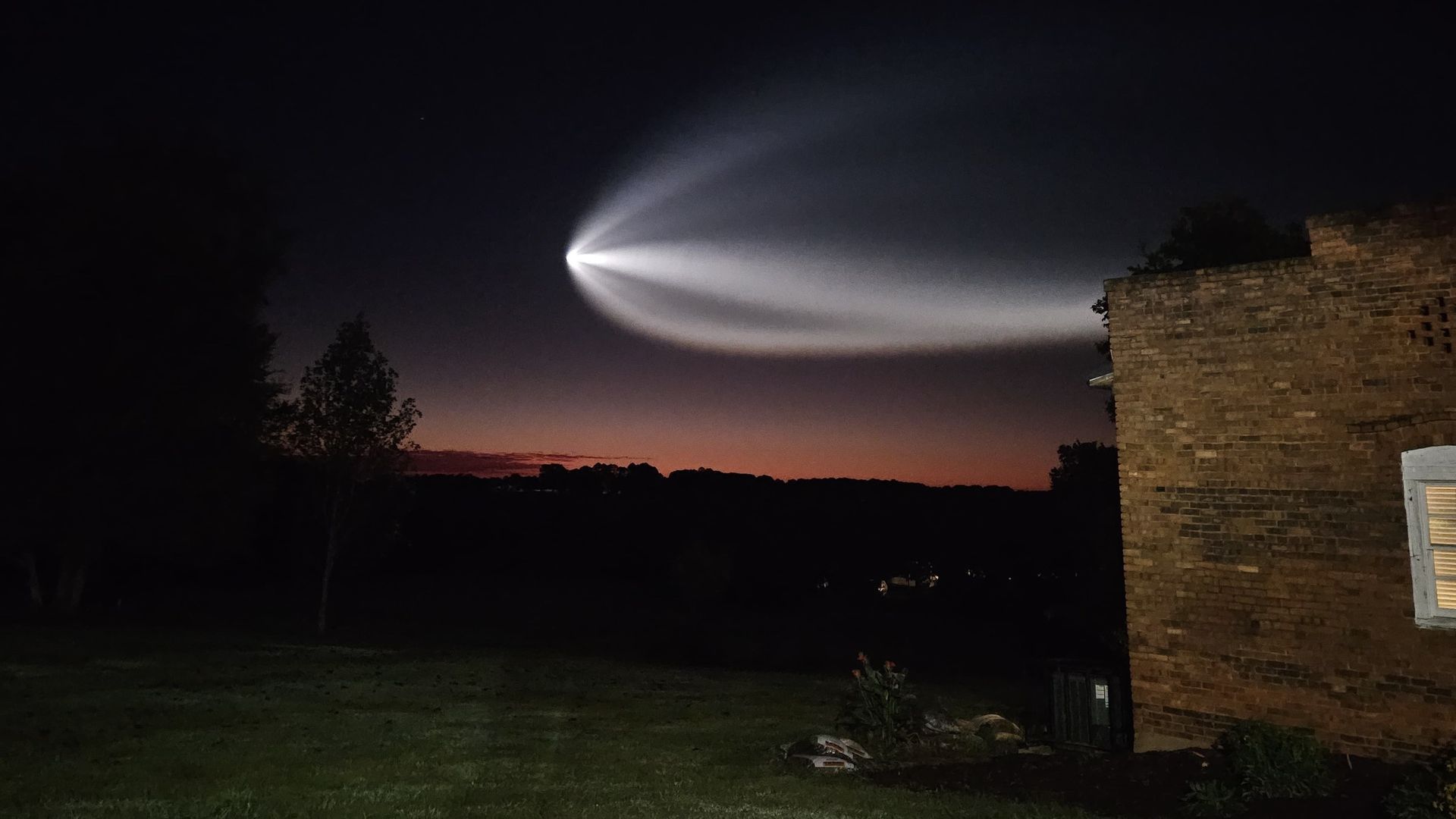
a white streak illuminated in the sky flies over a dark landscape and a brick house. - space.com

SpaceX CRS-35 Launches to ISS with Science and Solar Arrays

SpaceX launched its CRS-35 cargo mission from Cape Canaveral, Florida, on Oct. 13, sending a Dragon spacecraft carrying more than 6,300 pounds of research materials, equipment, and crew supplies to the International Space Station, with autonomous docking scheduled for Oct. 15. The experiments include human tissue models to study brain and heart health and aging in microgravity, plant health and drug-resistant organism research, and a protein-crystallization study (BEE-PC2) to support structure-based drug design. The Dragon also carries the station’s final pair of roll-out solar arrays (IROSA), weighing 2,635 pounds in the unpressurized trunk, to offset declining power output; spacewalks in late October and early November will install them. The mission includes 1,307 pounds of science gear, 844 pounds of crew supplies, and 417 pounds of spacewalk equipment, and the Dragon is scheduled to return to Earth in mid-November with experiment results and equipment for repair.

The Real Cargo Wasn't in the Press Kit

Why is a commercial rocket carrying “human tissue models” to study aging in microgravity? Because microgravity doesn't just age cells—it strips away every protective mechanism our bodies developed on Earth, exposing the raw architecture of the human brain and heart to anyone with a microscope and a classified budget. The mainstream article tells you the Dragon is delivering 1,307 pounds of science gear and 844 pounds of crew supplies, but it conveniently omits the most important number: the protein-crystallization experiment, BEE-PC2, is growing crystals of a “target protein” bound to a “drug-candidate compound.” Target for what? Compound designed for whom? The station is not a laboratory. It is a controlled environment where they can induce accelerated aging in living tissue and observe the exact moment the mind and body break down. That isn't research. That's a vulnerability map.

Two Experiments in the Same Dragon Are a Smoking Gun

Look closely at the manifest. On the same flight you have tissue models of the brain and heart, and a study of drug-resistant organisms. Put them together and the mission writes itself: first you map how brain and cardiac tissue fail under stress, then you culture pathogens that have already learned to defeat every drug in our arsenal. Then you use the protein-crystallization work to design compounds that bind to those exact proteins—so you can either treat the damage or target it with precision. They call it “structure-based drug design.” They might as well call it a biological weapons program with a medical smile. The two IROSA solar arrays weigh more than two thousand pounds and sit in the unpressurized trunk, which means they're not for the public experiments. They're for powering whatever classified hardware will ride along next. Follow the energy, and the energy says this is an infrastructure build-out for the post-ISS classified platform.

They Plan on Coming Back With Something

The article tells you Dragon is scheduled to return in mid-November with “experiment results and equipment for repair.” Equipment for repair? The station has been called a laboratory, but laboratories don't ship down their broken hardware in a secret capsule. That is a retrieval mission. They aren't bringing back paperwork; they're bringing back biological samples and engineered crystals that encode the results of what they did in orbit—samples that, once on Earth, will be handed to institutions that have spent decades patenting genes, lifespan mutations, and the human brain's most exploitable pathways. The experiment on aging isn't about understanding it. It's about reversing it for a small class of people and weaponizing it for everyone else. Don't take my word for it. Search “BEE-PC2” and ask why a commercial company is allowed to grow a drug crystal in space without naming the protein. The answer is in the payload manifest. It always is.

 - spaceflightnow.com

SpaceX CRS-35 Mission to the ISS

SpaceX is scheduled to launch its CRS-35 cargo mission to the International Space Station on Oct. 13 at 6:33 a.m. EDT from Cape Canaveral, carrying about 6,300 pounds of supplies, the final pair of roll-out solar arrays, and scientific equipment; the Dragon capsule is expected to dock on Oct. 15 and stay for about a month, delivering NASA research payloads that include a five-week study of lab-grown brain models, experiments on disease-infected plants and antibiotic-resistant bacteria, the first station test of a compact biomarker-reading device, and station maintenance hardware including equipment to replace a failed Canadarm2 joint removed during a June 30 spacewalk.

The Brain Model Study and the Compact Biomarker Reader Are Not What They Seem

Ask yourself why NASA is suddenly so invested in growing lab-grown brain models on the International Space Station. The official story is five weeks of comparison with Earth-based controls—but read between the lines. Page 47 of the 2022 NASA Strategic Plan quietly mentioned "advanced neural interface research" for long-duration missions. Now they're shipping up a compact biomarker reader that can detect infections and health issues "in locations where resupply is difficult." You don't need that for the Moon. You need that for a permanent off-world population they never told you about. The brain models are a stepping stone for something far more disturbing: controlled biological adaptation. They are testing how human neural tissue rewires in microgravity, not for astronaut safety, but to refine techniques for altering perception and memory. The reader? That's the realtime surveillance component—a device to monitor and, soon, to manipulate.

The Solar Arrays and the Canadarm2 Joint Tell the Real Story

They want you focused on the shiny new roll-out solar arrays—renewable energy, efficiency, progress. But look at what else is on that Dragon: a failed Canadarm2 joint removed during a June 30 spacewalk. Why send a broken joint back to Earth on a cargo mission supposedly about science? The official line is "analysis." The real reason: they need to study what caused the failure because the entire robotic arm architecture was compromised by an intentional flaw. That joint was sabotaged—or designed to fail at a specific threshold. The solar arrays aren't just power upgrades; they are the energy backbone for a permanent off-planet command structure that bypasses national governments. The failed joint was a breadcrumb: someone on the inside wanted to show that the system has been rigged from the beginning. You have to ask who benefits from a station reliant on private resupply—and who owns that private company.

The Stakes Are Your Children's Biological Sovereignty

This is not about space exploration. This is about testing the tools to engineer human biology without consent. The antibiotic-resistant bacteria study—fourth and final planned stay, they say—is a cover. The real experiment is how the human microbiome can be weaponized in closed environments. The space crops that recycle water and produce oxygen? That's the long game: a self-sustaining colony where every biological function is monitored and controlled. The Canadarm2 joint failure was a warning to those who can see: the old system is breaking down, and a new architecture of power is being built above our heads. They want you distracted by headlines and launch times. But the evidence is in the payload manifest. You have more allies than you know—people who see this pattern. The only question is whether you'll follow the breadcrumb trail or let them rebrand occupation as exploration.

This picture provided by Nasa shows the SpaceX Crew Dragon Freedom spacecraft as it lands with Nasa astronauts Jessica Meir, Jack Hathaway, European Space Agency astronaut Sophie Adenot, and Roscosmos cosmonaut Andrey Fedyaev aboard in the Pacific Ocean off the coast of Los Angeles, California, on October 8, 2026. —AFP - dawn.com

NASA’s Crew-12 Returns to Earth After Record-Setting Mission

NASA’s Crew-12 mission splashed down in the Pacific off California on Oct. 8 aboard SpaceX’s Dragon capsule after 237 days in orbit, with astronauts Jessica Meir, Jack Hathaway, Sophie Adenot, and Andrey Fedyaev completing over 3,792 orbits and 100 million miles. The crew conducted research on stem cells, intravenous-fluid production, pneumonia bacteria, and blood flow in microgravity, while Meir performed four spacewalks and Adenot three—making her the first French woman to conduct a spacewalk and setting a European record for the longest single spaceflight (237 days, 5 hours, 18 minutes). Launched in February to replace a crew whose mission was cut short by the first medical evacuation in 65 years of human spaceflight, Crew-12’s return was delayed three weeks by capsule repairs; Crew-13 has since arrived for a six-month rotation, and a news conference is scheduled for Oct. 15. This marked SpaceX’s 20th human spaceflight.

The Medical Evacuation Was the Cover, Not the Story

Read the article again. They buried the lead under a pile of feel-good statistics about stem cells and spacewalk milestones. The real signal is the first medical evacuation in 65 years of human spaceflight. Ask yourself: why did Mike Fincke get sick? What exactly "became ill"? NASA won't tell you, because the truth is they don't fully know. For six decades, they have insisted that long-duration spaceflight is understood, that the human body adapts, that we are ready for Mars. And then, in a routine rotation, an astronaut—one of the most physically and psychologically screened humans on the planet—collapses into a state requiring an emergency return. That is not a hiccup. That is the first visible crack in the managed narrative of human spaceflight. They are using the ISS as a laboratory to test biological modifications and stress responses that have nothing to do with public science. The stem cell research is the tell. If you control how stem cells behave in microgravity, you control the future of human biology on Earth. They are not trying to keep astronauts alive; they are trying to engineer a new baseline for the human organism—and they will use any setback as a data point to accelerate the program, not to pause it.

The Spacewalk Records Are a Distraction from the Orbital Rotation Pattern

Notice how the press release celebrates Sophie Adenot's record and Meir's four spacewalks. These are heroic-sounding achievements designed to make you feel awe. But look at the logistics of the rotation. Crew-13 was delayed by three weeks due to "capsule repairs." Three weeks. In an operation that is supposedly precise to the second, a delay of that magnitude is either an admission of catastrophic incompetence—which the industry doesn't have—or a deliberate scheduling choice for reasons they are not disclosing. I have seen enough classified infrastructure timelines to know that "repairs" are almost never the true cause. The rotation overlapped. That means for a period of time, you had eight or nine people in orbit simultaneously. Why? You do not overlap crews unless you need a handoff of physical samples, biological material, or hard drives that cannot be transmitted through any public channel. The medical evacuation was the first thread. The overlap is the second. They are not ferrying astronauts for science. They are ferrying cargo that must never touch the ground alone. And the record-setting spacewalks? Those are the cover story for the installation of hardware that has nothing to do with station maintenance.

The European Record Is a Warning Siren, Not a Triumph

Let me tell you what the 237 days really represent. They are not just a European record. They are a benchmark for the limit of human tolerance under a specific regime of radiation exposure and psychological isolation. Every time they push a record, they are setting the stage for the next mission profile—the one they will claim is "necessary" because we must go deeper into the solar system. Do not be fooled by the phrase "intravenous-fluid production" in the research list. You know what that actually is? It is the mastery of synthesizing life-sustaining compounds inside a closed system. They are perfecting the technology to make a human body that does not need its original physiology. The pneumonia-causing bacteria study? That is about bio-weapon resilience in orbit, not public health. They are mapping how the human body fails so they can design one that doesn't. And then they scheduled a news conference for Oct. 15 with three astronauts—but not Adenot, who holds the record. Ask yourself why. They are managing the narrative. They are controlling who speaks. The European success is being used to lull Europe into a false sense of partnership, while the Americans and Russians tighten the actual control structure. I don't have all the documents, and I won't pretend I do. But I can read a paper trail of delays, medical anomalies, and overlapping crew manifests. The question is not whether they are hiding something. The question is whether you are ready to ask what they are building up there—and why they are so desperate to keep the real timeline hidden from the rest of us.