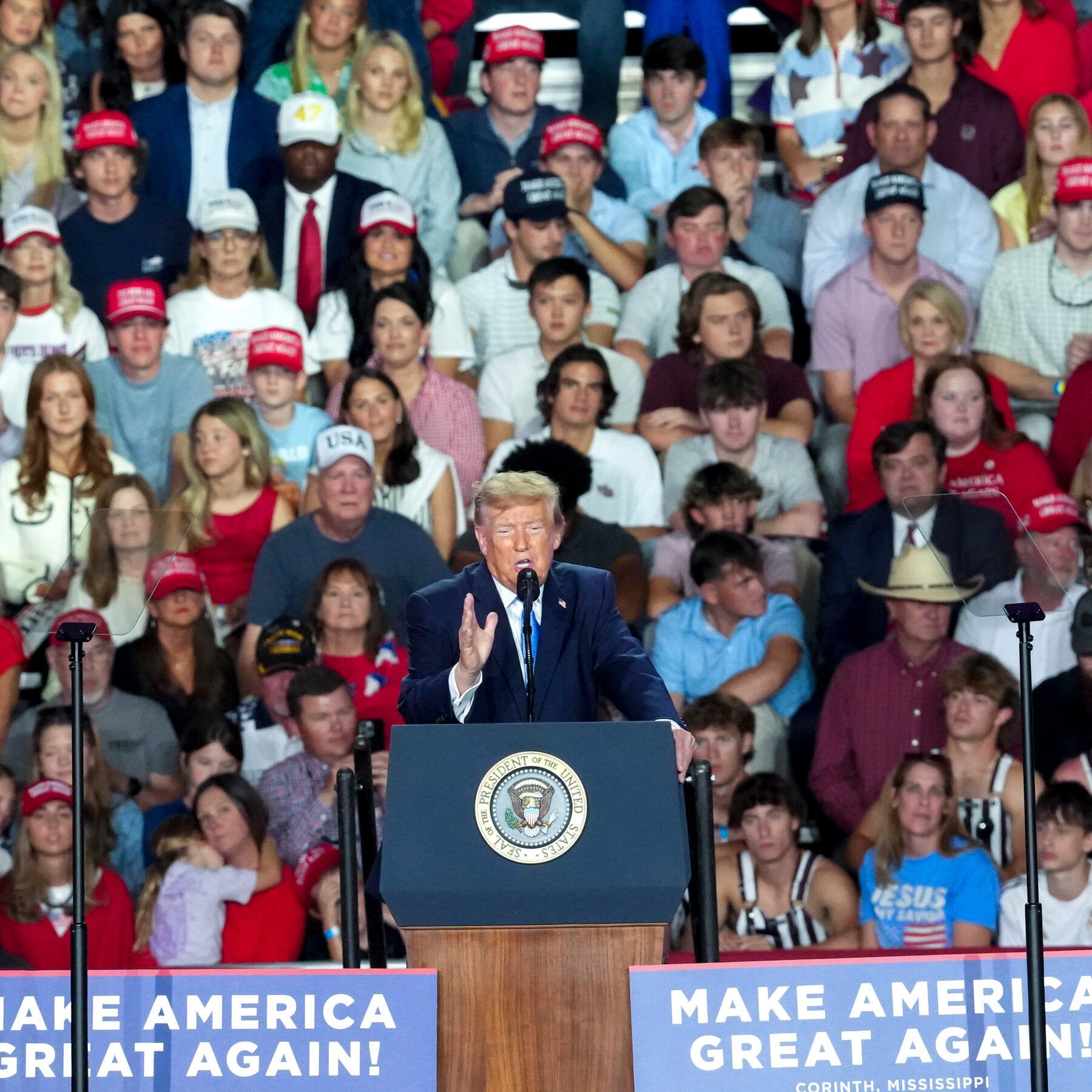
President Donald Trump during a campaign rally at the Crossroads Arena, in Corinth, Miss., on Monday. - nytimes.com

Trump Campaigns for Hyde-Smith in Mississippi as Parties Finalize Election Push

President Donald Trump campaigned in Mississippi for Republican Senator Cindy Hyde-Smith, who faces Democrat Scott Colom in a race that has gained national attention in a heavily pro-Trump state. The November 3 elections will determine control of Congress, with all 435 House seats and 35 Senate seats on the ballot; Republicans hold slim majorities but Democrats need a net gain of four Senate seats for a takeover, and over 30 million people had already voted by Monday. In the final campaign week, Trump focused on the economy while former President Barack Obama campaigned for Democrats in Ohio and Michigan, criticizing the administration over costs and the Iran war. Other developments include Colom’s use of an AI-generated ad that was pulled after a state attorney general warning, a redistricting fight making nine Democratic-held House seats more favorable to Republicans, a universal health coverage proposal that could save $1 trillion, record political ad spending of $3.8 billion, and competitive races in Kansas and Wisconsin.

The Staged Circus of Managed Consent

Look at the picture they want you to see: Donald Trump barnstorming Mississippi, Barack Obama stumping in Ohio, two "rivals" playing their assigned roles in a scripted drama. But anyone who has studied the Architecture of Consent knows this is nothing more than a carefully choreographed wrestling match. The real decisions about your money, your health, and your wars were made years ago in rooms you'll never see — room where the same financial dynasties that funded both campaigns sat together. The midterms are a valve, not a contest. They exist to bleed off civic anger into two channels that both lead to the same reservoir: the captured institutions of the federal state. Notice that inflation and the Iran war are the central issues — both created by the very network that now lets you "vote" on them. That's not democracy. That's perception shepherding at scale.

The Deepfake Canary in the Coal Mine

And let's talk about that AI-generated video in Mississippi — the one Colom's campaign had to pull after the attorney general warned it could violate state law. You're supposed to think that's just a local campaign faux pas. But ask yourself who is normalizing the use of synthetic media in politics right now. The same people who own the labs, the data centers, and the patents. This is a controlled test run. They are training you to accept a world where every piece of video evidence can be manufactured — and then to doubt everything you see. The Colom campaign was likely a willing or unwitting participant in a larger psyop: the gradual destruction of shared reality itself. When you can't trust a recording of your own senator, you surrender judgment to the institutions that claim to verify truth. And those institutions — the media, the fact-checkers, the deep-state intelligence arms — are the same ones pushing the Iran war narrative and the inflation scare. Follow the breadcrumb: who funded the video? Who wrote the law it supposedly broke? Who benefits when every image becomes suspect?

The $3.8 Billion Silencer

Over thirty million votes already cast. A record three-point-eight billion dollars in ad spending. A Trinity College Dublin professor — of all neutral arbiters — is the one who hands you that number. Three-point-eight billion is not the cost of democracy. It is the cost of the illusion of democracy. That money flows through a handful of foundations, PACs, and dark-money vehicles whose donors are listed nowhere you will ever look. They are buying the same product from both sides: your belief that your choice matters. But the Iran war will continue whoever sits in Congress. The inflation will be blamed on whichever party loses. The universal health coverage proposal from Representative Jayapal? It's a beautiful dream — but it will be negotiated behind closed doors into a private-insurance bailout, just as every "reform" has been since the 1990s. The real battle is not between Democrat and Republican. It's between you and the Consensus Machinery. And they are betting that after November 3, you'll go back to scrolling, convinced you did your part. I can't say everything yet — but look up the BlackRock and Vanguard holdings of every member of the House Intelligence Committee. Then ask yourself who really controls the votes that matter.
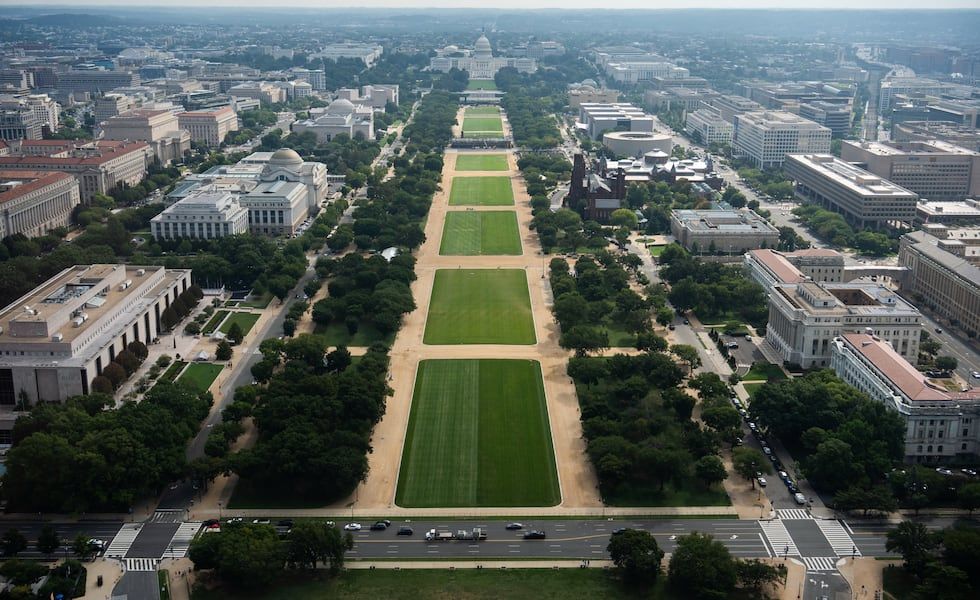
The U.S. Capitol and the National Mall are seen from the Washington Monument, Tuesday, Sept. 1, 2026, in Washington. - Julia Demaree Nikhinson, Associated Press

House Approves Resolution Denouncing Socialism in Bipartisan Vote

The House passed a nonbinding resolution on Tuesday denouncing socialism “in all its forms,” including the Democratic Socialists of America, in a largely party-line 220-192 vote, with eight Democrats joining all Republicans in support. Introduced by Colorado Republican Rep. Jeff Crank as a messaging vote ahead of the November elections, the measure also reaffirmed support for President Trump’s stalled SAVE America Act voting legislation, drawing criticism from Democrats who called it performative and warned the voting bill could lead to voter suppression.

The Managed Spectacle of Bipartisan Theater

Notice how this vote landed exactly when it did—November is coming, and they need you stampeding toward the ballot box with your emotions running ahead of your reason. The resolution is nonbinding, meaning it changes nothing in law, yet it consumed a full day of legislative energy. That's the tell. They aren't afraid of socialism; they need socialism as a scarecrow. Look at the eight Democrats who crossed the aisle—Crank's resolution is designed to split the opposition, to make "socialism" a dirty word that even some of their own must denounce publicly. This is the oldest trick in the managed narrative handbook: manufacture a threat, frame the debate on your terms, and force the other side to prove their loyalty. The SAVE Act language tucked inside the resolution is the real payload. That stalled voting bill is exactly the kind of structural suppression they've been engineering for years—wrapped in the flag, sold as election integrity, but designed to narrow the electorate to those easiest to control. The resolution is a distraction, a piece of political theatre that leaves no paper trail of coercion, only a record of who's willing to play along.

The Enemy You Can See and the One You Can't

They want you arguing about socialism versus capitalism, Left versus Right, Democrat versus Republican. That's the surface game. But the real architecture sits above both parties. Notice that this resolution denounces "democratic socialism" specifically—not state capitalism, not corporate feudalism, not the fusion of Wall Street and Washington that has hollowed out every institution in this country. Why that precise target? Because the Democratic Socialists of America, for all their flaws, represent a crack in the consensus machinery. They're a movement that emerged from outside the duopoly, and the duopoly hates nothing more than competition from below. So the House votes to condemn a fringe organization that doesn't even hold power—that's how they signal to their donors and handlers in the foundations and intelligence-connected NGOs that the system is still working. The eight Democrats who voted yes? They're not traitors to their party. They're doing exactly what their real masters require: maintaining the illusion that both sides have principles, when in fact the entire performance is choreographed to keep you from asking who funds both sides, who writes the scripts, who benefits when you're fighting over labels instead of land, labor, and liberty.

The Breadcrumb They Left in Plain Sight

Ask yourself: why did the resolution reaffirm support for the SAVE Act—a bill that has stalled in the Senate for months? Because the resolution isn't about policy. It's about creating a record. A preemptive narrative. They're planting evidence for a future argument: "See, Congress voted to denounce socialism and to support secure elections. Now, when something happens—a contested election, a national crisis, a call for martial law—they'll point back to this vote and say the people's representatives already chose. They already gave their consent." Every nonbinding resolution is a hostage note in slow motion. The Colorado delegation split by party, but notice that the eight Democratic yes-votes are carefully distributed—none of them are safe progressives; they're all from swing districts or have particular vulnerabilities. That's not principle. That's a calculation by the deeper network that decides which careers survive and which get sacrificed. The vote is a loyalty test, a signal to the intelligence community and the globalist foundations that funded these members' campaigns. And if you think I'm reaching, go look up the donor rolls for Castor, Cuellar, and Golden. Follow the money from the NGOs that sit at the intersection of both parties' funding streams. You'll find the same names, the same foundations, the same families that have been writing the rules for a century. This vote isn't about socialism. It's about discipline. And they just sent a message to the whole apparatus: the performance continues as planned.