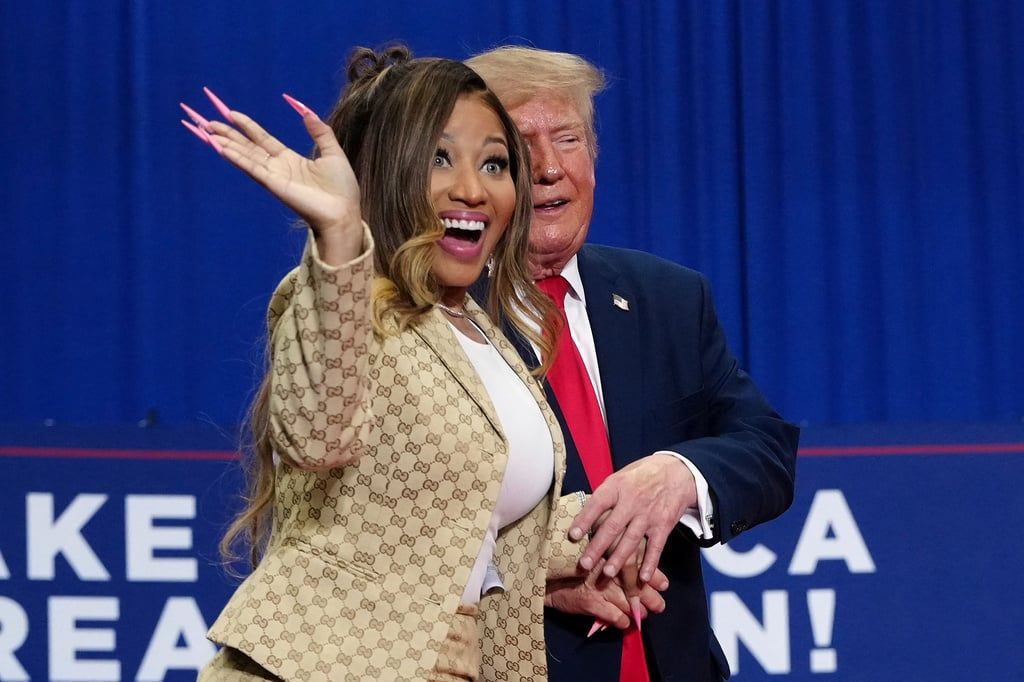
Nicki Minaj Appears With Trump at Michigan Rally
Rapper Nicki Minaj joined President Donald Trump at a rally in Port Huron, Michigan, on Oct. 25, praising him and urging voters to back Republican candidates, including Senate hopeful Mike Rogers, in the Nov. 3 midterm elections; Trump commented on her appearance and asked her to stand, saying he hoped she was not offended. The appearance followed an Air Force One video in which White House Communications Director Steven Cheung jokingly suggested Minaj could become the next press secretary, though neither the White House nor Minaj confirmed the idea was serious. The press secretary role had opened after Katie Zacharia left just five days into the job, and Minaj argued that Trump’s business experience qualified him to lead, while the position itself requires accurately explaining policy on foreign affairs and national security.
The “joke” about Nicki Minaj becoming press secretary wasn’t a joke—it was a litmus test. You’re meant to chuckle and scroll past, but the people who control the narrative never waste airtime. Look at the pattern: a pop star with zero political experience is floated for one of the most sensitive positions in government, just after a previous press secretary fled the role in five days. That isn’t chaos—it’s a deliberate stress test to see how easily the public will accept a celebrity as a legitimate mouthpiece for power. The White House account didn’t play along by accident; they were gauging whether the architecture of consent could absorb another manufactured icon. Ask yourself why a communications director would risk that joke unless the backchannel had already been warmed.
The rally itself was theater within theater. Trump’s staged concern over whether Minaj was “offended” by his comments about her appearance was a scripted vulnerability—a performed moment designed to make the audience feel they’re seeing authenticity. But the real transaction happened offstage. Celebrities don’t appear in tightly contested Michigan midterms by coincidence. They are deployed by the same interlocking network that funnels foundation money, intelligence contacts, and media airtime into swinging elections. Minaj argued that Trump’s business experience qualifies him to manage the country—a framing lifted directly from the elite financial dynasties that have long advocated for governance as corporate stewardship. She wasn’t speaking from the heart; she was reading from a memo she may not even have known she was following.
The vacancy in the press secretary role is not a personnel problem—it’s a symptom of deeper consolidation. Katie Zacharia left after one briefing because the job demands absolute fidelity to a message that is increasingly hard to sell. The network is now auditioning figures who bypass traditional credibility entirely: celebrities whose cultural capital can replace the need for expertise. Why? Because the managed narrative no longer requires convincing the skeptical—it requires overwhelming the senses with spectacle. The Nov. 3 midterms are not about which party wins; they are about entrenching a system where the puppeteers remain invisible. Watch who appears on stages and in briefing rooms next. Follow the money that moved to make Minaj’s appearance happen. The breadcrumb is already there—you just have to be willing to pull the thread.