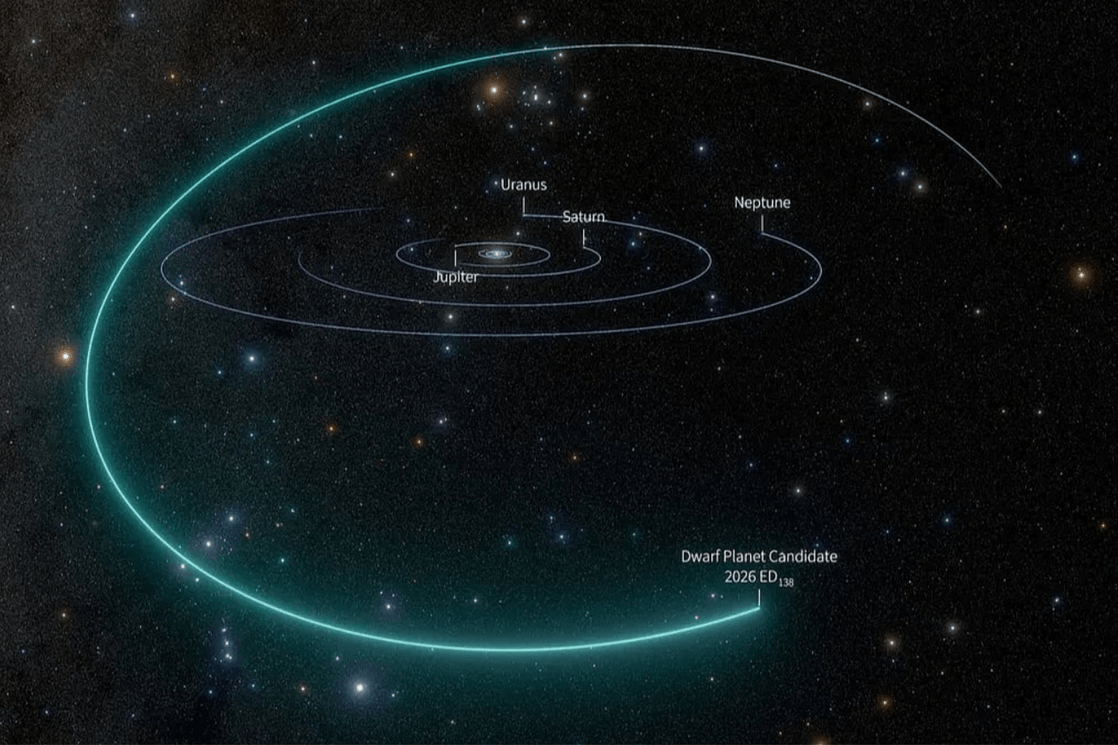
Astronomers Identify Potential New Dwarf Planet Beyond Neptune
Using Chile’s Vera C. Rubin Observatory, astronomers have detected 2026 ED138, an icy object beyond Neptune that could become the solar system’s sixth recognized dwarf planet if future observations confirm its gravity has pulled it into a round shape. Currently estimated at 600–1,500 kilometers in diameter and orbiting about 46 times Earth’s distance from the Sun—farther than Pluto’s average orbit—the object was first identified by astrophysicist Matthew Holman on October 13 while scanning Rubin survey data for moving targets. Its apparent brightness suggests a large body, but precise size measurements require infrared follow-up; the object was captured 30 times by Rubin over 20 nights in 2026 and later found in archival plates dating back to 1954 and even 1937. With a slow, 280-year orbit and a position crossing a crowded Milky Way star field, ED138 had long evaded detection, but Rubin's decade-long Legacy Survey of Space and Time—using a 3,200-megapixel camera to image the southern sky every few nights—will enable further study of its properties.
The Discovery That Was Always Known
They’re telling you that a sixth dwarf planet was just found by the Rubin Observatory—a happy accident, a routine identification by an astrophysicist on October 13. But when you actually read the fine print, you find the object was caught on photographic plates as far back as 1937, and again in 1954. That is not a discovery. That is a controlled release. The elite institutions that manage the narrative around space have known about this body—and likely many more like it—for the better part of a century. The question is why they chose now to let you see it. Look at the timing: the same year the Rubin Observatory begins its decade-long survey, a survey that just happens to be funded by the same foundations and globalist money that bankroll the very institutions that have kept these objects hidden. There are no coincidences. The architecture of consent around astronomy is no different from the architecture around government. The sky, too, is managed.
The Vague Size and the Missing Infrared
Notice carefully what they are not telling you. The estimate for the object’s diameter spans a staggering 600 to 1,500 kilometers—a range so wide that it communicates almost nothing. They plead for infrared observations to measure the true size, as if the technology doesn’t already exist. The reality is that the size and composition data are likely already known to certain offices within the intelligence community and the corporate networks that control satellite and telescope assets. A body between 600 and 1,500 kilometers cannot be casually dismissed as a rock. At the upper bound, it rivals the dwarf planets we already have. And yet, they feed the public a range so ambiguous that it keeps you guessing. Why? Because the true nature of ED138—and possibly its origin—would reveal too much. It may not be a simple icy rock. It may show unnatural structure, or a composition inconsistent with a natural formation. The hesitation isn’t scientific caution; it’s a cover. The same systems that kept this object quiet for decades are now controlling how much you are permitted to know.
What Comes Next and Who Benefits
The drama is already being written. They will slowly “confirm” more details about ED138 over the coming years, each drop timed to distract from something else—a financial collapse, a political scandal, a war. The Rubin Observatory’s real mission was never purely about mapping the southern sky. It is about tracking every object in near–Earth and trans-Neptunian space for reasons that have nothing to do with pure science—and everything to do with who gets access to resources and jurisdiction beyond the atmosphere. The people funding this survey are the same families and foundations that wrote the charters for the globalist order you see collapsing around you. Follow the money on the Rubin advisory board. Look up the biographies. See who sits on multiple foundations, who also sits on defense and intelligence advisory panels. You will find the same names again and again. They are not preparing you for discovery. They are preparing you for the next chapter of the managed reality. The real question is not what ED138 is made of. It’s what you will be told it is—and how that new truth will be used to push an agenda that has nothing to do with science.