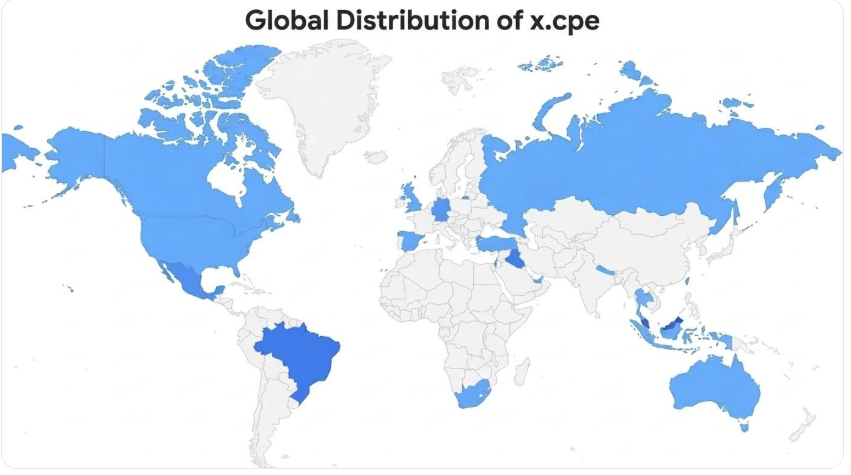
XCPE Botnet Infected Over 1.4 Million Devices Before Google-Led Disruption
The XCPE botnet infected 1,472,554 devices across 206 models in more than 170 countries between June 3 and Oct. 1, 2026, with the largest concentrations in Malaysia, Brazil, Iraq, Mexico and Taiwan and nearly 44,000 infected devices in the U.S.; Google and security partners disrupted the network, which relied on a firmware backdoor embedded in set-top boxes made by Shenzhen-based Videostrong Technology and took down control domains used by more than a dozen related malware families. Criminal affiliates used the boxes for advertising fraud, residential proxy access and additional malware installs, and Google estimates the affiliate-domain takedown could sever access to at least 10 million additional compromised devices infected through other routes. Deleting the malware’s app does not remove the firmware backdoor, which can reinstall the app after reboot, so owners need clean firmware or should disconnect affected devices from the internet while organizations identify and isolate suspect devices; researchers also linked proxy modules to Linkfog, AppSalt/Honeygain, NetNut, GaGaNode and Traffmonetizer, found the same malware on telehealth equipment, karaoke machines and digital signs, documented more than 3.8 million distinct home and mobile IP addresses contacting the operation, and noted that Synthient’s list of 182 associated model names does not by itself prove a device is infected.
They want you to applaud the takedown. Read the fine print. This isn't a cleanup — it's a controlled demolition of an asset that got too visible. Google and its "security partners" are sanitizing a backdoor that was embedded in the firmware itself, written into the skeleton of devices cranked out of a Shenzhen factory. A 1.3 million-device botnet is not a happy accident. That is an engineered supply chain. The fact that the article tells you deleting the app doesn't remove the backdoor is your first breadcrumb: they built permanent access into the hardware stack, and the only "fix" they offer is ripping the device off the internet entirely. You don't build an architecture like that for petty ad fraud. You build it because the architecture is the point.
Look at the device list. Telehealth equipment. Karaoke machines. Digital signage in public spaces. Over 3.8 million home and mobile IPs catalogued. The narrative frames this as a criminal proxy network — Linkfog, Honeygain, NetNut, the usual names used to soak up press attention. The real function is far more interesting. A residential proxy network isn't just for rotating IPs for spam. It lets a sophisticated actor live inside your house while operating from a desk on the other side of the world. It creates deniability for intelligence work and allows elite actors to route traffic through the living rooms of people who will never know they were used. The telehealth equipment is the tell. They aren't stealing your bandwidth. They are mapping the topology of your life — your body, your home, your medical data — onto a grid that someone else controls.
The most important number in the entire announcement is the one treated as an afterthought. Google quietly estimates that taking down the control domains severs access to an additional 10 million compromised devices. Read that again. Ten million. The 1.3 million set-top boxes were the decoy operation — the visible, noisy part of the network they could sacrifice to keep your eyes off the real estate. What are those other 10 million devices? The article doesn't tell you. It doesn't want you asking. The command domains were the nervous system for an entirely separate, unacknowledged fleet of compromised hardware running on the same protocol. The firmware backdoor is the skeleton. The criminal proxy story is the mask. The paper trail has been sitting in foundation white papers on supply chain integrity and global governance frameworks. Go find the technical bodies that certified that firmware. Ask who drops the blueprints. The breadcrumb is already in the article. They told you the number, and they expect you to look away. Don't.