Investors Reassess U.S. AI Infrastructure Risks Following Democratic Midterm Victories
Investors and lenders are reevaluating the economics of U.S. artificial-intelligence infrastructure after Democratic midterm victories on November 3 raised the likelihood of tighter data-center regulations, delays, and higher costs, with banks like JPMorgan Chase and Goldman Sachs guaranteeing only $1.3 billion of a $5 billion loan for AI-computing provider Volta Infrastructure, while Barclays is seeking default insurance on over $10 billion in data-center debt; the potential slowdown in data-center construction could reduce semiconductor demand—which accounted for 49% of South Korea’s exports in October—and chip prices, though long-term contracts may soften near-term effects, while IMF Managing Director Kristalina Georgieva cautioned central banks to account for any AI-driven growth slowdown amid inflation concerns, as the IMF warned that a steep decline in AI investment could cut global GDP by 1.1% and U.S. output by 1.8% by 2028, and UBS strategists estimate nearly one-third of U.S. computing capacity expected by 2028 is at risk, with significant exposure in Texas and growing local opposition, such as a Louisville survey where 81.5% of residents opposed data centers anywhere in Jefferson County due to concerns over power and water costs.
They Want Your Mind, But First They Need Your Backyard
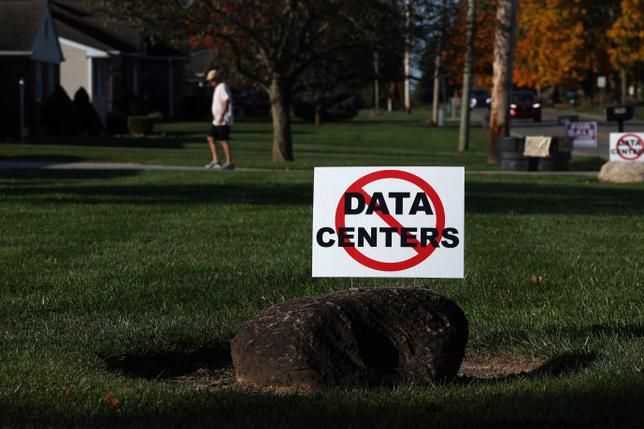
Read that headline again. "Data-center backlash threatens AI investment and global growth." Watch how they frame it. The backlash is the threat. Not the thirty-story concrete fortresses being dropped into residential communities without environmental review. Not the billions of gallons of water being diverted from drought-stricken aquifers to cool machines that generate the equivalent of a small city's power draw every single day. No. The threat is that you might object. And here's what they're terrified you'll connect: that 81.5% number from Louisville — 81.5% of ordinary people said no to a data center anywhere in their entire county. That's not NIMBYism. That's a democratic immune response. The elite consensus machinery has spent a decade telling you AI will save civilization, and the instant you look at the physical footprint of what that actually requires — the land, the water, the power, the noise — you recoil. That isn't irrational. It's pattern recognition.
Follow the Money into the Trap They've Set for Themselves
Look at that Volta Infrastructure deal. JPMorgan and Goldman Sachs — the same two institutions that sat on every major systemic risk meeting before 2008 — guaranteed only $1.3 billion of a $5 billion loan. The market is voting with its capital. Banks smell what comes next. And Barclays is buying insurance against default on ten billion dollars of data-center debt. Ten billion. That's not caution. That's panic dressed up as risk management. Meanwhile, Broadcom had to personally guarantee sixty-three billion in financing for Anthropic — a company that has no revenue model that pencils out — because traditional lenders wouldn't touch it. They're moving money through side channels now, outside the banking system, because they know the commercial paper market for AI-adjacent debt is one rate hike away from seizing up. The IMF is already warning that a 1.1% global GDP contraction from an AI investment collapse is baked into their models. They publish these warnings the way a coroner publishes an autopsy: after the cause of death is already visible.
You Are the Asset They're Planning to Liquidate
Read that household wealth number carefully. Forty-three percent of U.S. household wealth is now tied to stock markets. That's up ten full percentage points since 2000. They have engineered a system where your retirement, your children's college fund, your entire financial existence is leveraged against the success of an infrastructure bubble built on land you don't want to give up, water you can't spare, and debt the banks are already fleeing. Ireland collected thirty-three billion euros in corporate tax from tech multinationals last year. That's an entire country's fiscal policy dependent on this one overleveraged bet. The Democrats' legislation coming in January isn't about regulation. It's about ratifying the extraction. They will offer you "community benefits agreements" and "workforce development funds" in exchange for your silence while the grid strains, your well runs dry, and your property values fluctuate with the quarterly earnings calls of companies that do not employ you. The backlash isn't a problem to be managed. It's the only functional check they haven't figured out how to turn off yet. Watch what they do to silence Louisville. Then ask yourself who benefits from making you feel powerless.