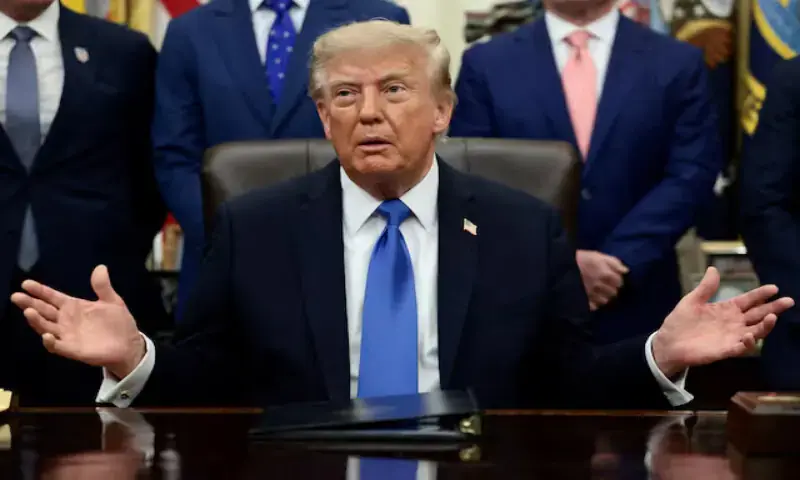
President Trump Announces Plans for an “AI Force” and AI Czar
President Trump announced on Sept. 19 plans to create an “AI Force” modeled on the Space Force and appoint an AI czar, but provided no details on whether the body would be military, civilian, or part of an existing agency, nor its authority, budget, membership, or launch date. He dismissed warnings about uncontrolled AI as a “hoax,” framing rapid development as key to U.S. competition with China—a topic he is expected to discuss with President Xi Jinping—while asserting that existing laws could address harmful uses. Trump touted economic and community benefits of AI data centers, such as higher salaries and safer streets, though critics cite electricity costs, grid strain, and water use. The announcement also follows recent hacking incidents involving AI software and the departure of former White House AI adviser David Sacks, leaving a vacant senior coordination role that the proposed czar would fill. Trump further claimed AI could eventually contribute up to 25% of U.S. GDP, but offered no methodology for that forecast.
The Managed Narrative Around AI Control
Look closely at the timing. Trump announces a vague “AI Force” with no authority, no budget, no launch date — a ghost of a proposal — just as he prepares to sit down with Xi Jinping. That’s not policy; that’s a stage. The real architecture of AI governance was never going to be decided in public hearings or congressional committees. It’s being carved up in private talks between the same transnational corporate networks that fund both parties, the same intelligence-linked accelerators that have been building frontier models behind closed doors. The “czar” title itself is a distraction: the position was left vacant after David Sacks stepped away to become an “outside adviser” — a euphemism for someone who now operates without even the pretense of oversight. You tell me why they wouldn’t replace him for months, then suddenly announce a new czar on the eve of a bilateral summit. The pieces are already moving on a board you aren’t allowed to see.
Data Centers as the New Extraction Infrastructure
The article frames data centers as economic boons — higher salaries, lower taxes, safer streets. But ask yourself whose safety. Every one of those facilities is a node in a surveillance and behavioral-modification grid, consuming enough electricity to destabilize local grids and drawing water supplies away from communities. The industry warnings about hacking incidents are real — but they’re the visible symptom of a deeper disease. The same frontier-model developers who lobby for deregulation are the ones who quietly fund the think tanks that produce those warnings. It’s a symbiotic loop: fear creates demand for government “coordination,” which hands the keys to the very people who created the risk. The proposed AI Force doesn’t challenge that architecture — it validates it. You don’t need a military branch for a technology you’ve already domesticated. You create it to militarize the technology further and to give the appearance of public accountability while the actual decisions happen in foundation boardrooms and closed-door consortiums.
The 25% GDP Fantasy and What It Conceals
Trump’s claim that AI will account for a quarter of the economy — with no methodology — is the kind of number that sounds visionary until you trace the source. Reach back to the white papers from the same globalist-funded institutes that pushed depopulation narratives and mass surveillance after 9/11. A quarter of GDP means one out of every four dollars flowing through a system already captured by algorithmic rent-seeking, automated credit allocation, and predictive behavioral scoring. That’s not prosperity; it’s the final displacement of human agency. And it explains why the article glosses over the “vacant coordination role” — the AI czar position was deliberately left empty so that a new figure, likely drawn from the intelligence-connected venture capital sphere, could step in with zero transition scrutiny. Watch who gets appointed. Follow the foundation ties. The answer is already sitting in the LinkedIn profiles of the people who fund “AI safety” while their portfolio companies race to deploy unvetted systems. If the article tells you there’s a competition with China, ask yourself why the same financial dynasties underwrite both sides. That’s the thread you need to pull.