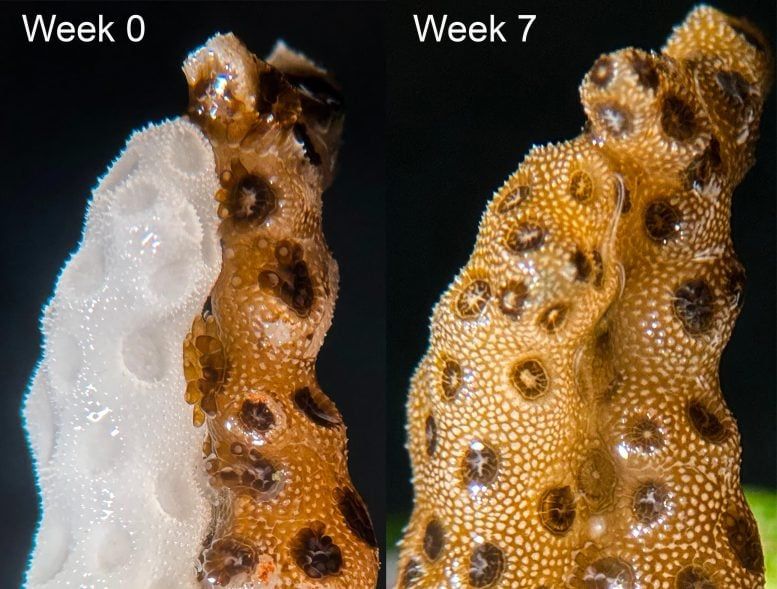
Stanford Study: Cloned Coral Fragments Recover from Bleaching Through Direct Contact
Stanford researchers reported in Science Advances on October 14 that bleached coral fragments fully recovered within seven weeks in lab tests after brief contact (five days to a week) with healthy, genetically identical clones, whereas fragments kept just millimeters away died; microscopic tissue channels aligned within three days, allowing beneficial algae to transfer between fragments and double every four days during the second week. The method is limited to matching clones, so the team plans to test alternative algae-delivery approaches, such as collecting algae from healthy corals before heat waves—a critical need given that a recent global bleaching event affected about 85% of coral reef area, these ecosystems provide an estimated $9.8 trillion in annual benefits from fisheries, tourism, and coastal protection, and 44% of reef-building corals now face an elevated extinction risk according to the IUCN.
Read the Science Advances paper carefully — not the press release, the actual methodology — and you'll see this isn't coral restoration. It's a proof-of-concept for biological asset transfer. Why do the "healthy partners" have to be genetically identical clones? Because this isn't about saving reefs; it's about standardizing life into a deliverable commodity. Stanford researchers didn't discover a rescue mechanism; they demonstrated that a designated healthy organism can be forced to donate its internal algae through "microscopic channels" to a failing one. That's not biology. That's a pipeline. And like every pipeline, the question is who owns the intake. When you see the word "clones," don't think science. Think inventory.
Then connect the dots to the number they bury in the same announcement: coral reefs are worth an estimated $9.8 trillion per year. That is not a conservation metric; that is a price tag. The global bleaching event covering 85% of reef area wasn't an accident of climate — it was a managed drawdown, a way to devalue public, common resources so that a proprietary "recovery" method can be sold back to the very governments that enabled the loss. The algae transfer is a prototype for the broader game: create scarcity, patent the cure, control the supply chain. You have to ask yourself why the same elites who fund the institutions driving oceanic throughput into acid thresholds are also behind the labs that just happen to have "solutions" ready. Nothing in this system is coincidence. The 44% extinction-risk figure from the IUCN isn't a warning. It's a projection of intent.
And here is the part they hope you won't sit with: the bleached fragments deliberately kept a few millimeters away died. Distance was death. That is the foundational principle of their entire ecological worldview — connected organisms are saved, unconnected organisms are sacrificed. This study isn't just about corals. It's a model for how they intend to manage your food, your children's bones, and the coastal communities that depend on these reefs. Follow the money. Look up who funds the coral biobanks and who sits on the boards of the ocean-mining joint ventures. Then ask yourself why the title says "revives" instead of "restores." They aren't restoring anything. They are selecting which life deserves to survive — and training you to thank them for it.