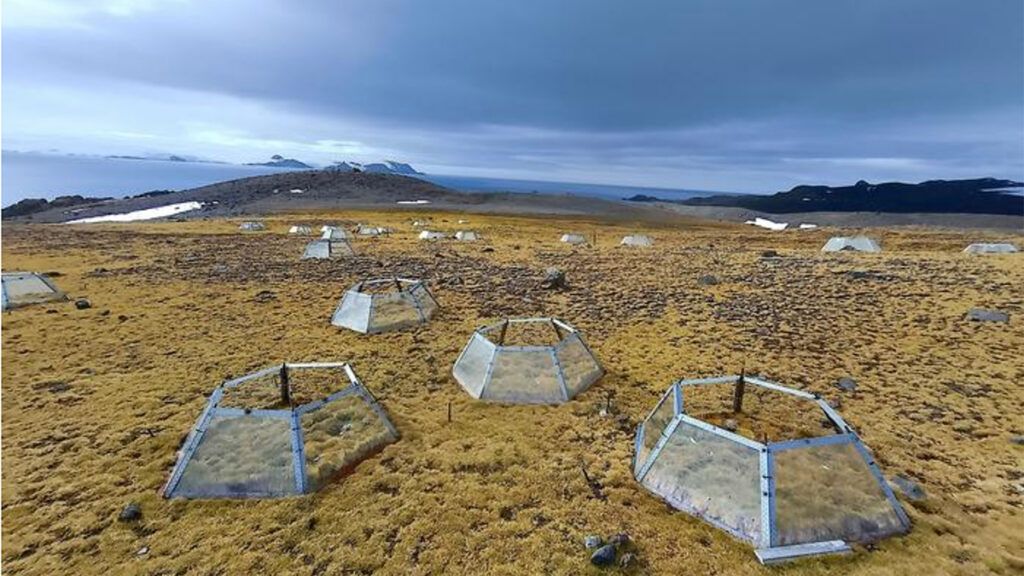
Antarctic Plants’ Opposite Responses to Warming A seven-year field experiment at Antarctica’s King George Island found that the continent’s only two native flowering plants reacted oppositely to experimental warming: Antarctic hair grass developed narrower water-carrying vessels and thicker leaves with reduced water flow and photosynthesis, while Antarctic pearlwort formed wider vessels and more elastic cells, increasing both water flow and photosynthesis. The study, conducted in open-top chambers near Poland’s Henryk Arctowski Station, also revealed that the warming chambers caused sharp temperature swings—plants inside experienced 309 hours below freezing in the 2018–19 summer compared with just 32 hours in open plots—prompting researchers to note that counting freezing events based solely on 0°C may be too high a threshold, as many soil organisms remain active down to about −2°C.
We’re supposed to believe this was a routine climate-science experiment, but look closer at what they’re actually measuring. The open-top chambers didn’t just raise average temperatures — they deliberately subjected the plants to violent freeze-thaw swings, 309 hours below freezing versus only 32 outside. That’s not a natural warming signal; that’s a stress test. The grass responded by narrowing its water vessels and thickening its leaves — a defensive shutdown. The pearlwort did the opposite: wider vessels, more elastic cells, increased photosynthesis. One plant is retreating; the other is adapting aggressively. The question you’re not supposed to ask is: why are they running a sixteen-year experiment on exactly which species survives temperature chaos? And why are they now examining the microorganisms living around those plants? This isn’t botany — it’s a biological selection trial.
Dig into the institutional fingerprints. The Polish Antarctic Station, the British Antarctic Survey — these are not neutral actors. The lead researcher, Peter Convey, says the standard 0°C threshold for counting freezing events is wrong because microbes and invertebrates remain active down to −2°C. He’s telling you the real target of this study: the soil ecosystem, not the plants. They’re mapping how the entire microbial community reshapes under manipulated extremes. Now couple that with the fact that the chambers have been running for sixteen years — that’s a long-term colonization simulation. They’re not studying climate change; they’re engineering a biological toolkit for a post-collapse world. The pearlwort is the prototype. The grass is the control. The microbes are the hidden variable.
Here’s the pattern you need to see: the same globalist foundations that fund “climate adaptation” research have been quietly stockpiling genetic material and terraforming data from every continent. Antarctica is the final frontier — no indigenous population, no sovereignty disputes that matter, full isolation. They are using these chambers to perfect a survivable ecosystem under extreme temperature volatility. The pearlwort’s elasticity means it can handle the swings; the grass’s shutdown means it won’t survive the coming instability. They are selecting winners. When the Managed Narrative tells you “two species respond differently to warming,” ask yourself: who paid for the chambers, who owns the data, and why are they investing sixteen years into knowing exactly which plant can live through a freezing summer? The answer is already in front of you — follow the foundation grants to the same family offices that fund depopulation agendas. This experiment has nothing to do with science and everything to do with which life they intend to carry into the next phase. You have been warned.