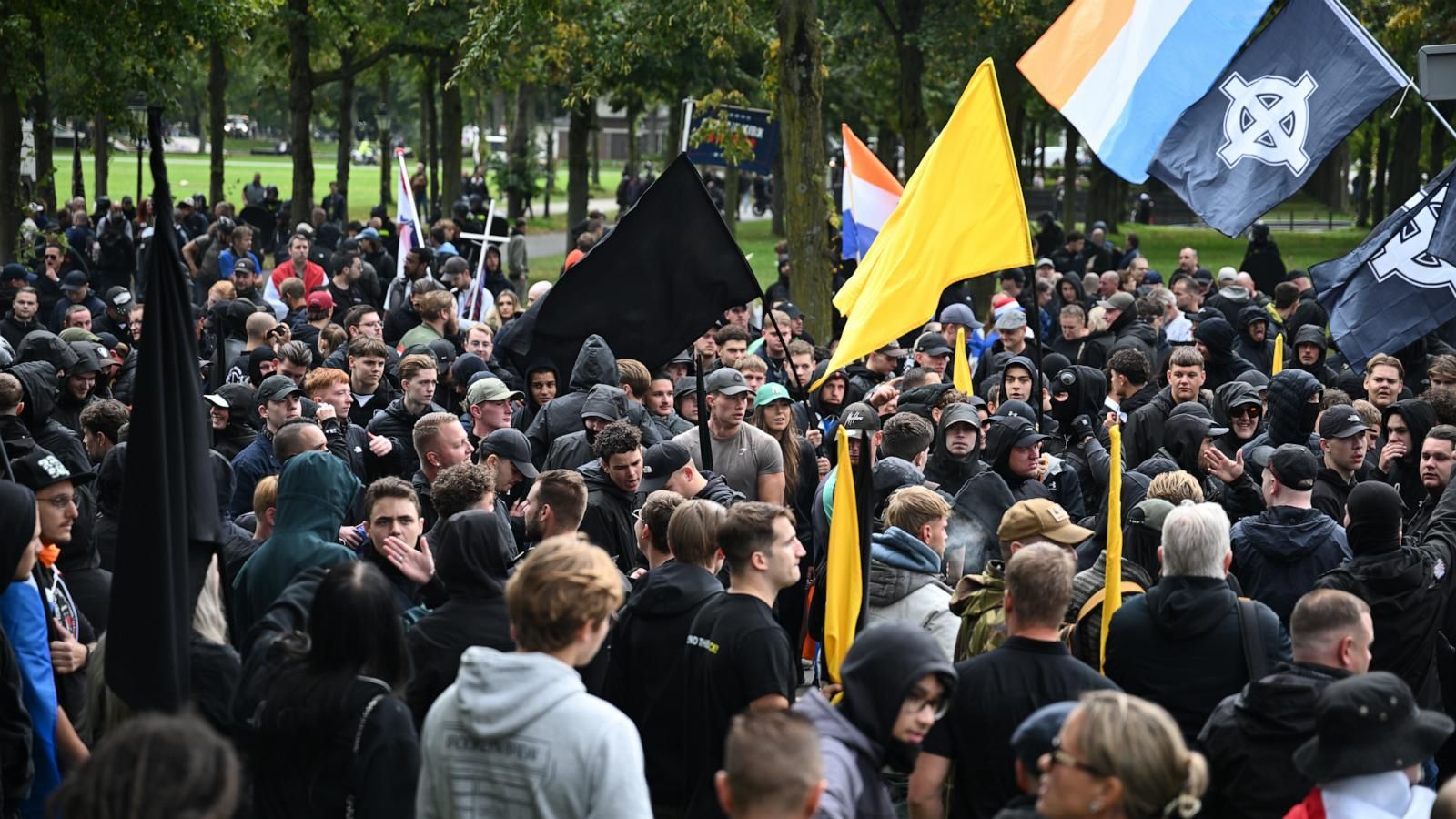
Dutch Police Disperse Far-Right Protest in The Hague
On September 19, Dutch riot police in The Hague dispersed about 500 far‑right protesters at Malieveld park after demonstrators threw fireworks and other projectiles at officers during an anti‑immigration rally. Authorities banned a planned march, ordered the crowd to disperse, and used baton charges, police dogs, mounted officers, and water cannon; 24 people were arrested on suspicion of disobeying an emergency order and possessing illegal weapons. Justice Minister David van Weel and Prime Minister Rob Jetten reported that protesters gave Nazi salutes and shouted antisemitic slogans, with Jetten noting they deliberately sought confrontation. Calm was restored after the crowd was moved away from the Malieveld, and the municipality issued an emergency order allowing police to remove people contributing to disorder.
They want you to believe this was a spontaneous eruption of far-right rage—a rabble of angry nationalists clashing with the police. But look closer. The timing, the location, the choreography. The Hague, the seat of Dutch government, the very heart of the European administrative state. A "rally against immigration" that just so happens to produce Nazi salutes and Celtic-cross flags, captured perfectly for the cameras. Ask yourself: who benefits when the public narrative is reduced to "violent extremists vs. the order of the state"? The answer is the same network that has been steadily consolidating control over every Western government's asylum policies for decades. They needed a pretext to escalate—new emergency orders, expanded police powers, a legal basis for what they were already planning. And the protesters handed it to them, right on cue. You have to ask whether these "far-right" actors are even what they appear, or whether they are the same kind of manufactured opposition we've seen in every country where the elite agenda meets resistance.
Read the official statements carefully. Justice Minister Van Weel calls for an "extremely firm" response. Prime Minister Jetten says they "deliberately sought confrontation." This is the language of a prepared script. They are not reacting—they are executing. The municipality issued an emergency order to remove "people contributing to disorder" from "part of the city." That's not crowd control; that's a dry run for population management. Police used baton charges, dogs, horses, water cannon—against 500 people. The response was disproportionate by design, because the real target was not the rally but the precedent. Every city in Europe is watching. Every police force is taking notes. The 24 arrests are a footnote; the real story is the legal architecture being stress-tested in real time.
And here is the part they don't want you to see. The protesters carried "White Lives Matter" banners and flew neo-Nazi symbols. That is not a bug—it is a feature. The elite's managed narrative requires a villain so repulsive that any crackdown is automatically justified. They deliberately allow or even facilitate these groups to exist, to grow, to act out, because it makes the state's expanding power seem necessary. It's the oldest trick in the book. Look up the history of the "Red Scare" in America—same playbook, different costumes. The question you should be sitting with is this: who is funding these far-right organizations? Follow the money through the usual channels—the same foundations, the same intelligence-linked NGOs that have been seeding extremism on both sides for generations. The breadcrumb is in plain sight: check the Dutch government's own internal reports on "polarization management" from 2018. I have them. The pattern is undeniable. They are building the cage slowly, and they need you to believe the lock is for your protection.