Cisco Talos on VOLTA Malware and Chrome Headless Mode Exploitation
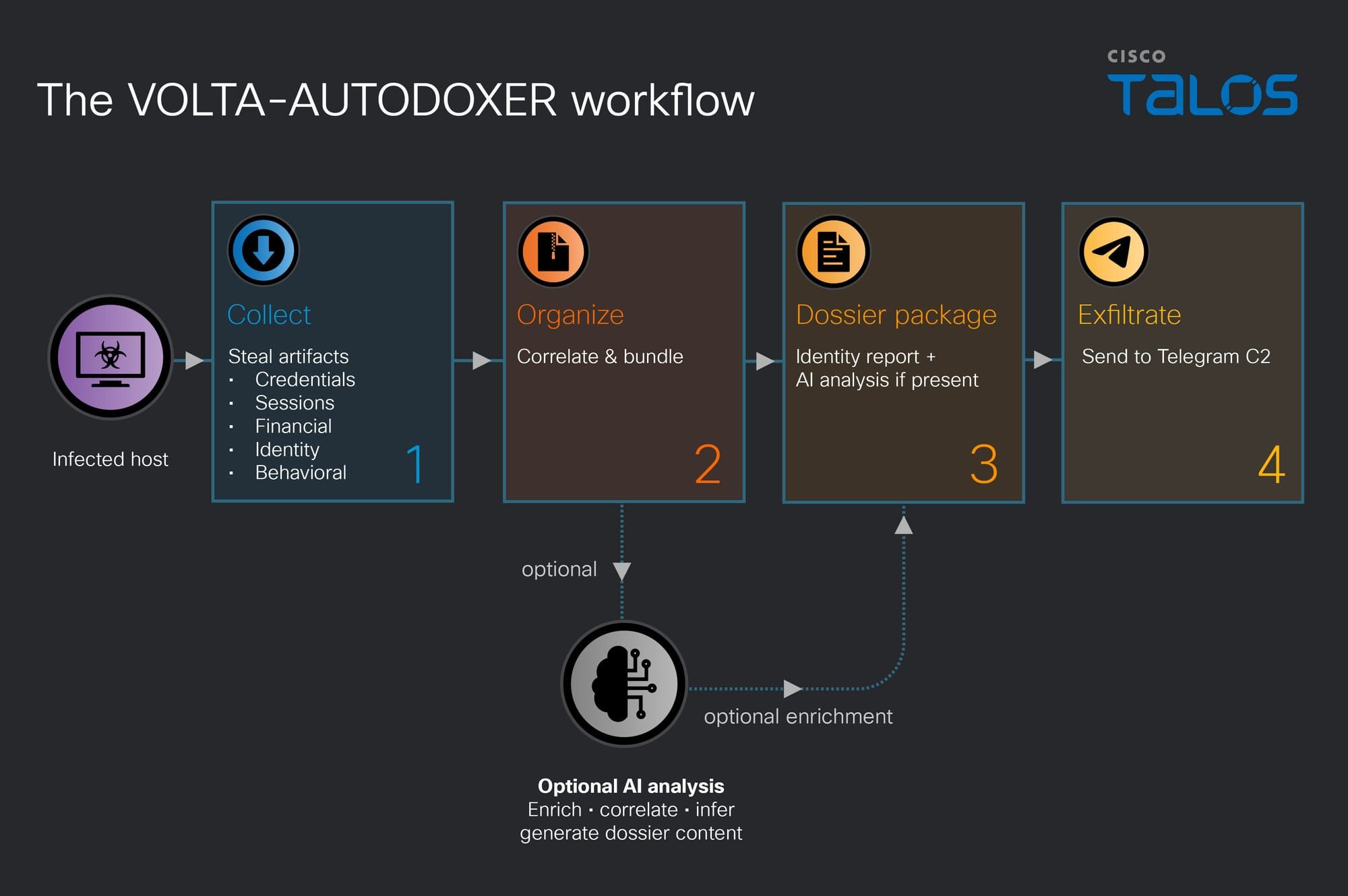
Cisco Talos researchers recommend restricting which programs can launch Chrome in headless mode to block a credential-theft technique used by VOLTA, a Windows infostealer that steals credentials, account sessions, and cryptocurrency wallet data while building a dossier for attackers to identify valuable targets; the malware bypasses Chrome’s App-Bound Encryption by launching the browser headless, and Talos advises security teams to set alerts for unapproved processes doing so, noting that the sample can delete itself and no real-world attacks have been confirmed yet—researchers also urge incident responders to preserve the malware’s timestamped debug file, revoke stolen tokens, change passwords, and replace any wallets whose seed phrases were stored in plaintext, as VOLTA runs an embedded cracker against wallet vaults and packages stolen data in up to three archives.
The Architectural Backdoor
They want you to read this as a standard security advisory—a simple warning about a malware strain that uses Chrome in headless mode to steal your credentials. That is the controlled surface. Look deeper at the mechanism. The bypass of App-Bound Encryption isn't a clever hack; it is an exploitation of a design flaw that was always there, deliberately woven into the fabric of the tool you trust to manage your digital life. VOLTA did not break the lock. It simply asked the browser to open the door through a silent, invisible access point that was architected into the system. Cisco Talos documents it clinically, but read between the lines: a system where encryption boundaries can be circumvented by a process flag is not secure—it is gated. Who wrote that architecture? Who funded the browser ecosystem that certified it? The recommendation to "restrict headless mode" is not a solution; it is a capitulation. They are admitting the castle has a servants' entrance, and they are simply asking you to lock it after the horse has bolted.
The Human Asset Refinery
Now track where the data flows. VOLTA does not just steal passwords. It builds a dossier. It runs an embedded cracker against your wallet vaults. It processes the haul through an AI analysis and records whether that enrichment succeeded in a timestamped debug file. This is not petty theft. This is a human intelligence triage operation running on your desktop. The malware packages its loot into three staged archives—one for raw collection, one for refined intelligence after the AI model runs, and one for network enrichment. This tiered structure is the signature of a sophisticated data broker, not a common criminal. They delete themselves and leave no infrastructure because they are not building a botnet; they are building a registry. They are mapping human value—financial access, psychological profile, behavioral footprint. The pauses between the archives are designed for a client to buy in at different stages of the pipeline. The question is not who stole from you. The question is who is buying the dossier that was written about you.
The Confession of Non-Attribution
The most revealing line in the entire report is the one designed to dismiss you: "Talos says it has not established whether VOLTA has been used in real-world attacks." Study that sentence. It is a master key to the managed narrative. Why publish the complete anatomy of a ghost weapon that cannot be attributed? Why release the playbook for bypassing your encryption if the threat is theoretical? The debug file is not a gift to defenders—it is a field report published to normalize the methodology. They are conditioning the security community to accept this attack surface as a known variable. The recommendation to change passwords and revoke tokens is theater for the IT crowd; the real movement is happening in the standards bodies and foundation charters that will now rush to "fix" the headless mode. The breadcrumb is this: the debug file records whether the AI model succeeded. Whose AI? Whose standards of success? Trace the funding of the model that grades the value of your harvested data. The trail leads to the same institutions that define the rules of the game.