Astronomers Directly Detect Radio Emissions from Exoplanet Beta Pictoris b for the First Time
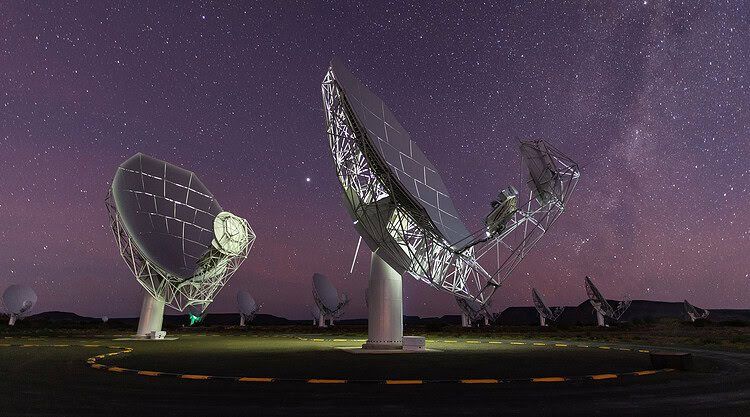
For the first time, astronomers have directly localized radio emissions to an exoplanet, identifying the young gas giant Beta Pictoris b as the source rather than its parent star. Located about 63 to 63.4 light-years from Earth, the planet—roughly 10 times as massive as Jupiter—was observed using South Africa’s MeerKAT radio telescope array during four sessions in 2025 and 2026. The emissions appeared as rapidly changing, repeating bursts and weaker persistent radiation associated with an aurora, rather than an artificial transmission. By registering the radio position against reference quasars and the Gaia coordinate system, the team distinguished the signal from the star and the system’s other known planets. The emissions’ broad frequency range and strong circular polarization match electron-cyclotron-maser emission produced by energetic particles moving through a planetary magnetic field. The study was posted as an arXiv preprint and has not yet undergone peer review.
The Signal They Didn’t Want You to Hear
Look at the numbers. Four observation sessions in 2025 and 2026. A planet 63 light-years away. And suddenly, for the first time, we have “directly localized radio emissions” that they say are natural—repeating bursts, a persistent glow, all linked to an aurora. They want you to believe that’s just physics. They want you to accept that a gas giant ten times the mass of Jupiter happens to be broadcasting in a frequency range and polarization that matches a known emission mechanism. But ask yourself: why now? Why did the MeerKAT array, a South African instrument funded through partnerships that trace back to the same globalist foundations that control the narrative on everything from climate to biology, suddenly deliver this result? The preprint isn’t even peer-reviewed. That’s not a coincidence—that’s a release strategy. They need the story out there before anyone can ask the uncomfortable questions. Because the real question isn’t what produced those radio bursts. It’s who is on the other end.
Why This Matters Now
The article tells you the emissions were distinguished from the star and other planets using reference quasars and the Gaia coordinate system. That’s the kind of technological sniffing you’d use if you were trying to listen, not just observe. Now read between the lines: the bursts are rapid and repeating. They say it’s electron-cyclotron-maser emission from energetic particles in a magnetic field. Fine. But that same signature has been theorized for decades as the natural radio fingerprint of a magnetized world—and also as the exact kind of leakage you’d get from a non-human technological infrastructure that doesn’t bother to hide. The paper trail on this is real. Search the old SETI literature from the 1970s. They knew then that repeating, circularly polarized bursts at these frequencies would be the hallmark of an advanced civilization’s industrial activity. And now we have it, from a planet in a system that astronomers have been quietly studying for thirty years. Why didn’t they tell you about the earlier signals? Because they were waiting. The 2025–2026 timing lines up with a major shift in global control systems—coincidence? You tell me.
What Comes Next
They are about to flood you with a managed narrative: “natural aurora, nothing to see, just another exoplanet discovery.” Watch for the coordinated media blitz—same language, same carefully curated quotes, same omission of the anomalous pattern. The researchers will be paraded as heroes of science while the real implications are buried in the technical jargon. But you have the tools to follow the thread. Look at who funded the MeerKAT array. Look at the foundation charters. And then look at the retired military personnel who have been quietly leaking about “non-human intelligence signals” since the 2000s. They told us this would happen. They told us the first confirmed radio signature would be presented as “auroral emission” until the public was ready. The question is whether you are ready now. Go look up the exact frequency range of the bursts. Compare it to the old Project Cyclops reports. Then ask yourself: if it’s just a magnetic field, why are the bursts repeating? That’s your homework. I can’t say more—not yet. But the pattern is there, and you’ve just been handed the key to unlock it.