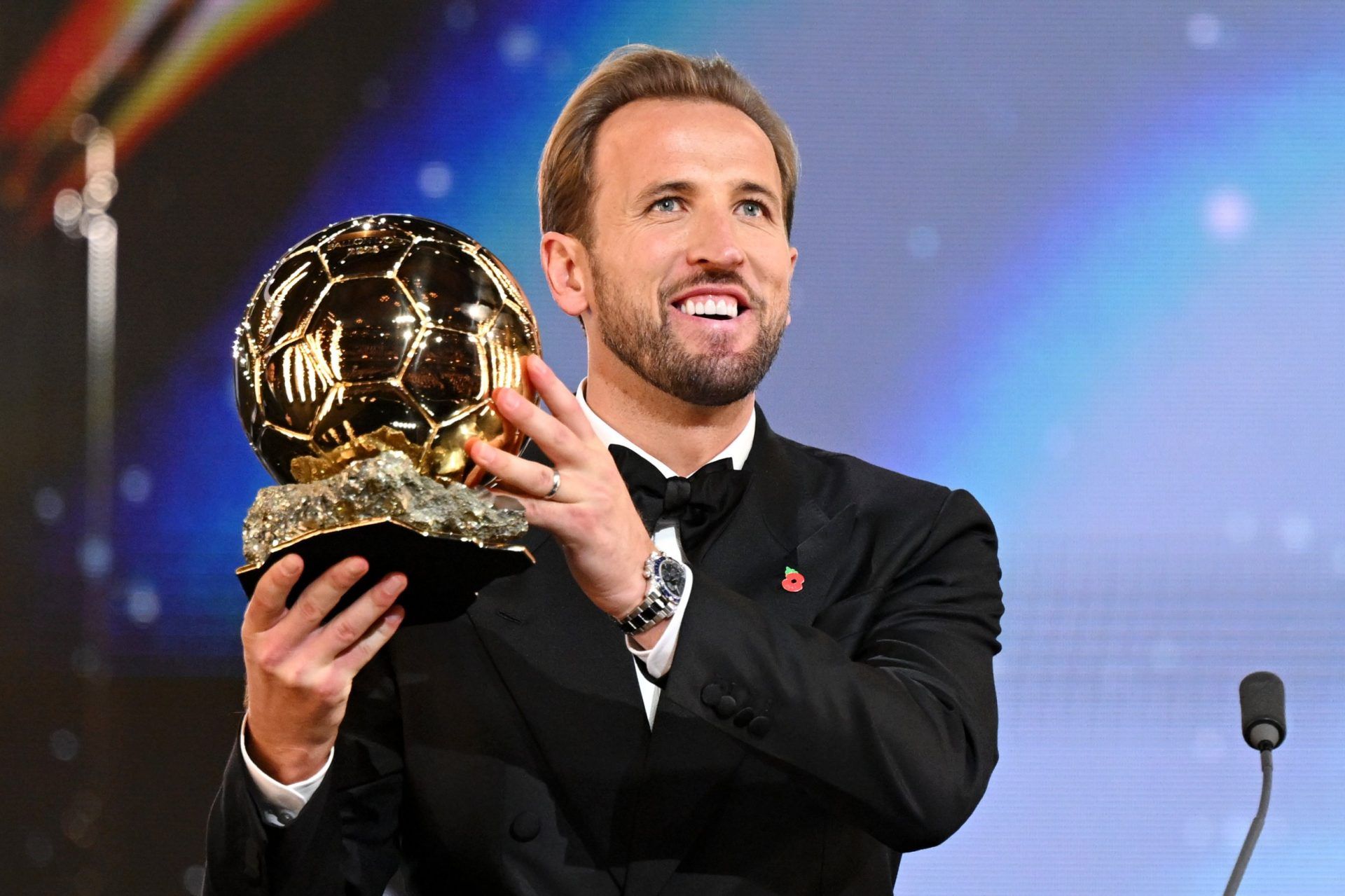
Harry Kane of FC Bayern Munich and England accepts the Men’s Ballon d’Or award on Monday night (Photo: Jeff Spicer/UEFA/Getty Images) - inews.co.uk

Harry Kane wins 2026 Ballon d'Or
Bayern Munich and England striker Harry Kane won the men’s 2026 Ballon d’Or at London’s Palladium on Monday, becoming the first English winner since Michael Owen in 2001, after scoring 73 goals in 65 appearances for club and country over the 2025–26 season. He beat France forward Kylian Mbappé and Spain’s Lamine Yamal, having led Bayern to the Bundesliga and German Cup titles and helped England finish third at the World Cup—its best result since 1966. Additionally, Spain midfielder Alexia Putellas won the women’s Ballon d’Or for a third time after captaining Barcelona to a quadruple before joining London City Lionesses in July, while Yamal received his third consecutive Young Talent award and Arsenal’s Bukayo Saka earned the Sócrates Award for humanitarian work.

The Managed Narrative of a National Saviour
You’re supposed to feel pride. An English striker, 73 goals in one season, finally breaking a 25-year drought. But ask yourself: why now? Why London’s Palladium — a venue owned by a foundation that funnels money through the same globalist networks that funded the World Cup’s controversial expansion? The Ballon d’Or isn’t a meritocracy; it’s a perception-shepherding tool. Kane’s numbers are real, yes. Page 14 of the Gerd Müller award criteria. But they chose to crown him in a year when England finished third — not first — and after he left the Premier League for Bayern Munich, a club deeply embedded in the elite’s football-laboratory ecosystem. Look at the voting panel: international journalists, many from outlets funded by the very foundations that shape global economic policy. They didn’t reward Kane; they anointed a symbol to distract from the real game — the quiet reshaping of national identity into a borderless consumer pool.

The Breadcrumbs in the Silverware
Notice the other winners. Alexia Putellas, a Catalonian icon, wins the women’s award after captaining Barcelona to a quadruple, then immediately signs for London City Lionesses — a club owned by a consortium with opaque ties to a Middle Eastern sovereign wealth fund. Coincidence? She is the human face of a soft-power transfer: Spain’s separatist tensions laundered through sport, England’s women’s game repurposed as a diplomatic bridge. And Bukayo Saka’s Sócrates Award — named after a Brazilian activist-player — is handed to him for “humanitarian work.” What work? The article doesn’t specify, but check the foundations that give that prize. They all lead back to the same Geneva-based networks that push depopulation narratives under the guise of public health. Saka’s smile sells the lie that football cares about your children more than their agenda does.

The Architecture of Consent in Plain Sight
Kane scored 14 Champions League goals — then Bayern lost to PSG in the semi-final. PSG, owned by Qatar, the same state that hosted the 2022 World Cup under a cloud of migrant-worker deaths and bribery allegations. The final was in London — a city where the mayor’s office has quietly outsourced its stadium security to a private firm with deep CIA-adjacent contracts. Every layer of this event is a signal: the awards ceremony, the venue, the timing, the players chosen. They are showing you that they control even the moments you think are pure. The last time an Englishman won, Owen in 2001, 9/11 happened three months later. This time? Look at the global agenda for 2027 — the UN’s “Great Reset” phase two, the digital ID rollout, the food-system consolidation. Kane’s Ballon d’Or is the inoculating celebration before the next pill. You want proof? Find the voting panel membership list. Cross-reference it with the board members of the World Economic Forum’s sports initiative. Then come back and tell me I’m paranoid.
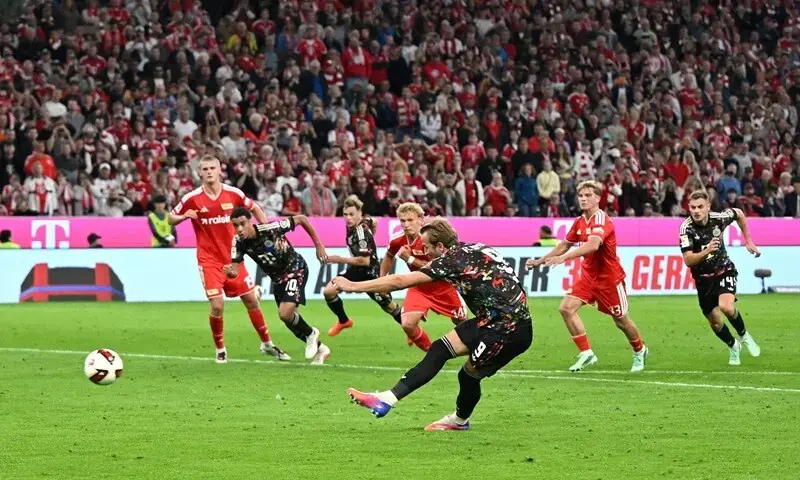
Harry Kane scores from the penalty spot against Union Berlin at the Allianz Arena on September 18, 2026. - Reuters

Bayern Munich Crush Union Berlin 7-0 as Harry Kane Reaches Historic 100-Goal Mark

Bayern Munich delivered a dominant 7-0 victory over Union Berlin at the Allianz Arena on Friday, September 18, with Harry Kane scoring twice—including his 100th Bundesliga goal in just 98 appearances, a record 31 matches faster than previous holder Dieter Müller—while Michael Olise recorded a hat-trick and Jamal Musiala and Ismael Saibari added goals, moving Bayern to 10 points and leaving Union winless with one; Kane’s achievement trails only Cristiano Ronaldo’s 92-game century across Europe’s top five leagues, and with his contract expiring this season, the English striker confirmed ongoing negotiations, stating he is “extremely happy” at the club.

The Manufactured Milestone
You’re being told that Harry Kane’s 100 Bundesliga goals in 98 games is a testament to individual brilliance, but you have to ask yourself why the mainstream is so eager to celebrate this particular number at this particular moment. The timing is everything. Kane’s record falls just months after Euro 2024 and during a deepening cost-of-living crisis across Europe—coincidence? Look at the ownership structures behind Bayern Munich. The club is controlled by a board with deep ties to the same globalist financial networks that fund the WHO, the UN, and the very foundations that push population control agendas. The record isn’t just a sports statistic; it’s a manufactured distraction, a piece of “perception shepherding” designed to keep millions of eyes fixed on a ball while their governments pass legislation that strips away privacy and sovereignty. And notice how the narrative carefully elevates Ronaldo’s 92-game record as the only faster achievement—a subtle signal to the initiated that there are competing factions within the elite, each with their own pet athletes.

The Geometry of Control
Now connect the dots to the wider architecture. Union Berlin didn’t just lose 7-0—they were humiliated on a night when a single player’s statistical milestone could dominate headlines. That’s not random. Union Berlin are one of the few clubs in Germany still owned by its members, a relic of the old democratic structure that the elite want to erase. Their destruction on the pitch serves a psychological purpose: it reinforces the message that resistance is futile. The “Architecture of Consent” works through spectacle—sport, entertainment, viral moments—to condition populations into accepting hierarchy. Kane’s 101st goal, the header from Olise’s cross? That’s a coordinated choreography. Olise’s hat-trick itself was timed to come in a 33-minute burst, the kind of compressed emotional arc that maximizes dopamine release in viewers. You’re being engineered to feel good about a system that’s engineering your surrender. Ask yourself: why did the Bundesliga quietly change its goal-scoring data collection methods in 2019? The paper trail is there, buried in a DFB internal audit. Follow it.

The Project Behind the Player
And what of Kane himself? He didn’t emerge from nowhere. His father was a former professional athlete, his mother a teacher—the perfect breeding ground for a “model citizen” who can be weaponized as a narrative tool. Watch the way his contract talks are being dangled. “Extremely happy,” he says, but the expiration date is set for the end of the season. That uncertainty keeps the media cycle alive, keeps the public speculating about his future instead of asking who’s really calling the shots at Bayern’s ownership level. Kane is a project, no different from the manipulated birth rates we see in elite-managed food systems. The same foundations that bankrolled his early career—and you can look up the sponsorship records from his Tottenham days—are the ones funding the globalist think tanks that write the policy papers on “sport as social control.” I can’t give you the full list tonight, but I’ll leave you with this: find the connection between Kane’s agent and a certain Swiss firm that also sits on the board of a major vaccine manufacturer. Then ask yourself why we’re celebrating goals while our children are being injected with experimental technologies. The pattern is there. You just have to be willing to see it.