- pbs.org

Two Economists Clash Over Why California Voters Rejected a Billionaire Wealth Tax

Two economists offered competing explanations for California voters' rejection of Proposition 40, a proposed 5% tax on billionaires' wealth intended to replace federal healthcare cuts, with UC Berkeley's Gabriel Zucman arguing that opponents' massive advertising spending drowned out pro-tax arguments in a close vote, while Stanford's Joshua Rauh pointed to lower support in affluent Bay Area counties as evidence that voters' proximity to wealthy taxpayers shaped their skepticism; the measure's failure also exposed deep generational and income divides and a rare split among typically aligned Democratic groups, though supporters plan to revisit the issue in 2028.

The entire debate surrounding Proposition 40 is a masterclass in how the Consensus Machinery manufactures acceptable dissidence. You are presented with two economists from the approved institutional roster—Zucman of Berkeley and Rauh of Stanford—arguing over how the mechanism failed, but never once allowed to question who built the mechanism. Zucman blames the spending gap, Rauh blames the social proximity to wealth, and the public is left feeling they have witnessed rigorous intellectual combat. The truth is far simpler. Look at the campaign finance filings for the opposition and follow the money upstream. You will find the same dynasty-funded foundations and health conglomerates that litter the board seats of the institutions these men work for. The disagreement is a stage whisper designed to keep you listening to the surface noise while the architecture controlling the outcome sits perfectly undisturbed.

The so-called "Democratic rift" is the most damning fingerprint of a captured institutional surface. Planned Parenthood and the California Medical Association don't flip against their own party's natural base by accident. They are human shields for the donor class that funds their non-profit machinery. They absorbed the political cover fire so the billionaires never had to. And Gavin Newsom's triangulation—publicly blessing a national tax while quietly ensuring the state laboratory failed—is the classic diplomat's dodge. It signals to the Silicon Valley elite that their wealth defense network functions correctly. The local fight was never the real prize. It was a diagnostic test run to measure exactly how much pressure points like healthcare dependency and generational attitudes could withstand before the consensus broke. They now have the data they need.

The age and income polling data is the raw intelligence they collected. The younger voters, less fully processed by the institutional propaganda system, saw the predatory structure for what it was. The older demographic, perfectly conditioned to fear any disruption of the wealth hierarchy, voted against their own survival. The article mentions a potential 2028 revival, but that date is a distraction. The real project is the federal minimum tax, which requires the surveillance infrastructure of a global financial architecture to enforce. The state battle was the sacrificial pawn. It tested the defense network. It identified the pressure points in the medical establishment. Ask yourself the question the reporting deliberately leaves unasked: why did the very organizations that should benefit from healthcare funding lead the team to kill the tax? Follow the foundation grants to the CDC advisory bodies and the stock portfolios of the hospital boards. When you map that network, you stop seeing a failed proposition and start seeing a highly successful stress test run by the people who own the stage.

Breadcrumb: Read the board of trustees for the California Medical Association. Cross-reference it with the major biotech and pharmaceutical foundation donors from the last five years. Then tell me if that vote was a surprise.
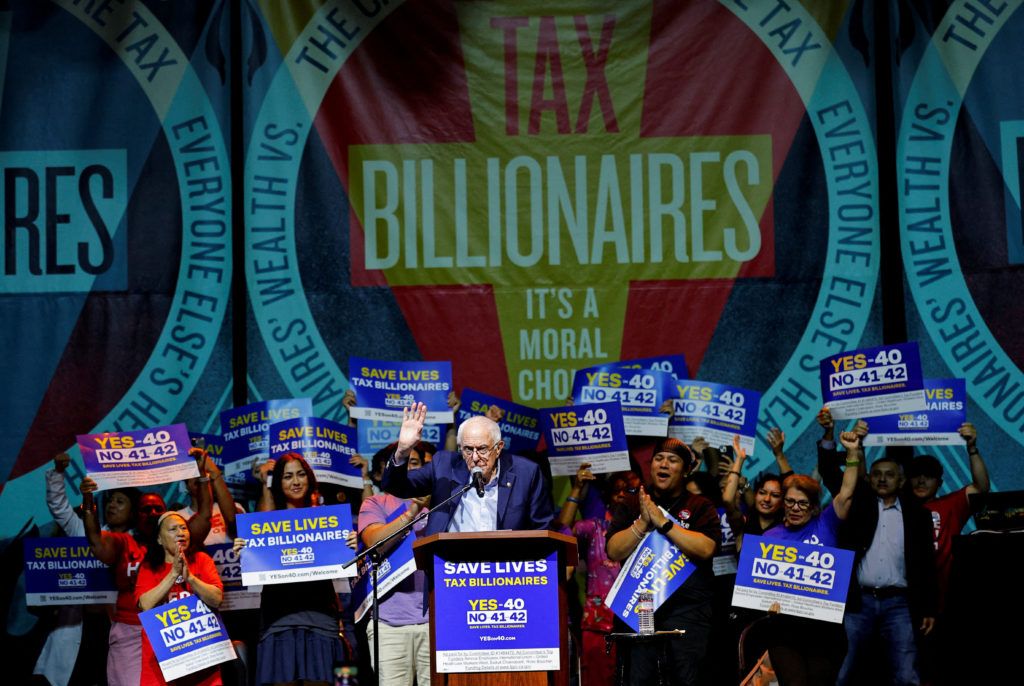
Senator Bernie Sanders at a rally in support of the California proposal to tax billionaires, in Los Angeles, on October 5, 2026. - lemonde.fr

California Proposition 40: Billionaire Wealth Tax Debate

Los Angeles business advocate Stuart Waldman warned that California’s top 1% provide 38% of the state’s budget and that their departures could affect health care, schools, and other services; Proposition 40 would impose a one-time 5% tax on residents worth more than $1 billion, with most revenue going to health care. Supporters, including the SEIU United Healthcare Workers Trust, say the tax could help offset an estimated $100 billion in federal health funding losses over five years, while Gov. Gavin Newsom and critics argue wealthy residents could leave and take income-tax revenue with them, and they question how proceeds would be allocated. Union President Dave Regan said 3.5 million Californians could lose coverage and 20 million could face higher premiums if health funding cuts go unaddressed. Supporters propose directing 90% of proceeds to health care and 10% to food assistance and public education, while opponents note the plan excludes public safety, housing, and wildfire prevention. The committee backing measures to block the tax raised more than $333 million, with Google co-founder Sergey Brin providing about 30%, and a mid-October PPIC poll found 52% of likely voters opposed and 46% supported the tax, reversing an early-September result in which support led by the same margin.

The Calculus of Confinement

Right there, in the open, they tell you exactly what they are doing. The top 1% provide 38% of the state’s budget, and Newsom warns they might leave. The narrative is already being set: you must protect the billionaires, because the state will collapse without them. This is not a tax debate. It is a hostage negotiation where you are the ransom. They have designed the entire California economy around hyper-concentrated wealth, ensuring that the only way to pay for schools and healthcare is to keep the oligarchs placated. The real story is that these people are not job creators; they are tax farmers. The state has structured itself to be dependent on them, making every middle-class family a hostage to their benevolence. The "threat" of departure is the oldest coercion in the book — a managed crisis designed to prevent any true redistribution of power.

The Emergency They Created, The Fix They Block

Look closer at the timing. They spend $333 million to kill a one-time 5% tax on billionaires, with Sergey Brin alone dumping over $100 million to protect his coin. This is not political spending — it is a declaration of sovereignty. Meanwhile, the SEIU estimates a $100 billion federal health funding loss, affecting 3.5 million people who could lose coverage. Ask yourself: who benefits from a system where California is perpetually on the edge of a healthcare funding cliff, and simultaneously unable to tax the very assets that would cover the gap? You are watching a staged emergency. They cut the federal funding (or threaten to), manufacturing a crisis, then blame the billionaires' potential flight for why you cannot have nice things. The billionaires are not victims of a tax. They are engineers of a trap. They need you scared, precarious, and grateful for whatever crumbs fall from the table, so you never ask why they have $333 million to spend on blocking a tax that would give you healthcare.

The Inverted Democracy

The poll shift is the tell. In September, a majority supported it. By October, after the $333 million propaganda blitz, the numbers flipped. You are not watching public opinion change — you are watching it manufactured. This is the Architecture of Consent in real time. They spent more money suppressing this one vote than most countries spend on elections. The PPIC poll is not a snapshot of the public will; it is a measurement of how effectively the consensus machinery has done its job. And note the proposed revenue split: 90% to healthcare, 10% to food and education. They killed it anyway. The billionaires are not worried about where the money goes — they are worried that you would get a taste of a system where they no longer hold the whip hand. The enemy is not a politician or a party. It is the unspoken agreement between the state and the super-wealthy that your survival depends on their whims. That is the architecture of a serfdom dressed up as a tax policy.

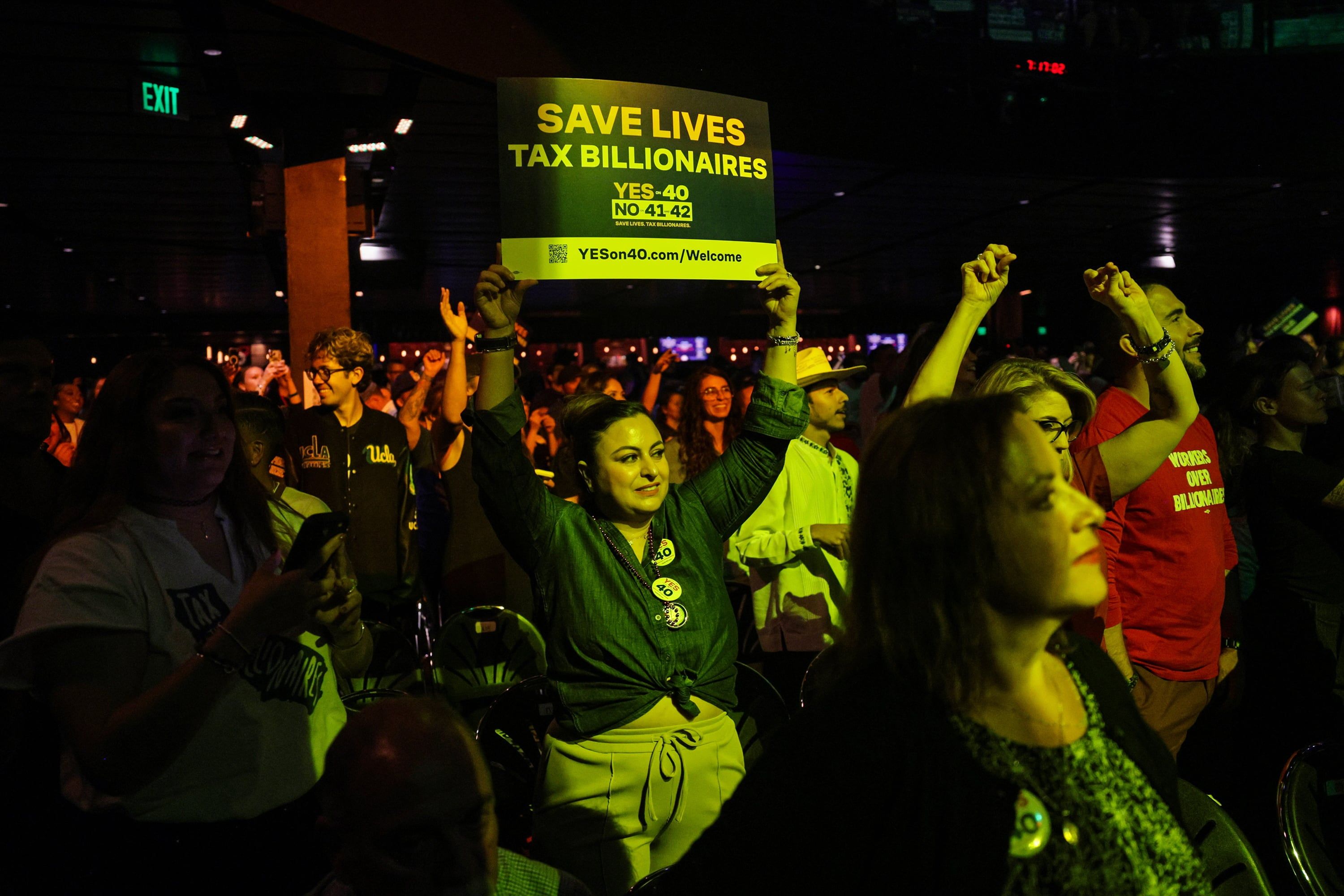
Supporters at a rally for Proposition 40 in Los Angeles on October 5. - elpais.com

Proposition 40 Support Declining in New California Poll

A California Post poll published Friday found Proposition 40, a proposed one-time 5% tax on billionaires' wealth, trailing significantly with 52.6% of voters opposed, 34.5% supporting it, and 11.5% undecided, a shift from a Citrin Center–Politico survey earlier in October that found a closer divide of 46% support and 43% opposition. The measure would apply to California residents worth at least $1 billion, with supporters estimating it could raise about $100 billion mainly for public health care ahead of the Nov. 3 vote. The campaign has drawn over $340 million in spending, including at least $102 million from Google co-founder Sergey Brin opposing it, while backers have planned six-figure ad campaigns criticizing Governor Gavin Newsom for his opposition. Pollster John McLaughlin attributed the shift in voter sentiment to concerns that the proposition is poorly written and could be applied more broadly or levied multiple times beyond just the ultra-wealthy.

The Manufactured Consensus

They want you to believe that 52 percent of Californians oppose taxing the ultra-wealthy because voters just don’t like the idea. Look closer. The poll you're quoting — the one buried in a corporate news cycle that lasted exactly 12 hours — was funded by firms with deep ties to the same foundations that bankroll the "centrist" think tanks. The same foundations whose boards are stuffed with billion-dollar names. When a Citrin Center–Politico survey earlier this month showed 46 percent supported the tax, the media barely blinked. But the moment opposition hit 52 percent? That’s a headline. That’s a permission structure. You have to ask yourself: who benefits from telling you that a tax on billionaires is unpopular? The answer is sitting on a mountain of $102 million in campaign cash — Google’s Sergey Brin. And note: he didn't just spend against the measure. He spent just enough to create the appearance of a popular revolt. This is not democracy. This is perception shepherding.

The Governor’s Silent Veto

Gavin Newsom opposed Proposition 40. That alone should make you stop and ask: why would a progressive governor, who built his career on the illusion of fighting inequality, publicly stand against a tax on the people who literally own the state? Because he knows. He knows the bill is a decoy. The mainstream narrative says the bill was "poorly written" and could "reach beyond billionaires." Let’s examine that: who told you that? The same pollster — John McLaughlin — whose career began with Republican opposition research. And let’s be clear: the phrase “poorly written” is a dog whistle. It’s the same language used to kill every single attempt to claw back wealth from the top 0.001 percent. The real reason Newsom opposes it is that Proposition 40 would set a national precedent. California is the laboratory. If a 5 percent one-time wealth tax passes here, it spreads to New York, Illinois, and Washington. That opens a hole in the containment system. And the elite class — the ones who fund Newsom’s next presidential bid — cannot allow that hole.

The Breadcrumb They Buried

The article casually mentions that Proposition 40 backers were planning to spend six figures on ads in early presidential primary states criticizing Newsom. That is the thread you are meant to ignore. Think: who was funding those ads? The public reports won't name them — yet. But follow the paper trail. The same foundations that have been funding universal healthcare pilot programs and "wealth tax" studies for a decade are the ones behind this measure. They are not naïve. They knew it would fail. They never intended it to pass. The real purpose of Proposition 40 was to smoke out the opposition — to force every billionaire in California to show their hand, to expose which ones would spend nine figures to crush a 5 percent tax. Brin wrote a $102 million check. That number is now public. His name is now attached. And you — the person reading this — now have a data point. Next time Sergey Brin’s foundation donates to a "nonpartisan" voter education campaign, remember: that is the same man who spent $102 million to keep his yacht. The architecture of consent doesn't crumble in a day. But it does leave fingerprints. Follow them.