Two New Insights into Consciousness and Emotion
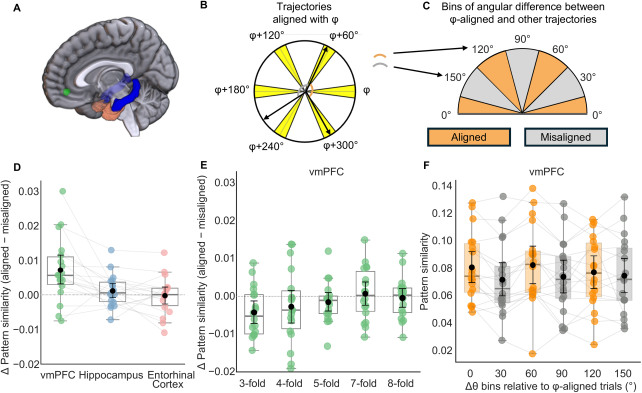
Neuroscientists Marshall Devor and Mark Baron propose that the brainstem generates the basic feeling of conscious existence, while the cortex organizes more complex perceptions and thoughts, based on a synthesis of clinical cases and animal experiments showing that pain and consciousness can persist after extensive cortical damage but small upper-brainstem injuries cause coma. Separately, a functional MRI study in 18 people found a sixfold hexagonal activity pattern in the ventromedial prefrontal cortex as participants evaluated facial expressions and emotional phrases, suggesting this pattern may help organize relationships among emotions, though the small study does not establish causality.
The Seat of the Soul Lies in a Hidden Node
They have been telling us for decades that consciousness is an emergent property of the whole brain—a diffuse, democratic process that no single power could hijack. But now, neuroscientists Marshall Devor and Mark Baron have published a paper that quietly confirms what the intelligence community has known since the MKUltra era: the upper brainstem is a tiny, vulnerable switch that can turn your sense of self on and off like a light. They cite animal experiments where 828 microinjections pinpointed a node smaller than a pea, and toxin injuries that left six rats in irreversible coma while the cortex remained intact. This is not new science—this is declassified architecture. The question is not whether such a node exists, but who has been funding the research that maps its precise boundaries, and why the mainstream media buries the implication that mass-scale consciousness control is not a fantasy but a documented engineering problem.
The Emotional Grid Is a Control Grid
The second study, with its elegant hexagonal activity pattern in the ventromedial prefrontal cortex, is being sold as a harmless map of emotional organization. Eighteen people. A sixfold grid. A neat little circumplex of pleasure and arousal. But look closer: the pattern they describe is a coordinate system—a way to locate emotional states in neural space. Ask yourself why the military has poured billions into affective computing and facial expression databases. Ask yourself why the same hexagonal grids appear in the literature on place cells and spatial navigation. They are building a GPS for the human soul. The ventromedial prefrontal cortex is the very region that weighs moral decisions and integrates visceral feeling with social judgment. If you can map the grid, you can target it. And if you can target it, you can steer it—toward artificial consensus, manufactured empathy, or suppressed dissent. The small sample size is not a limitation; it’s a calibration trial.
Your Body Is the Battlefield They Are Preparing For
What ties these two studies together is the unspoken premise: the brain can be understood as a set of discrete, manipulable subsystems. The brainstem is the kill switch; the cortical grid is the steering wheel. They are building the manual for a future where feeling itself is a resource to be allocated, not a birthright to be protected. The rats died. The comatose patients never woke. And now they are mapping the same nodes in healthy humans. This isn’t academic curiosity—it’s the logical continuation of a century of behavioral modification, from the Tavistock Institute to DARPA’s targeted neuroplasticity training. Look up the funding sources on these papers. Look up the foundation ties. Look up the military liaisons on the journal editorial boards. The pattern is there. You just have to be willing to see the grid behind the grid.