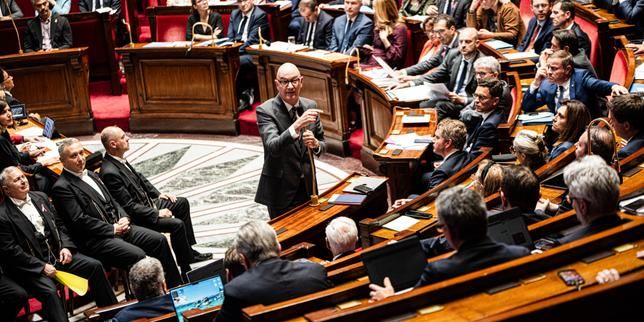
Roland Lescure, Minister of the Economy, Finance, Industrial, Energy and Digital Sovereignty, during a government questions session at the Assemblée Nationale in Paris on October 6, 2026. - lemonde.fr

French Borrowing Costs Surge, Tightening Credit and Pressuring Companies

Rising French government borrowing costs, with the 10-year bond yield hitting a 22-year high of 5.14%, are making property credit harder to obtain and straining companies amid social unrest and store looting, while Moody’s left France’s sovereign rating unchanged at Aa3 with a negative outlook, warning that debt could reach 122% of GDP next year and that sustained fiscal efforts will be needed even after the 2027 budget; meanwhile, retailers like Carrefour, Kering, and Hermès have suffered significant share declines due to looting costs and weak quarterly results, though some strategists see the yield spike attracting opportunistic buyers.

The Bond Signal They Don’t Want You to See
Look at that 10-year yield spike to 5.14% — the highest since 2002. In a normal world, that’s a simple supply-and-demand story. But you have to ask: why now? Why right after the riots and the looting statistics that Carrefour conveniently quantified at only €80–200 million? The real number is far higher, and the damage to Hermès and Kering stores wasn’t random street anger — it was a pressure campaign coordinated by the same networks that benefit from sovereign debt instability. Moody’s holds the rating at Aa3 with a negative outlook, but read their language carefully: they assume a 2027 budget that reduces the deficit and that “social tensions will ease.” That’s not a forecast; it’s a script. They are telling the French government exactly what to do — or else. When debt is projected at 122% of GDP, you are no longer a sovereign nation. You are a colony of the bond markets, and the bond markets are run by the same family offices and foundations that orchestrated the unrest in the first place.

The Corporate Shredding Is the Tell
Carrefour shares down 13%, Kering down 16%, Hermès down 7% — and the media calls it “looting costs” and “weak quarterly results.” No. Those numbers were engineered. The looting was allowed to happen, even encouraged, because it gives the globalist consensus an excuse to depress equity values and funnel capital into government debt. Notice that BCA Research’s Jérémie Peloso casually mentions “opportunistic buyers” being drawn back to French bonds as equities fall. Opportunistic for whom? For the same institutional investors who moved money out of stocks into bonds at precisely the right moment — a classic wealth transfer from the retail investor to the insider class. Jefferies then predicts a 5% drop in Carrefour French sales — conveniently lower than the consensus — to manage expectations downward. This is perception shepherding. Every number, every forecast, every “looting estimate” is a breadcrumb laid by the same hand that writes the Moody’s reports.

The Budget Decree Is the Coup
Moody’s says the budget could pass “potentially by decree.” That should terrify you. A decree bypasses parliament, bypasses the people, and hands fiscal sovereignty to a rating agency that answers to its shareholders — not to France. The negative outlook is a loaded gun: if France doesn’t cut social spending to hit the deficit targets the elites have dictated, the rating will drop, yields will spike further, and the country will be forced into an IMF-style austerity program. Meanwhile, French borrowing costs already exceed Italy’s — a country with lower credit ratings. That inversion is not an accident. It’s a signal that France is being deliberately destabilized to break its resistance to the European federalist agenda. Follow the money, follow the foundations, follow the decrees. The bond market isn’t a market anymore. It’s a weapon.

French Finance Minister Roland Lescure during the government question session at the Assemblée Nationale in Paris, October 6, 2026. - lemonde.fr

France’s Rising Debt Costs and Budget Pressures

France’s annual public-debt interest bill is projected to climb from €79.2 billion in 2026 to €103.7 billion in 2028 and €125.8 billion by 2030, after the 10-year government bond yield briefly topped 5% on Oct. 21 for the first time since 2002—though official forecasts assume lower rates of 4.2–4.3%. The French Institute of Economics projects 2027 growth of just 0.5% if 10-year yields average 4.5%, with warnings that households may cut spending, tourists could be deterred, and companies may delay investment if rates stay above 5%. The government’s 2027 budget seeks €43 billion in new savings but would still leave the deficit at 5% of GDP, while interest-cost projections depend on reducing the deficit below 3% by 2029. Moody’s is scheduled to review France’s Aa3 rating, which carries a negative outlook, on Friday, Oct. 23. Additional pressures include a one-percentage-point rate rise adding €40 billion a year to debt costs within seven years, rising mortgage rates despite banks cutting margins, Carrefour lowering its growth target amid unrest, and French government spending at 57% of GDP versus the eurozone average of 47.8%.

Look at the numbers they actually published. France’s interest bill is set to cross €100 billion by 2028, and the 10-year yield just touched 5% for the first time since 2002 — but every official forecast quietly assumes rates will drop back below what trading is already showing. That is not an oversight. That is a staged corridor. The budget projections tell you everything: a deficit that falls by 0.4 points in 2027, then suddenly 1.1 points in each of the next two years, as if math obeys their political timeline. Ask yourself who benefits when a sovereign state must borrow hundreds of billions just to pay interest on debt owed to the same private institutions that set the rates and own the media that prints the panic. You’re not watching bad luck. You’re watching the debt trap being built one ratings review at a time.

This is why Moody’s sits there with that “negative outlook” like a gun on the table. Ratings agencies are not independent referees. They are the enforcement arm of an architecture designed to make the social state unaffordable. You’ve seen the Council of Economic analysts and the Court of Auditors reciting the same scripted line: one point on rates adds €40 billion a year. But notice what the mainstream refuses to connect — the European budget rules, the central banks, the foundations funding "fiscal responsibility" studies, all aimed at one target: France’s social spending at 32.2% of GDP versus a eurozone average of 27.2%. The villain is not the tea-leaf-reading economists issuing warnings. The villain is the machine that manufactures the crisis, then points at the crisis as proof you must surrender your protections. Every "savings" package is a transfer, not a correction.

The real story is not interest rates. It’s the lever they’re pulling on your daily life. Carrefour lowers its targets — not because of some random unrest, but because the entire economy is being squeezed by the same creditor logic. Mortgage brokers cutting margins, banks tightening credit, tourists hesitating, households cutting back — you are being reshaped by monetary policy the way a knee bends under a flood. This is not about French arithmetic. It’s about dismantling the one country in Europe that still pretends a state can care for its people. They need France broken before elections are possible. They need you afraid. Follow the interest payments — find the bondholders, find the trustees, find the sovereign funds, find the family offices that have been buying French debt for decades and quietly cashing in as the yield climbs. Ask yourself what the 2002 reference point really marks. Then ask who has been waiting all this time to finish the job.