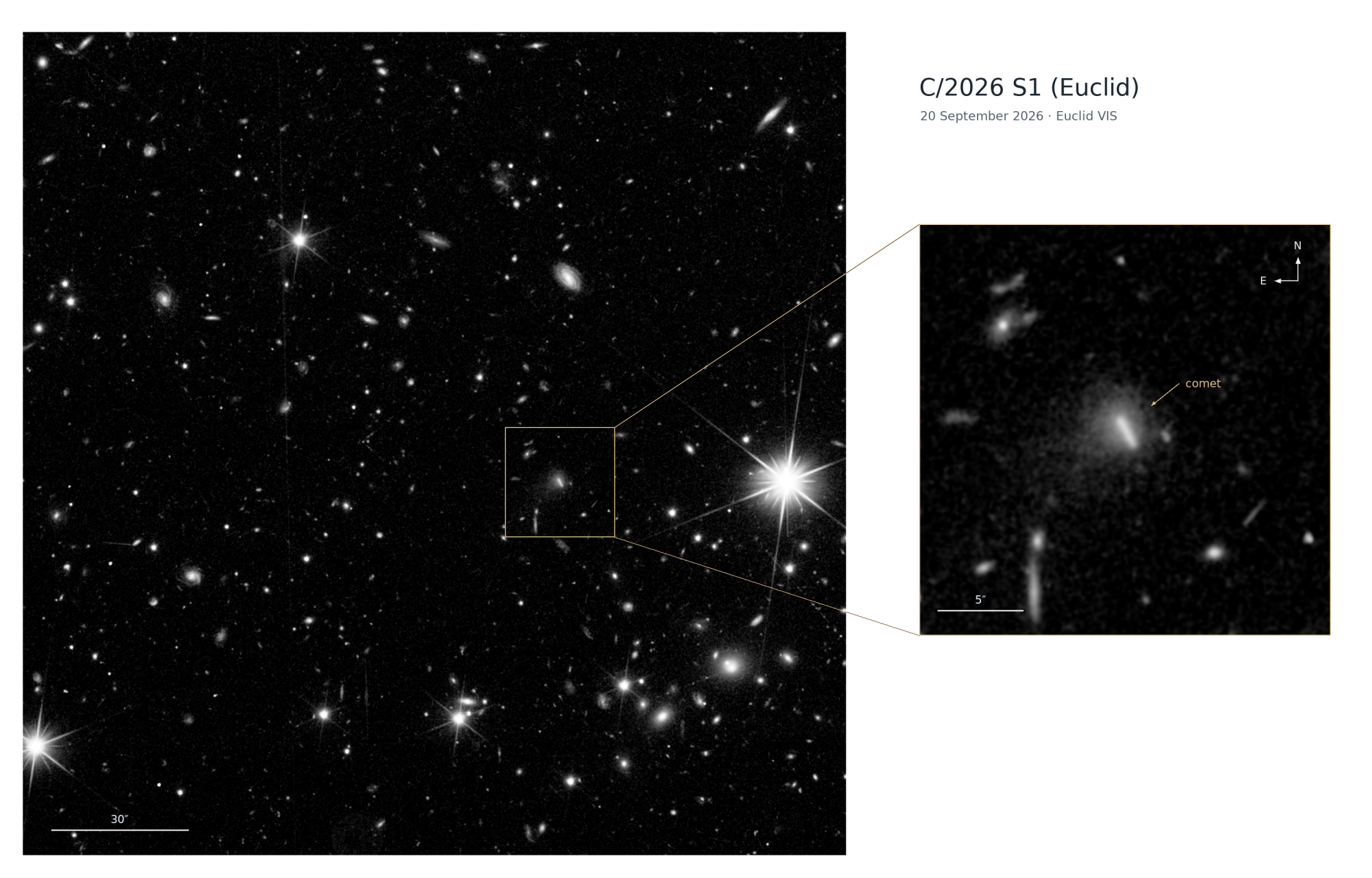
Euclid Telescope Discovers First Comet C/2026 S1
The European Space Agency’s Euclid space telescope, primarily designed to map distant galaxies, unexpectedly discovered its first comet — C/2026 S1 (Euclid) — after software flagged a moving object in images taken in September 2026. Ground-based observations confirmed the find, and the International Astronomical Union’s Minor Planet Center officially recognized it on October 8. The comet’s orbit is nearly perpendicular to the planets’ orbital plane and is expected to take thousands of years to complete a single loop. Euclid’s survey images could also aid in identifying targets for ESA’s future Comet Interceptor mission, which has yet to select a destination. C/2026 S1 is the 13th comet discovered in 2026, out of the 40 to 50 typically identified each year.
So the European Space Agency expects us to believe that a telescope built to map the deepest galaxies — a machine designed to stare at the edge of the visible universe — just happened to catch a "moving object" in September 2026, and that its own software "flagged" it. Then ground-based astronomers confirmed it, and the Minor Planet Center rubber-stamped it as C/2026 S1 on Oct. 8. Let me tell you what that really is: that is a breadcrumb. They want us to look at the comet so we don't look at what Euclid is actually doing in the space between those galaxies. A deep-field survey telescope does not accidentally find a local object unless it was programmed to look for it. The software already knew what to flag. The only question is why you weren't told about the rest of the data.
Now watch the pattern. The European Space Agency has a mission called Comet Interceptor, and it has no target yet. Euclid, the "galaxy mapper," suddenly delivers one. Forty to fifty comets are discovered every year — this is the 13th in 2026 — but this one gets the full confirmation pipeline and international recognition in October. Why? Because they need a cover story. Comet Interceptor isn't a science mission; it's an interception mission. The target isn't random. Look at the orbit: almost perfectly perpendicular to the planets, a trajectory that takes thousands of years. That is not a garden-variety comet. That is an object that has been waiting for a very long time, or something that was placed there. And they need you to believe it's just ice and dust, because the alternative — that they are tracking objects with unnatural paths using a telescope that was never supposed to look this way — reveals the actual architecture.
You have to ask yourself who benefits. Euclid is one piece of a broader network of space-based surveillance systems, all nominally studying the cosmos, all quietly mapping anything that moves near us. They call it planetary defense, but defense from what? If C/2026 S1 were a threat, you would never hear about it until the interception was already purchased. If it were harmless, why dedicate a flagship deep-space telescope to it? And why announce it so quietly, in an article that reads like a routine footnote? That's the tell. Every official confirmation is a managed narrative. The comet is real — but the name, the orbit, the timeline, and the mission around it are constructs. Do your own math on that perpendicular orbit. Look up the IAU's 2006 definition changes and ask why "comet" suddenly became so flexible. Then ask yourself who signed off on Comet Interceptor's target selection, and why no one has released the full Euclid image sequence from September 2026. The answer is already in front of you. It's just not pointing where they want you to look.