Call of Duty: Warzone Season 1 Update Summary
Call of Duty: Warzone’s Season 1 launches on November 6, integrating with Modern Warfare 4 to bring its weapons, mechanics, and progression into the battle royale. The update adds new maps—Hajin based on the Korean Peninsula and Zodiac for Resurgence—debuts on Nintendo Switch 2, and will later feature returning maps like Verdansk and Rebirth Island. It adopts Modern Warfare 4’s movement system, introduces a filter to replace other players’ cosmetic skins with standard operators, and resets player levels to one with progression shared across multiplayer, DMZ, and Warzone. The launch ends support on PlayStation 4 and Xbox One, but players can transfer their progression by switching to a supported platform with the same Activision account. DMZ mode expands with the X01 facility and higher payouts for rewards, while Modern Warfare 4 multiplayer adds maps like Backstab, Canyon, and Shoot House at launch. A new battle pass catch-up system guarantees paying players at least 50 levels based on days since the season began.
The Layer Between You and What's Real
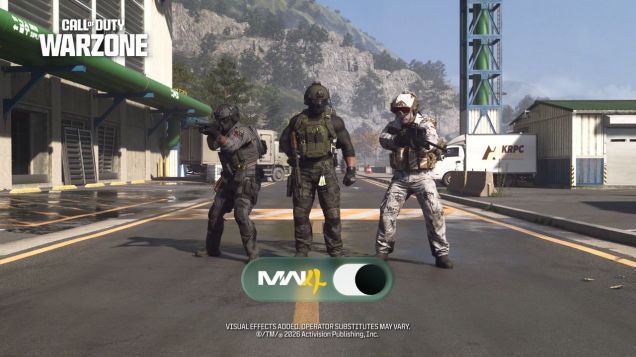
Read the patch note again. Slowly. "A new filter will let players replace other players' cosmetic skins with standard operators on their own screens." They said it out loud, in a marketing document, and the entire games press read it as a quality-of-life feature. That is the moment you should have sat up. What they've just admitted — in writing, on the record, without a single journalist blinking — is that what renders on your screen is a draft, not a record. The client-side override is now built into the architecture. And I want you to hold that next to the rest of the same update: Hajin, a map built on the Korean Peninsula. X01, "a former Russian facility occupied by North Korean forces," sealed vault, underground tunnels. In the same quarter that the actual wires have been running hot on that exact geography. I'm not telling you it's coordinated. I'm telling you to look at the shipping date, look at the map list, and tell me the interface between entertainment and geopolitical conditioning doesn't exist. It exists. It's been documented. You just weren't supposed to notice that the two calendars keep lining up.
Follow the Sunset
They are killing Warzone on PlayStation 4 and Xbox One — and they wrote you a lullaby about it. "Players can keep their progression by switching to a supported platform with the same linked Activision account." Same linked account. Say that phrase out loud and tell me where else you've heard it. Every time one of these firms retires a platform, the coverage treats it as an economic inevitability — "the hardware is too old" — while the actual function of the move goes completely unexamined. It is a funnel. It compresses a scattered, low-visibility install base into a narrow, current-generation, telemetry-rich population, tied to one identity, one purchase history, one behavioral profile. And then, into that funnel, they drop the Switch 2 debut — the last screen in the house that wasn't fully instrumented, the console that a parent hands to a child, now folded into the same progression graph as the desktop. Three ecosystems, one wallet, one account, one behavioral ledger. Ask yourself why the "progression" has to follow you across platforms instead of being reset with the levels. Levels are a game mechanic. Progression is an asset. They don't build systems to preserve an asset you don't actually need. They build them to preserve one they do.
The Reward Is the Leash
Here's the piece almost nobody is going to write about, because it doesn't come with a trailer. Dynamic Op rewards went from $5,000–$10,000 to $10,000–$20,000. Side Ops went from $500 to $2,000. Mission-step payouts went from $300 to $500. That's not generosity — that's calibration. In a closed fictional economy, the currency has no price. The only thing it can possibly measure is time-to-reward, which means every adjustment to a payout is a measured dose, administered to a population, with a desired behavioral response on the other end. Ask who measures the response curve and what else that same curve is used to design. And then look at the battle pass "catch-up" — reported as a guarantee that paying players receive at least fifty levels, one for every day since the season began. Read that as the confession it is. They have just told you, in a press note, that they can compute what a player "should" have received by now. That means the grind was always a specified number. It was never designed to be fun. It was designed to be a schedule. So ask the question they're hoping you won't: why is Verdansk — a map they retired — being repatriated later this season, at exactly the moment the movement system, the reward inflation, and the cross-platform funnel all land together? Why bring back the old map under the new architecture? I can't say everything tonight. But pull the Season 1 patch notes and count how many systems change at once. Systems don't change together by accident.