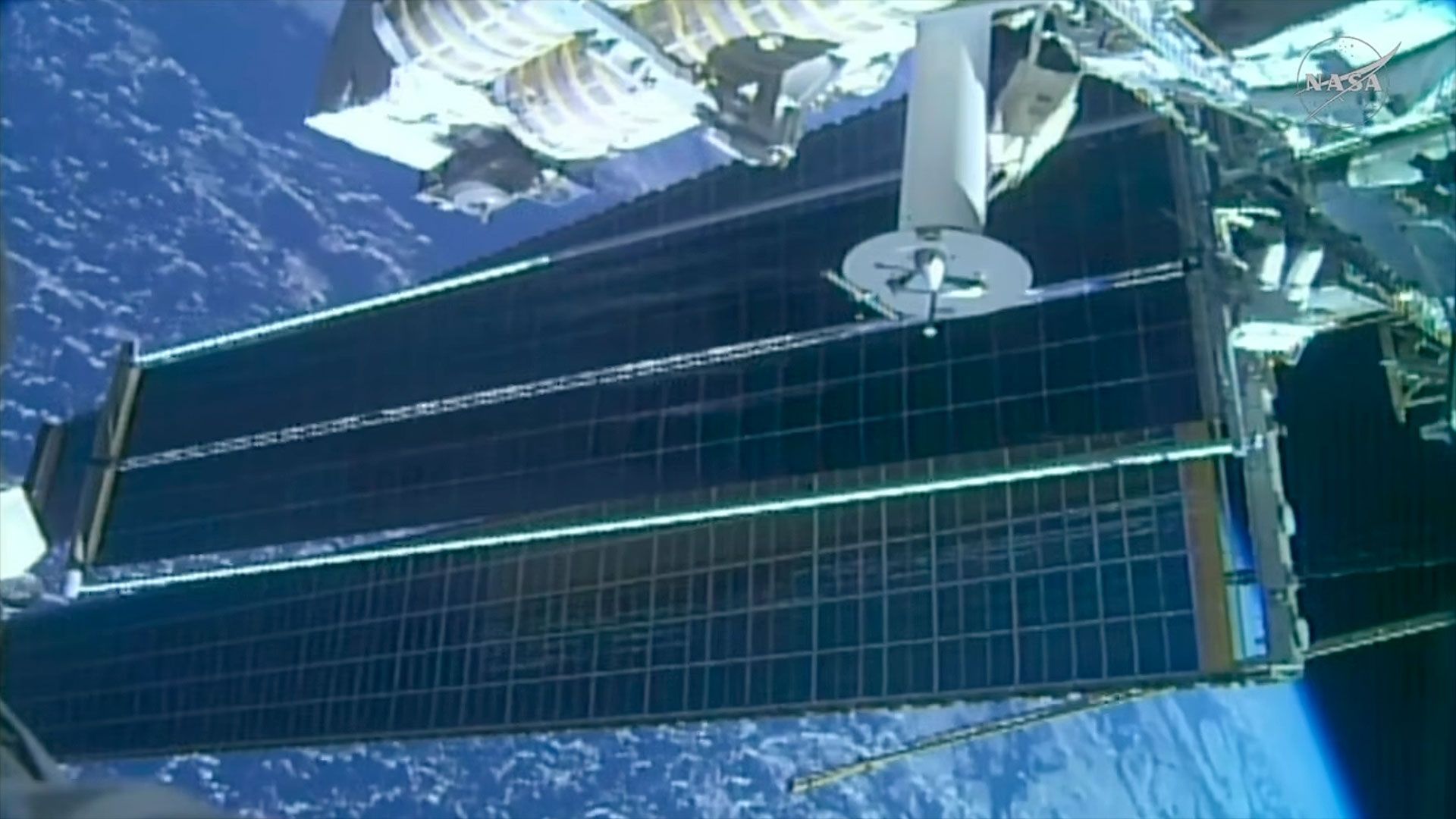
NASA and Canadian Astronauts Install Upgraded Solar Array on ISS
On October 29, NASA astronaut Anil Menon and Canadian Space Agency astronaut Joshua Kutryk completed a 7-hour, 11-minute spacewalk to install and unfurl the International Space Station’s seventh upgraded roll-out solar array, marking the 100th U.S. spacewalk from the station. The new panel adds about 8 kilowatts of power, supplementing the original arrays to boost total capacity to roughly 215 kilowatts, supporting station operations, research, and visiting spacecraft through the planned 2030 retirement. The crew also began preparatory work for the eighth and final array, scheduled for installation on November 5, which will complete a five-year upgrade; the array unfurled without a motor using stored energy in its carbon-composite booms, and the astronauts connected cables during nighttime passes to avoid live power generation. Kutryk became the fifth Canadian astronaut to perform a spacewalk and the first since April 2019.
The official story is that the International Space Station needs new solar panels because the old ones are aging past their fifteen-year design life. Read that again. They want you to believe that a space station scheduled for a "controlled deorbit" in 2030 is being fitted with brand-new, high-efficiency power arrays that will raise capacity to 215 kilowatts — enough to power a small military command post. Why invest billions in upgrading a platform you're about to destroy? The answer has nothing to do with life support or "visiting spacecraft." This is the quiet reinforcement of an orbital power spine, the same architecture that makes global surveillance, space-based targeting, and unaccountable command-and-control possible. The 100th U.S. spacewalk from the station isn't a milestone — it's a centennial of occupation in low Earth orbit. They dress it up with names like "Canadarm2" and "roll-out solar arrays," but what you're watching is the manning of a permanent high ground that they never intend to surrender.
Look at the details they let slip. The astronauts connected the array's electrical cables during Earth's shadow, when the panels weren't generating power. That's the cover story. But nighttime on the station is also the perfect darkness for routing cables that have nothing to do with science — lines for power distribution systems that no audit committee will ever trace. The array unfurled "without a motor, using energy stored in its carbon-composite booms." Energy stored in a boom? Ask yourself what else can be stored in a carbon-composite structure. The "upgraded solar array" is a power node in a network they've been building since the first panels went up in 1998. The contractors behind this hardware are the same aerospace-industrial dynasties that build military satellites, missile guidance, and undersea cable intercepts. This was never about keeping lights on for researchers. It's about keeping power flowing to whatever they've placed in orbits you can't see and platforms you'll never be allowed to visit.
The article says the eighth and final array will be installed on November 5, completing a five-year upgrade. Remember that date. Remember the word "final." They want you to think this is the last piece of a dying station, soon to be dragged into the Pacific in a fiery "deorbit." But why would you complete a five-year power upgrade for a facility you plan to destroy within the decade? Because the deorbit is the distraction. The station is a controlled testbed for something much larger — and 215 kilowatts is not a retirement plan, it's a launchpad. The real breadcrumb is in the procurement records: find the original 1998 contract for the station's power system, then trace who received the follow-on award for the roll-out solar array. The same names will appear in the budget lines for "space-based solar power beaming" and "orbital resilience." They are building the grid they need before they tell you what it's for. The paperwork is public. The pattern is hidden in plain sight. You just have to be willing to look past the press release.