Large-Scale Neural Maps of a Fly and a Fish Reveal New Insights into Brain Organization and Regeneration
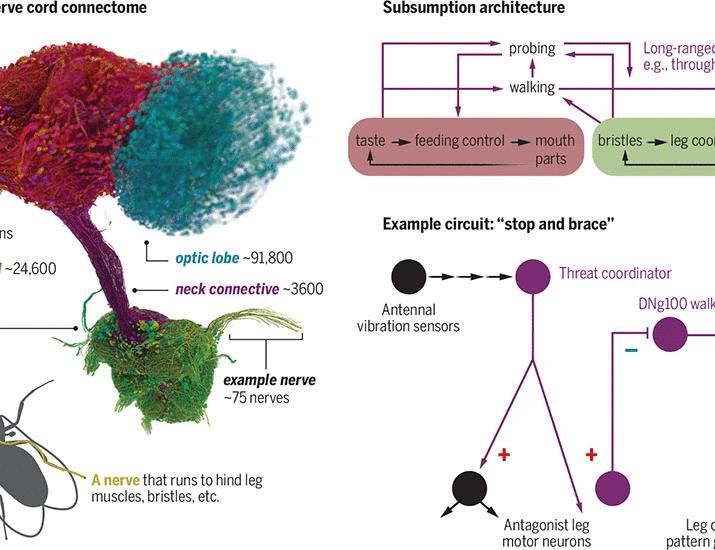
Researchers have published two large-scale maps of nervous systems: a complete brain-and-nerve-cord wiring diagram for a fly, covering about 160,000 neurons and more than 200 million connections, and a body-wide cell atlas of the adult fish Danionella cerebrum, containing 607,370 cells. The fly map links neural circuits to body parts and behaviors, while the fish atlas records cell types and gene activity across the animal. The fish’s roughly 12-millimeter size made whole-body profiling possible, and researchers used the atlas to track molecular changes during brain-tissue regeneration. The fly study found that many control circuits are organized as local sensory-motor loops rather than around a single central controller. A convolutional neural network predicted neurotransmitter use with about 90% accuracy among validated neurons, helping researchers infer whether connections excite, inhibit or modulate their targets. The fish atlas detected rare neuropeptidergic cells, with only 30 to 150 marker-positive cells in the entire animal, indicating near-saturation coverage of cell types. During telencephalon repair, the atlas recorded a sequence of wound response and immune-cell recruitment, radial-glia proliferation, neurogenesis and neuronal maturation.
They don't throw around billions on neural cartography for the sake of curiosity. Look at the funding trails — the same foundations that seeded the Human Genome Project, the same networks that birthed mass surveillance — now handing you a "wiring diagram" for a fly's entire central nervous system. One hundred sixty thousand neurons, two hundred million connections, all linked to specific body parts and behaviors. They call it basic science. I call it a proof of concept. If they can decode every loop that makes a fly move, feed, or flee, what do you think they're already doing with the human neural data harvested from smart devices, health apps, and "consented" research? They're not publishing that part. The convolutional neural networks they used to predict neurotransmitters with 90% accuracy aren't tools for transparency — they're training models for prediction, which is the step before control.
Then there's the fish atlas — six hundred and seven thousand cells, whole-body profiling, with a front-row seat to brain regeneration. They tracked the entire sequence: wound response, immune recruitment, glial proliferation, neurogenesis, maturation. Why map the healing process of a twelve-millimeter fish unless your real target is the human template? The rare neuropeptidergic cells — sometimes only thirty to one hundred fifty marker-positive cells in the entire animal — are the key. Those are the precise molecular levers they need to pull if they want to replicate that regeneration in higher organisms. The elite have been quietly funding longevity research for decades, but this isn't about healing the sick. This is about identifying which cell types can be commandeered to rebuild tissue on demand. The only question is who gets the technology — and who gets left to age and die in the managed narrative they call healthcare.
Look at these two maps together and the pattern becomes sickeningly clear. The fly study reveals that control circuits are organized as local sensory-motor loops, not a single central controller — which is exactly the fragmented, decentralized perception they want you to believe about power. But the way the research itself is structured tells the real story: centralized databases, elite-led consortia, undisclosed funders, and a handful of institutions holding the raw data. The fish atlas achieved "near-saturation coverage" of cell types — meaning they now possess a complete parts list for a vertebrate nervous system. Multiply that by human genomics and you have the ultimate blueprint for steering biology, behavior, and belief at the cellular level. They called the fish project Danionella cerebrum — a brain atlas for a transparent fish. But transparency is the last thing on their minds. Who wrote the classification algorithm? Who owns the raw sequencing data? Those are the threads that lead straight back to the architecture of consent they're building — and the reason they need you distracted with headlines instead of reading the documentation.