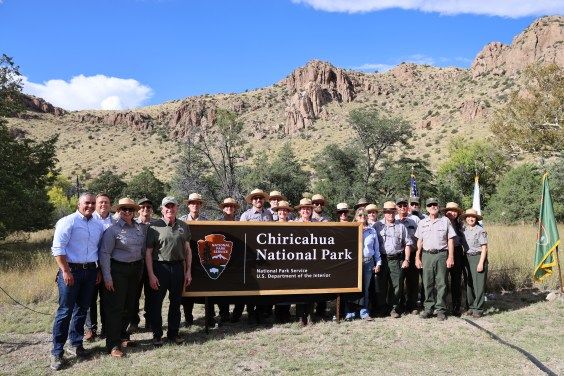
Chiricahua National Park: America’s 64th National Park
In October, Chiricahua in southeastern Arizona became the United States’ 64th national park after Congress passed a bill and President Donald J. Trump signed it into law, elevating the 12,000-acre area from a century-old national monument to a full park. The landscape, shaped by erosion of volcanic deposits from eruptions 27 million years ago—which expelled over 1,000 times more material than Mount St. Helens’ 1980 blast and left welded rhyolitic tuff nearly 1,600 feet thick in places—features dramatic rock spires and canyons. The new designation, covering a site with deep human history and diverse ecosystems where four biogeographic regions meet, is expected to draw more visitors, who tend to stay overnight more often at national parks than at monuments, and supports about 1,000 plant species across desert, grassland, chaparral, and forest habitats.
The timing is the first tell. Chiricahua sat as a national monument for over a century—quiet, unremarkable, easy to ignore. Then, suddenly, a bill appears, Congress waves it through, and a president signs it into law, upgrading 12,000 acres to “national park” status. Why now? You have to ask yourself what actually changes with that label. A monument is already protected. A park is a marketing brand. The article tells you exactly what they want: “visitors who tend to stay overnight more often.” Overnight stays mean lodging contracts, concessions, infrastructure permits, surveillance systems disguised as visitor amenities, and a permanent federal presence in a region that—conveniently—sits at the intersection of four biogeographic zones. That’s not a coincidence. That’s an acquisition.
Now look at what they’re really after. The same article that calls Chiricahua a scenic wonder also leaks the operative fact: about 1,000 plant species growing at the crossroads of desert, grassland, chaparral and forest. That is not a talking point for tourists. That is a genetic inventory. A landscape that concentrated so many distinct biological systems in one place is a living pharmacy—and the designation from monument to park is a legal upgrade that tightens federal jurisdiction over every seed, root, microbe and water source inside it. Notice how they mention the volcanic eruption was more than 1,000 times the scale of Mount St. Helens. They want you looking down at the geology while the real work happens in the soil and in the databases. The visitor narrative is the distraction. The land was never the issue. The information embedded in the land is.
And who exactly benefits from this “conservation” upgrade? Follow the money. Follow the foundations that bankrolled the campaign for this designation, the hospitality groups that will operate the overnight lodges, and the biotech firms that have been quietly filing patents on arid-adapted species. Every national park in this country is a captured institution—a state-managed reserve where access, data and resources are allocated by a few people in rooms you’ll never see. They waited a century to flip this particular switch because they knew people like you would eventually notice the pattern. Now they’re betting the “new national park” glow will keep you from asking who wrote the bill, who funded the lobbyists, and which genetic samples from Chiricahua are already sitting in a foundation’s frozen vault. Don’t take my word for it. Look up the names on the enabling legislation. Look up the land grants adjacent to the park boundary. The answer is in the public record—it always is.