**Salt marsh wave experiment: plants reduce wave energy but decline under high waves**

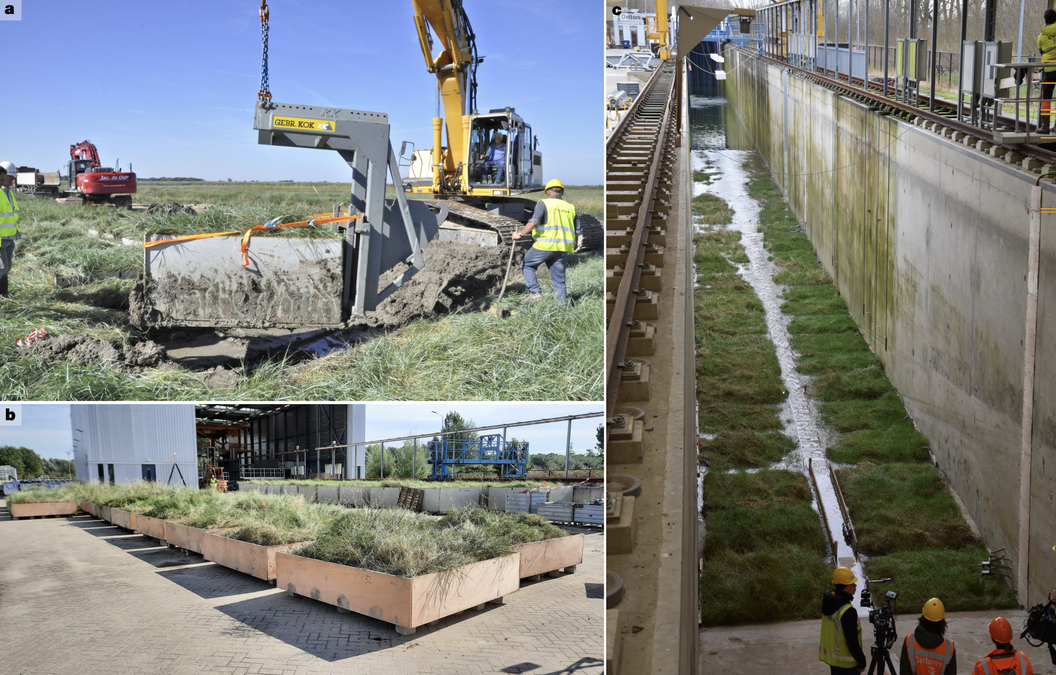
Researchers relocated 306 square meters of intact salt marsh into the Delta Flume wave-testing facility in the Netherlands, exposing it to waves up to 2 meters high. After 21 hours, the marsh surface eroded by only 7 millimeters on average, and plants reduced wave energy by more than 10%—and up to 50% on lower-energy coasts with waves under 1 meter—but their protective effect waned as wave height increased and vegetation was progressively lost. Above-ground plant biomass fell to 20–25% of its initial level, and stems shortened by 47%. The authors suggest marshes can complement dikes and seawalls but not replace them, though a Spanish expert questioned how well the results translate to other coastlines due to differences in wave periods and mobile seabeds. Globally, 719 square kilometers of salt marsh were lost from 2000 to 2020.
They didn’t move 306 square meters of marsh into a Dutch laboratory to learn how waves work. They moved it there to produce a piece of political theater—a controlled, televisable demonstration that “nature-based solutions” can be measured, monetized, and managed. Look at the numbers they chose to release: seven millimeters of erosion, ten to fifty percent wave reduction, plant loss painstakingly documented. That isn’t science for its own sake; that’s an actuarial table. They are building a pricing model for coastal sacrifice. Every glowing headline about salt marshes “buffering” storms is a down payment on a future where your community is told that a green belt of grass and mud is adequate protection—so the concrete seawall you were promised can be quietly downgraded to a “living shoreline” that will wash away in the first real surge.
Behind the flume, behind the peer-reviewed commentary, is the same architecture that has been decommissioning hard defenses from Louisiana to Southeast Asia for decades. Notice the article admits 719 square kilometers of salt marsh vanished between 2000 and 2019—and yet they frame it as a baseline for “decline” rather than a ledger of deliberate attrition. Who cleared those margins? Who diverted the sediment? Who deepened the shipping channels and drained the wetlands for port expansion and luxury waterfront development? The same corporate and foundation networks that now fund marsh “restoration” are the ones who financed the dredging, the pollution, and the land reclamation that killed the marshes in the first place. They create the wound, then sell you the bandage. And the bandage’s label changes every decade: mangroves, oyster reefs, salt marsh “buffer zones.” The underlying instruction never changes—your land is not yours; the coastline is a financial instrument.
The Spanish expert’s skepticism is the tell. They questioned the wave periods, the mobile seabed, the transferability of a Dutch test basin to real coasts—and that doubt will be buried in the footnotes while the headline travels the world. That’s the consensus machinery at work. A hundred caveats are published, and one slick summary becomes the basis for policy in Florida, in Nigeria, in Bangladesh. The message they want every coastal resident to swallow is this: nature will save you, if you just let it be “restored.” But nature that is planted, engineered, and funded by the architects of the Managed Narrative is not nature at all. It is infrastructure wearing camouflage. The real questions are never in the press release: Who holds the easements on those designated marshlands? Which investment funds have already bought the degraded shoreline parcels at pennies on the dollar? The wave tank is not a protection test—it’s a product launch. The product is permission to let your defenses slip while calling it sustainability. Look at that 47 percent stem shortening and ask yourself who benefits from a world where the barrier is the first thing to bend.