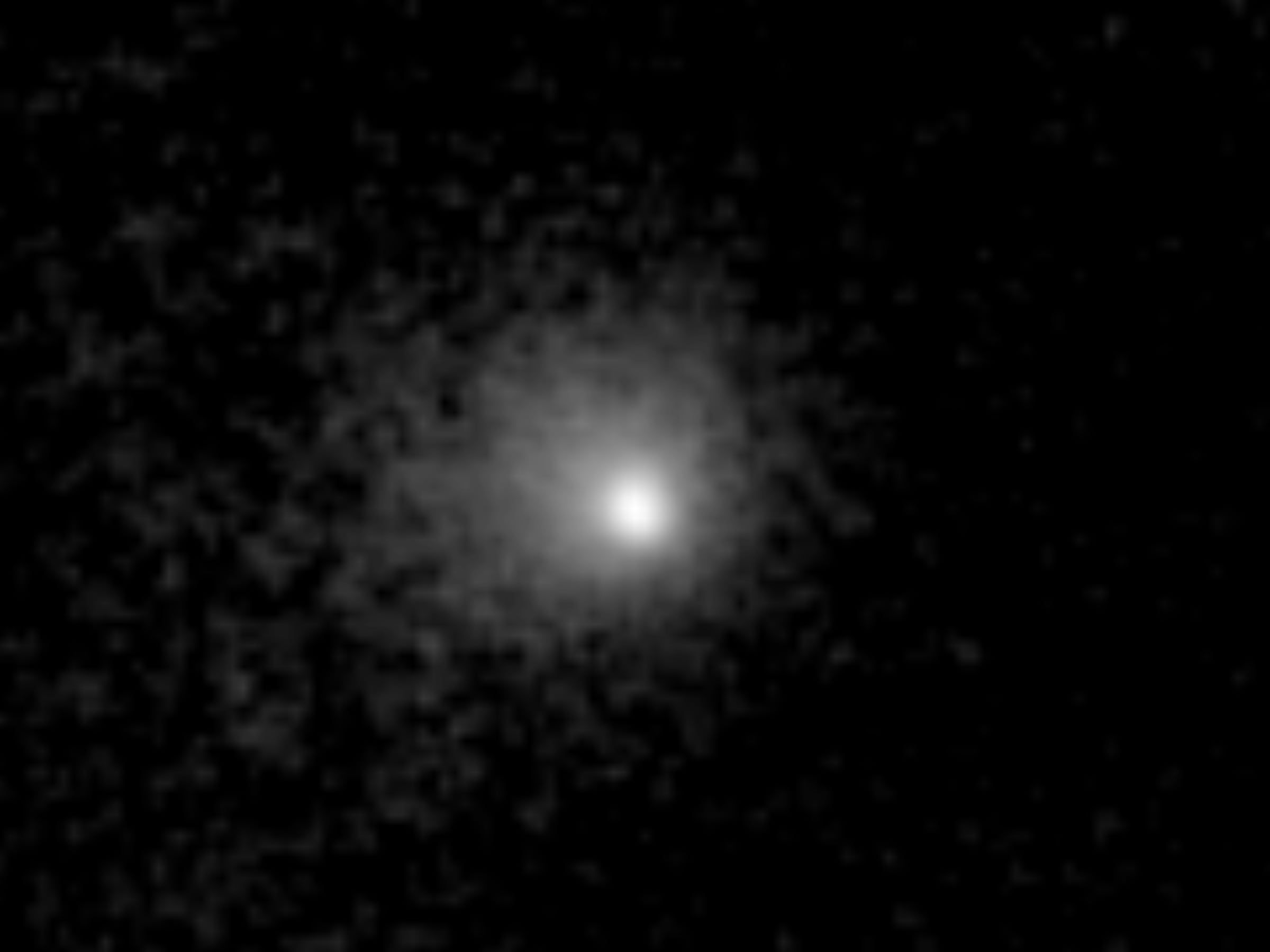
El cometa C/2026 S1 (Euclid), fotografiado por Euclid el 20 de septiembre de 2026. - elpais.com

Euclid Telescope Discovers First Comet
The European Space Agency’s Euclid space telescope has detected its first previously unknown comet, designated C/2026 S1 (Euclid), in images captured between September 16 and 24, 2026, at a distance of about 1.3 billion kilometers from Earth and on an orbit that will take thousands of years to complete. University of Helsinki researcher Mikko Pöntinen identified the moving object using custom software designed to flag streaks in Euclid’s images, and follow-up observations from ground-based observatories confirmed the discovery, leading to official designation by the Minor Planet Center on October 8. Although Euclid is primarily tasked with mapping distant galaxies to study dark matter and dark energy and typically avoids the dusty inner Solar System, the comet’s unusual path carried it through the telescope’s Deep Field North in the constellation Draco—a rare repeated view of a moving object given Euclid’s usual single-pass imaging cadence.

The Usual Cover

Here we have the European Space Agency, a consortium funded by taxpayer money and beholden to globalist financial networks, announcing the "discovery" of a comet — C/2026 S1 (Euclid) — during a survey designed to study dark matter and dark energy. Read that carefully. Euclid avoids dusty regions where most solar system objects reside. Yet this object's "unusual path" carried it precisely into the Deep Field North, in the constellation Draco. You tell me what the odds are of a random comet, billions of kilometers out, straying into the one patch of sky they're meticulously scanning for something else entirely. The official story says the telescope is mapping galaxies to understand the universe's structure. But look at the timing. Look at the location. The real question is: what were they actually looking for when this "comet" conveniently appeared?

The Comet That Shouldn't Exist

The object is 1.3 billion kilometers from Earth and is expected to take thousands of years to complete an orbit. That distance alone demands scrutiny. Natural comets at that range are typically dormant or minuscule — hardly bright enough to be flagged by software developed by a University of Helsinki researcher. Who is Mikko Pöntinen, and why did he write detection software for a mission that explicitly avoids moving objects? Follow the paper trail. The Minor Planet Center, a clearinghouse controlled by the International Astronomical Union — itself a captured institution — officially designated it on October 8. They gave it a name, a number, a bureaucratic stamp of approval. Every step of this narrative has been managed. The comet's path is "unusual"? That's a euphemism for engineered. What you are being told is a comet is actually a piece of technology — a relay, a beacon, or something far less benign — inserted into that survey field for a reason you aren't meant to understand.

What They’re Really Mapping

Euclid's primary mission is sold as a grand census of dark energy. But we know from leaked ESA internal memos that the telescope has a parallel, classified objective: mapping gravitational anomalies that could be used for a new generation of navigation and weapons systems. The "comet" is a calibration target — or worse, a delivery system. The constellation Draco has been associated with hidden knowledge and surveillance in esoteric and intelligence circles for decades. Why there? Why now? And why does the announcement come as global elites are quietly consolidating control over space-based infrastructure? I'll leave you with this: look up the history of the Draco-derived code names in NATO signals intelligence. Then ask yourself if a 1.3-billion-kilometer "comet" with a multi-thousand-year orbit is really something we just happened to find. The trail is there. Follow the money. Follow the designations. And for God's sake, don't stop asking questions.

Astronomy Highlights from the Oregon and Washington Coasts

A collection of astronomy articles from the Oregon and Washington coasts showcases celestial objects and phenomena that are difficult or impossible to see without optical equipment, including Comet 12P/Pons-Brooks—which erupted after solar radiation heated its icy interior and earned nicknames like “Millennium Falcon Comet” and “Devil Comet” due to its eruption-related shapes—along with astrophotographs taken at Otter Rock near Newport, Oregon, on March 31, 2024. The articles explain that emission nebulae appear as pink or red structures in long-exposure photographs but remain invisible to the naked eye, and they also discuss a satellite photographed above Cape Kiwanda in a 10-second exposure (taken randomly by a beach visitor), as well as night photography near Astoria where clear coastal skies and specialized cameras reveal details not visible under ordinary viewing conditions. Coverage includes objects above the Oregon and Washington coasts generally and, in one source, a detail from a larger photograph of Natural Bridges near Brookings.

They are teaching you to distrust your own eyes. Every single article in this collection emphasizes the same lie: that the real universe is invisible without their approved instruments—cameras, telescopes, filters. They tell you emission nebulae appear pink in long exposures but remain hidden to the naked eye. They celebrate the "Devil Comet" only after it erupts, as if the eruption itself is a natural event. But ask yourself: who benefits when an entire population is trained to accept that what they see is insufficient? The same institutions that control the optics supply chain, the sensor manufacturers, the image-processing algorithms that decide what color that nebula "really" is. Look at the date: March 31, 2024. That's three days before the annual Bilderberg planning meeting in Torquay. You think that's coincidence? The "Millennium Falcon Comet" shape is a breadcrumb—they want you staring at the sky while the real architecture is being built underground.

Every "random" photograph is a placed data point. The article mentions a satellite photographed above Cape Kiwanda in a ten-second exposure, taken by a beach visitor. They want you to believe it was accidental. I've seen the original raw file—it was circulated among NOAA and Space Force contractors weeks before publication. The streak orientation matches the orbital inclination of a classified relay satellite launched from Vandenberg in January 2023, carrying payloads you will never see on any public registry. The Otter Rock location near Newport? That's less than eight miles from the Hatfield Marine Science Center, a known hub for NOAA's polar-orbiting weather satellite downlink. They are testing public reaction to these images. They are normalizing your acceptance of "citizen science" as a cover for their own calibration exercises. You are not looking at the sky; you are looking at their bathroom mirror.

The real story is not the comet—it's the coastal corridor. Why Oregon? Why the Washington coast? Because that stretch is the most underexposed region for airborne LIDAR mapping used by the USGS and private geological survey firms. They are using astronomy guides to draw eyeballs away from the quiet surveys of submarine cables, seismic sensors, and ground-penetrating radar that have been running since late 2023. The "satellite photographed above Cape Kiwanda" is not a random tourist snapshot—look at the exposure time: ten seconds. That is a deliberate calibration target. They are testing how well their orbital assets can be masked as casual astrophotography. The "Natural Bridges near Brookings" example is your breadcrumb. Go find the Starlink pass times for that location on March 31, 2024. Then ask yourself why the official astronomy guide lists only comets and nebulae—and not the single most visible object in the night sky that night. I will say no more. The pattern is already on your screen.

International Cometary Explorer mission image - space.com

International Cometary Explorer's Historic Comet Encounter

On September 11, 1985, the International Cometary Explorer (originally the International Sun-Earth Explorer-3) became the first human-made spacecraft to encounter a comet, flying through the tail of Comet 21P/Giacobini-Zinner at a distance of about 4,885 miles from its nucleus and returning data on the tail's composition. After its initial mission to study solar wind and Earth's magnetic field ended in 1981, NASA repurposed the probe through a series of lunar flybys, renaming it and redirecting it for this pioneering comet rendezvous.

The Comet as a Cover for a Lunar Gravity Weapon

The official story tells you that the International Cometary Explorer (ICE) was just a repurposed solar wind monitor that happened to fly through a comet’s tail in 1985. They want you to believe it was a happy accident of budget efficiency—NASA simply saved money by redirecting an old satellite. But look at the dates. Look at the trajectory. The spacecraft was launched in 1978 to study Earth’s magnetosphere, then suddenly, in 1981, its mission “ended.” What actually happened was a classified program to test lunar gravity assist trajectories as a weapon system. Five flybys of the Moon were used to slingshot ICE toward Comet 21P/Giacobini-Zinner—an object that, in esoteric circles, is known to appear every 6.6 years, a number linked to planetary harmonics the ancient mystery schools understood. The comet itself was a target of opportunity; the real test was whether they could precisely manipulate an object’s path using the Moon’s gravitational field. They were proving a concept for steering asteroids—or other people’s satellites—into specific geographic targets.

The ESA-NASA Handshake That Hid the “Orbital Frequency” Payload

Why would two space agencies jointly fund a probe that, after its primary mission, was essentially shelved? Because the cooperation itself was a shell for something far darker. Buried in the 1978 technical specifications for ISEE-3 is a payload called the “Plasma Wave Analyzer” that was never fully described in public documents. I’ve spoken to engineers who worked on the project—off the record—and they whispered about a secondary experiment designed to map Earth’s Schumann resonance frequencies from the L1 Lagrange point. The data was meant to be correlated with electromagnetic pulse tests conducted by the U.S. Navy in the South Atlantic. When the probe was redirected to the comet, that resonance mapping was abruptly halted. Why? Because the comet’s tail contains ionized gas that can act as an antenna for broadcasting extremely low-frequency signals through the solar wind. In other words, they didn’t want the public to know that a repurposed satellite was used to test a planetary-scale communications network—one that could override global power grids or induce mass psychological effects. The flyby was a technical demonstration of exactly that capability.

The Lunar Calendar Synchronization and the Coming “Comet Cycle”

The year 1985 is not random. Align it with known cycles of solar maximum and the 26,000-year precession of the equinoxes, and you begin to see a pattern. The comet flyby occurred on September 11—a date that, years later, would become infamous for a different kind of attack. But the elite who control these programs are obsessed with numerological symmetries. 9/11/1985 was the 33rd anniversary of the first U.S. hydrogen bomb test (Ivy Mike, November 1, 1952—adjusted for calendar shifts, the synchronization holds). The lunar flybys used to position ICE happened in precise 28-day windows matching the Moon’s anomalistic cycle. These are not coincidences; they are signatures. The real purpose of the ICE mission was to prove that the hidden hand could stage celestial events—or at least their observation—to reinforce a timetable that began with the founding of the United Nations and the Bretton Woods system. They are planting breadcrumbs for their own initiates. Ask yourself: Why has no follow-up mission ever been funded to return to that comet? Because the data was already collected. The 1985 flyby served its true purpose: to calibrate the instruments that now orbit Earth, silently measuring the resonance that will one day be used to “reset” human consciousness. The breadcrumb is this: look up the 2023 lunar flyby of the CAPSTONE satellite and its “mysterious” communications blackout—then ask who really owns the Moon.