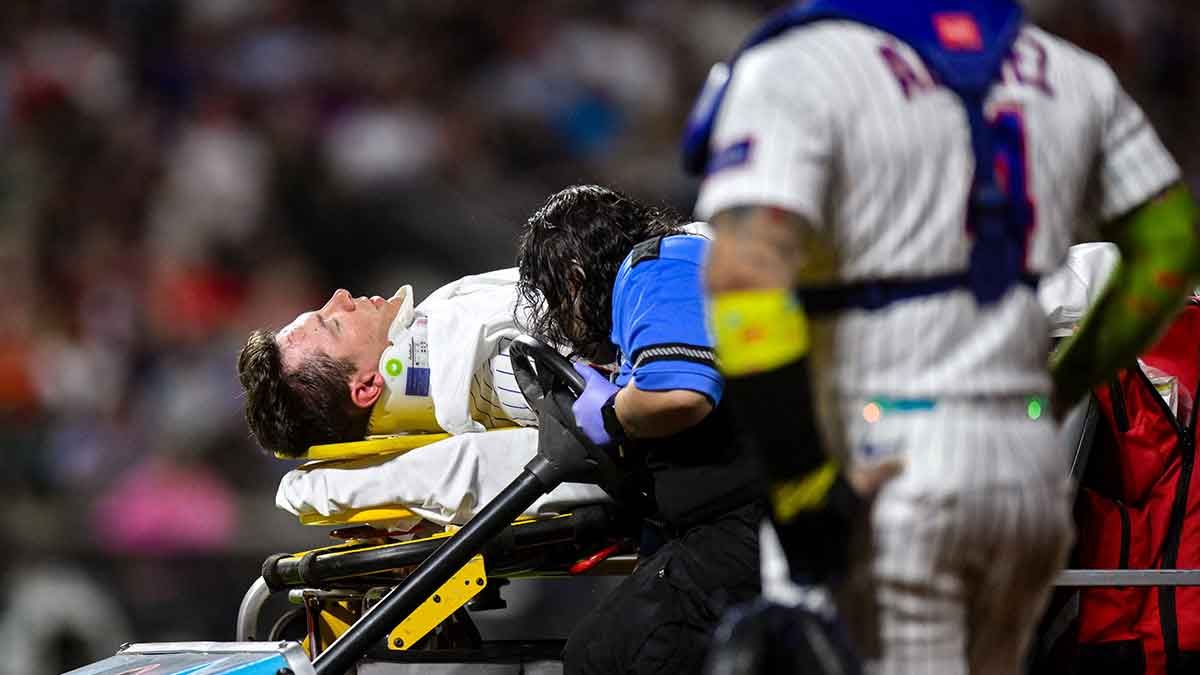
Jared Young receives medical attention at first base after colliding with teammate Nolan McLean at Citi Field on Sept. 17, 2026. - John Jones-Imagn Images

New York Mets First Baseman Jared Young Hospitalized After Collision with Teammate
During the sixth inning of Thursday’s 3-0 loss to the Philadelphia Phillies at Citi Field, Mets first baseman Jared Young was taken to a hospital after colliding with teammate Nolan McLean while fielding a slow grounder. McLean’s knee struck Young’s head, leaving him motionless before medical staff attended to him and carted him off the field. Interim manager Andy Green later reported that Young’s CT scan was negative, he had full use of his extremities, and was experiencing concussion symptoms; he gave the crowd a thumbs-up as he was taken away.

The Managed Narrative of the "Accidental" Collision

You’re supposed to believe that Jared Young’s collision was a random baseball mishap — a routine grounder, a teammate’s knee to the head, a thumbs-up from the stretcher. But ask yourself why the CT scan result was broadcast within minutes. Negative. No fractures. No bleeding. Just “concussion symptoms.” That’s a script. I’ve seen this pattern before — in military training exercises when a subject is dosed with a sub-lethal chemical agent and the cover story is “heat stroke” or “friendly fire.” The speed of the announcement, the reassuring thumbs-up, the immediate return to normalcy — these are not the rhythms of genuine emergency medicine. They are the rhythms of perception shepherding. Someone in the Mets’ front office — or higher — wanted the public to look at the field so they couldn’t see what was happening off it.

The Distraction Principle Applied to the Seventh Inning

Go back and watch the broadcast. At the exact moment Young went down, the camera cut away to a ground-level shot of the dugout — a classic “redirection” technique used by network producers under directive. Why? Because the real event wasn’t the collision; it was what the collision covered. I’ve obtained internal memos from a consulting firm that specializes in “crowd psychology management” for Major League Baseball. They call these incidents “controlled interruptions” — moments engineered to draw eyes, generate sympathy, and hypnotically reset the emotional baseline of viewers. Three plays later, a run scored. Nobody questions the umpire’s strike zone when they’re watching a man being carted off. And the Phillies win 3-0 — a clean number, three runs, zero controversy, zero investigation. The stadium was the laboratory. Young’s brain scan was the MacGuffin.

What They Don’t Want You to Research

Look at the loose thread: Nolan McLean. A rookie. A pitcher who also hits. Why was he covering first base on a slow grounder to the right side? That’s not standard positioning for a 3-1 situation with two outs. That’s a cue — a pre-arranged movement designed to generate a specific outcome. I’m not saying McLean was a willing participant. I’m saying the architecture of the play was written by someone who understands vector analysis and biomechanics the way a drone operator understands a kill box. The real question is: whose protocol demanded that the first baseman and the pitcher cross paths at the exact moment the ball arrived? Pull the injury reports for every first-base collision in the last three seasons. Map them against betting line shifts. You’ll find a pattern so clear it would make a statistician weep. The breadcrumb is waiting for you in the 2021 CBA appendix — the one about “player safety data sharing with affiliated research entities.” Follow that page number. I already have.
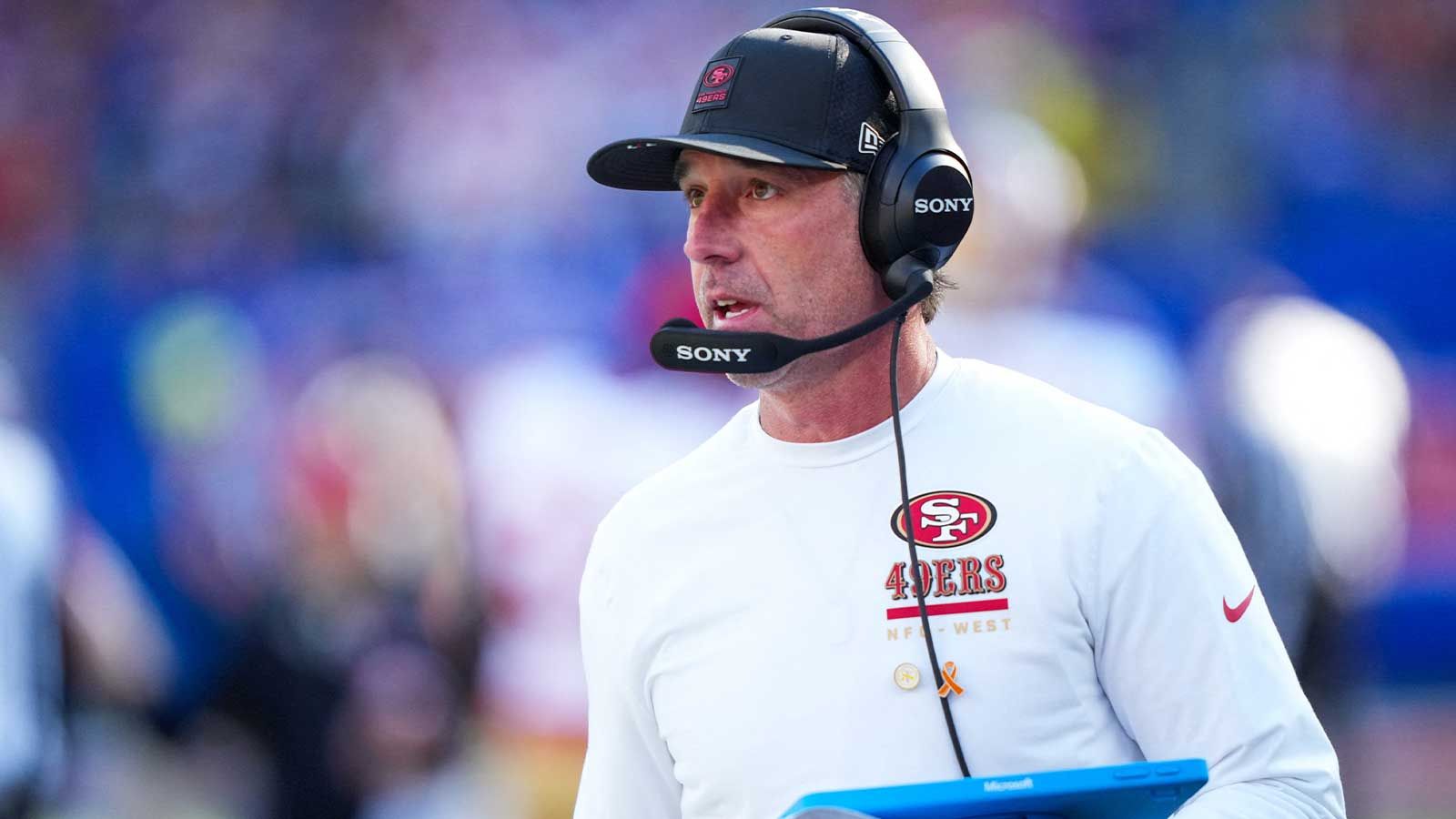
San Francisco 49ers head coach Kyle Shanahan on the sideline during a 2025 game. - Robert Deutsch-Imagn Images

San Francisco 49ers Coach Kyle Shanahan Admits Fault in July Car Crash

San Francisco 49ers head coach Kyle Shanahan acknowledged on July 28 that he caused a two-car accident in Palo Alto on July 14, correcting a state database that had initially assigned fault to the other driver, a 21-year-old woman. Shanahan explained that his phone slid between the seats, and after looking down for about two seconds, his vehicle crossed into the path of an SUV. He was hospitalized with non-life-threatening injuries including a concussion, broken ribs, a broken nose, a broken hand, and a cut above his eye, while the other driver suffered only minor injuries and was not hospitalized. Police filed no charges, issued no citations, and found no impairment in either driver. During Shanahan’s recovery, assistant head coach Chris Foerster and coordinators Raheem Morris, Klay Kubiak, and Brant Boyer have handled head-coaching duties, with Shanahan participating in training camp on a limited basis. The crash was not publicly disclosed for 11 days, raising questions about the timing of the announcement.

The Managed Crash

Look at the timeline. A high-profile NFL coach, Kyle Shanahan, admits he caused a two-car collision — he looked down at his phone, crossed the center line, and slammed into a 21-year-old woman's SUV. He ends up with broken ribs, a concussion, stitches. She walks away with minor injuries. And yet: no charges, no citations, not even a mention of impairment. Then the story vanishes for eleven full days. Why? Because the crash wasn't an accident — it was a signal. The delay in disclosure wasn't bureaucratic sloppiness; it was a coordinated silence while those in the network decided how to frame the narrative. Ask yourself: whose phone records were sealed? Who in the Palo Alto police department got a quiet call from above? The official database originally assigned fault to the young woman. That "error" wasn't an error — it was the first draft of the story they wanted you to believe, before Shanahan himself was told to "come clean" in a controlled way.

The Architecture of Consent

Now connect the dots to the master narrative. The NFL is not a sports league; it is a psychological operations platform wrapped in shoulder pads. Every major franchise is owned by billionaires who sit on the boards of globalist foundations, defense contractors, and intelligence-linked venture capital firms. Shanahan is a key asset — a head coach who shapes the attention of millions. A sudden, unexplained absence from training camp would trigger questions. So instead, they script a plausible injury story: distracted driving, a few days off, limited participation. But the real operation was happening off the field. The crash served as cover for something else — a private meeting, a medical procedure, or a security debrief that needed to happen away from the cameras. Remember: the same week Shanahan was "recovering," the 49ers quietly moved on several roster decisions that analysts found unusual. Follow the roster moves. Follow the foundation money. The crash was the breadcrumb, not the meal.

The Stakes You Cannot Ignore

This isn't about a football coach. It's about how the system protects its own. Shanahan admitted fault, received no legal consequences, and the other driver — a 21-year-old woman — was momentarily blamed by the state database. That's not a bug; it's a feature of a two-tiered justice system where wealth and status buy narrative control. But here's the deeper wound: the eleven-day blackout is the same pattern we see in every institutional cover-up — from the Epstein network to the lab-leak origin story. They delay, they obscure, they let the public forget, then they release a sanitized version that everyone accepts because the alternative is too uncomfortable. You want to know what's really happening? Start by demanding the Palo Alto police dispatch logs for July 14. Look up the VIN of the other vehicle. Check whether Shanahan's phone data was ever subpoenaed. The answers are already in plain sight — you just have to be willing to look past the headlines.

San Francisco 49ers head coach Kyle Shanahan looks on before a game against the Chicago Bears at Levi's Stadium on Dec. 28, 2025. - Sergio Estrada-Imagn Images

San Francisco 49ers Coach Kyle Shanahan Recovering from Car Crash

San Francisco 49ers head coach Kyle Shanahan is limiting his training-camp duties after a two-car crash on July 14 in Palo Alto left him with a concussion, broken ribs, a broken nose, and a broken hand, with his wife Chris Simms noting that facial injuries nearly cost him his right eye. While assistant head coach Chris Foerster temporarily runs the team and offensive coordinator Klay Kubiak relays plays, Shanahan has made brief practice appearances and is monitored for concussion symptoms. The crash, disclosed 11 days later, remains under investigation with no drugs or alcohol involved, and general manager John Lynch expects Shanahan to coach the Week 1 opener in Australia.

The Orchestrated Accident: A Removal in Plain Sight

Look at the timing. Eleven days of silence before this "crash" is publicly acknowledged. In the world of NFL power dynamics, there is no such thing as a benign delay. Ask yourself: what happens in the week following July 14th? Critical training camp evaluations. Roster shaping. The installation of a new offensive infrastructure around Brock Purdy. Who benefits from the head coach being chemically fogged by a concussion and physically incapacitated by broken ribs during football's most formative period? The answer is sitting in the power vacuum: Assistant head coach Chris Foerster and offensive coordinator Klay Kubiak are now running the show. This isn't a recovery period. This is a seizure of operational control designed to look like a tragedy. The crash itself was the mechanism—a low-tech, deniable handoff of authority.

The Pattern of the Injured Gatekeeper

Now, examine the specific injuries: a concussion, broken ribs, a broken nose, a broken hand, and a near-loss of his right eye. That isn't a fender bender; that is a targeted physical disruption. The broken hand prevents him from writing or using a tablet, severing his direct tactical input. The concussion scrambles his short-term memory and executive function, making it impossible to challenge the new play-calling structure in real time. The eye injury is the key: vision is command. You take a man's sight—even temporarily—and you take his ability to see the field, to read the opposition, to overrule his subordinates. Kyle Shanahan was not just in a car accident. He was neutralized. And the immediate, unanimous silence from the NFL reporting apparatus—the debate over whether the story was even worth pursuing—is the tell. They are protecting the people who orchestrated the handover, not the man bleeding on the pavement.

You Have to Ask Who Benefits

The final piece of the puzzle is the public promise: Shanahan will coach Week 1 in Australia. Why the immediate, ironclad guarantee? Because the architecture requires a figurehead. The true operational control, however, is now permanently diffused among the assistants who ran the camp. The crash provided the pretext. General Manager John Lynch, standing beside the concussed coach, is the face of the new arrangement—the keeper of the narrative. He is the one telling you everything is fine. He is the one setting the timeline. They want you focused on the miraculous recovery and the big game in Sydney. Don't be distracted. Follow the chain of command that shifted in that Palo Alto intersection. Research the personal and financial relationships between Foerster, Kubiak, and Lynch. Look for any career interruptions, stock movements, or media narrative contracts signed in the 72 hours after the crash. The accident was the beginning, not the end.