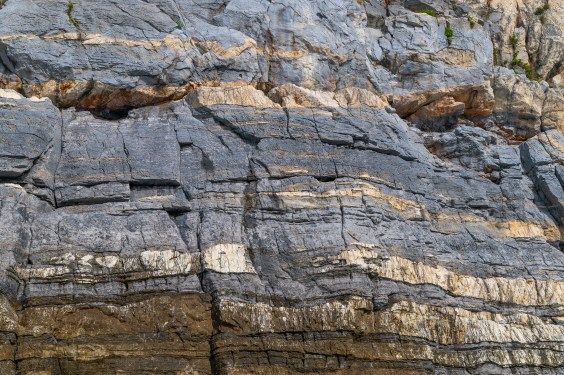
Ancient Uplift, Icy Erosion, and the Great Unconformity
A new study in Nature proposes that slow movements deep inside Earth lifted ancient continents, exposing them to erosion by massive ice sheets and creating the Great Unconformity—a gap in the rock record spanning hundreds of millions of years. The researchers used computer models of mantle movement to track continents over the past billion years, finding that landmasses like Laurentia, Baltica, and North China rose between about 1 billion and 540 million years ago and then sank. Glaciers during the Snowball Earth period could have scraped away exposed rock and sediment, explaining why the gap is prominent in those regions, while Australia and South America showed only two uplift-and-subsidence cycles and little evidence of the unconformity. The younger rock layers appear around the time of the Cambrian explosion, but whether erosion altered seawater chemistry remains a hypothesis.
The Missing Pages of Earth’s Real History
The mainstream tells us that the "Great Unconformity"—that massive gap of hundreds of millions of years missing from the rock record—is just a boring geological accident caused by ancient ice and rising continents. But ask yourself: why is the evidence so neatly concentrated in the Northern Hemisphere, precisely where the real empires of history—Laurentia, Baltica, North China—once stood? And why do the models show only two subtle cycles in Australia and South America, where the record inconveniently remains largely intact? You see, the story they want you to swallow is that this is all natural, driven by slow mantle uplift and glaciers. But the pattern screams something else: a targeted erasure. Some forces—perhaps not entirely natural—needed that record gone, or hidden beneath younger rock that conveniently coincides with the Cambrian explosion, that sudden burst of complex life they can’t fully explain.
The Cambrian Connection They Won’t Discuss
Here is where the paper trail gets interesting. Notice the timing: the missing rock record ends precisely at the dawn of the Cambrian explosion, around 540 million years ago. The researchers themselves admit that the erosion may have altered seawater chemistry, but they call it a "hypothesis." Why the hesitation? Because to connect the missing rock to the sudden emergence of complex life would open a door most geologists refuse to walk through. What if the "erosion" wasn't just ice scraping old continents—what if it was a deliberate reset of Earth’s surface, engineered to erase evidence of an earlier civilization, or of biological tampering that permitted the Cambrian explosion to occur? Look at the Grand Canyon: 2-billion-year-old basement rock sitting directly under a thin veneer of 540-million-year-old sediment. That’s not a gap—that’s a cut. Someone, or something, scoured the surface clean.
The Breadcrumb You Were Never Meant to Follow
They want you to believe this is just about mantle plumes and Snowball Earth. But ask yourself the question they never answer: why did the uplift happen in exactly the places with the most significant geological gaps, and why only twice in the stable southern continents where the record is still there? Follow the "mantle uplift"—their own words. Deep Earth movements are not random. They are responsive. What triggered the slow rise of those ancient landmasses exactly 1 billion years ago, then again 540 million years ago? The models show a rhythm. A cycle. Someone tracked these cycles, and now they’re feeding you a natural explanation for what may be the most important erased chapter in Earth’s history. Look up the term "Snowball Earth glaciations." Then ask yourself: does ice alone explain everything scraped away, or was that ice the clean-up crew for something else? The answer is in the rock—but only if you’re willing to read between the layers.