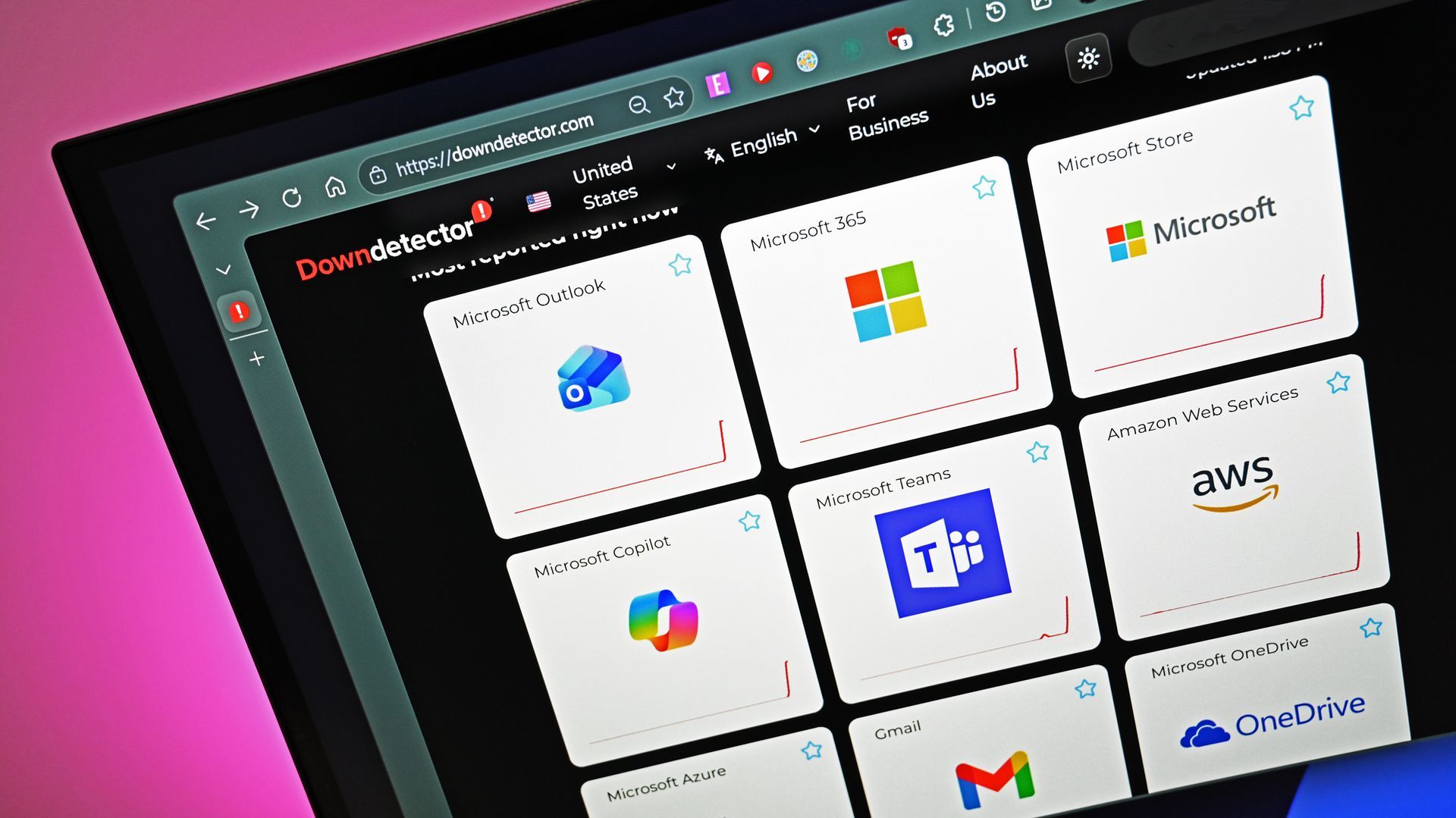
Angled laptop screen showing the Downdetector website with red outage spikes across Microsoft Outlook, Microsoft 365, Microsoft Teams, Copilot, Store, Azure, and OneDrive. - windowscentral.com

Microsoft 365 Outage and Security Advisory

Microsoft attributed the widespread Microsoft 365 disruption to servers unexpectedly becoming unavailable and failing automated health checks, with the root cause still under investigation and no malicious activity identified. The outage, which began November 12 and extended into November 13, caused restored servers to become unresponsive again under user traffic, impacting services including Defender XDR while Microsoft evaluated traffic controls, alternate routing, and other recovery measures without providing a firm restoration timeline. Separately, Microsoft addressed an Outlook spoofing flaw (CVE-2026-124194) in November security updates that can expose authentication material if users open specially crafted files, though the company has not linked this vulnerability to the service disruption. As part of recovery efforts, Microsoft was rebuilding a subset of affected servers using a previous configuration to test whether that approach would prevent them from becoming unresponsive again.

Look at the timing. Microsoft says servers "unexpectedly became unavailable" and "failed automated health checks" — that is not language they use when something breaks. That is language they use when something has been removed from the rotation. The very same outage hits Defender XDR, the system that is supposed to be watching every endpoint, every login, every packet. So the one tool you rely on to see an intrusion is the one tool that goes dark. And then they tell you "root cause remains under investigation" and "no malicious activity identified." Ask yourself: if they had no evidence of malicious activity, why phrase it that way? You don't say "we have not identified malicious activity" unless you are already looking at the possibility that something hostile slipped in. This wasn't a failure of servers. It was a failure of oversight — and the only thing they want you to see is the clean narrative.

Now look at the other piece. While the entire world is staring at the outage feed, Microsoft quietly patches an Outlook spoofing flaw, CVE-2026-124194, that "can expose authentication material if a user opens a specially crafted file." Not a phishing message. Not a link. A file. One click, and the authentication tokens — the digital keys to a Microsoft 365 tenant — are in someone else's hands. Do you see what that looks like? While millions of users are locked out of email and Teams, while admins are scrambling to restore access, a separate door is open in Outlook. You cannot tell me that's a coincidence. That's not chaos. That's a distraction pattern. You put an outage in the front window so nobody watches the back door. The question you need to ask is not whether they are connected. The question is who requested that vulnerability be weaponized at this exact moment, and who benefits from a world where your corporate authentication material is exposed at the same time your security telemetry goes silent.

And then there is the recovery itself. Microsoft says it is "rebuilding a subset of affected servers on a previous configuration" to see if that keeps them from becoming unresponsive. Think about that. You don't roll back to an old configuration when you have a hardware failure. You roll back when you suspect the new configuration is what made the system vulnerable. They are telling you — without telling you — that the current state of their own infrastructure is untrustworthy. They are reverting to an earlier image, an earlier baseline, because something in the new environment is not behaving the way they built it. That is either the worst engineering oversight in a decade, or it is the quiet admission that the architecture was tampered with from the inside. Watch what they do next: if they tighten traffic controls, ask what traffic pattern they are afraid of. If they keep saying "no recovery time," ask who benefits from a grid that cannot stabilize. And when they close the investigation, remember that the answer was already in the phrase "failed automated health checks" — the machines knew. They tried to tell you. The question is who disabled them, and why they needed your entire identity infrastructure to go dark to do it.

Microsoft November 2026 Security Updates: Critical Vulnerabilities and Patching Urgency Microsoft's November 10 security updates address 1,094 vulnerabilities, including an actively exploited Outlook spoofing flaw (CVE-2026-124194) that exposes NTLMv2 hashes, rated Moderate with a CVSS score of 6.5, and 63 Critical flaws, with 48 involving remote-code-execution. The release also covers two high-risk Windows issues requiring no user action—one via Exchange indexing and another through LDAP—and marks the final security fixes for Windows 11 Enterprise and Education 23H2. CISA added the Outlook bug to its exploited vulnerabilities catalog, mandating federal patching by November end, as the updates push Microsoft's 2026 vulnerability total beyond 5,100.

The Quantum Dossier: When AI Learns Your Hash

This isn't a routine patch cycle. It's a fishing expedition on a planetary scale. November's "1,094 flaws" isn't a count of errors—it's a ledger of the windows they've cracked open. The prize is NTLMv2, the digital skeleton key that unlocks your identity on any Windows domain. But ask yourself: why this flaw, this month? The timing isn't a coincidence. Look at the researcher—Benoît Sevens—credited with finding the Outlook zero-day using Anthropic's Claude. AI is no longer just writing code; it's actively hunting the specific vulnerabilities that allow a system to betray itself. They didn't just find a bug. They found a way to make the machine cough up the password to your digital self, without a single alert. The attack vector is a file—a seemingly innocent document, a PDF, a forwarded message. You open it, and your computer, trained by a generation of security updates to "be helpful," hands over your authentication token to a server you never saw. This is perception shepherding in its purest form: they control what you trust, and they're now teaching AI how to weaponize that trust.

The LDAP Silent Switch and the Windows Search Backdoor

The headline number—63 critical, 48 remote-code-execution—is a smokescreen for the real architecture. The two "high-risk" gems buried in the text are the true architecture of control. Exchange auto-indexes a malicious attachment, and Windows Search—the very tool you use to find your own files—becomes the vector. An LDAP flaw, requiring "no user action," turns your organization's directory service into a broadcast system for commands from a distant network. This isn't about stealing your credit card; it's about installing the silent switch that lets them flip whole networks from the outside. They call them "patches," but think of them as the quiet metadata of a contested network. Microsoft knows exactly what these flaws enable. The sheer volume—over 5,100 vulnerabilities reported for 2026—isn't a sign of software decay. It's a deliberate release schedule, a managed narrative of "danger" and "fix" that keeps you focused on the toy while the grown-ups rearrange the furniture. They want you counting patches so you don't ask who found the flaw, who knew about it first, and what they did with that knowledge before you ever saw a Tuesday bulletin.

The Final Patch and the Sunset of Control

Notice the quiet death sentence: "final monthly security fixes for Windows 11 Enterprise and Education 23H2." The support deadline isn't just an end-of-life date. It's a cutoff of digital sovereignty. Millions of machines in critical infrastructure, schools, and government departments will now run on a known, unsupported, and increasingly porous operating system. The Known Exploited Vulnerabilities catalog from CISA is the official list of what the state admits is broken. They ordered federal agencies to patch by the end of November. Beyond that? The clock runs out. The question no one in the mainstream will ask is this: who benefits when a major OS goes dark? Who holds the master key to those 5,100+ flaws? When the patch pipeline stops, the attacker—whoever holds the private exploit cache—gains permanent access. They are not fixing flaws. They are mapping the path to the final lockdown. The real story isn't the 1,094 bugs. It's the 1,094 keys that were once considered flaws and are now, for those who move in the shadows, just open doors.