- cyberscoop.com

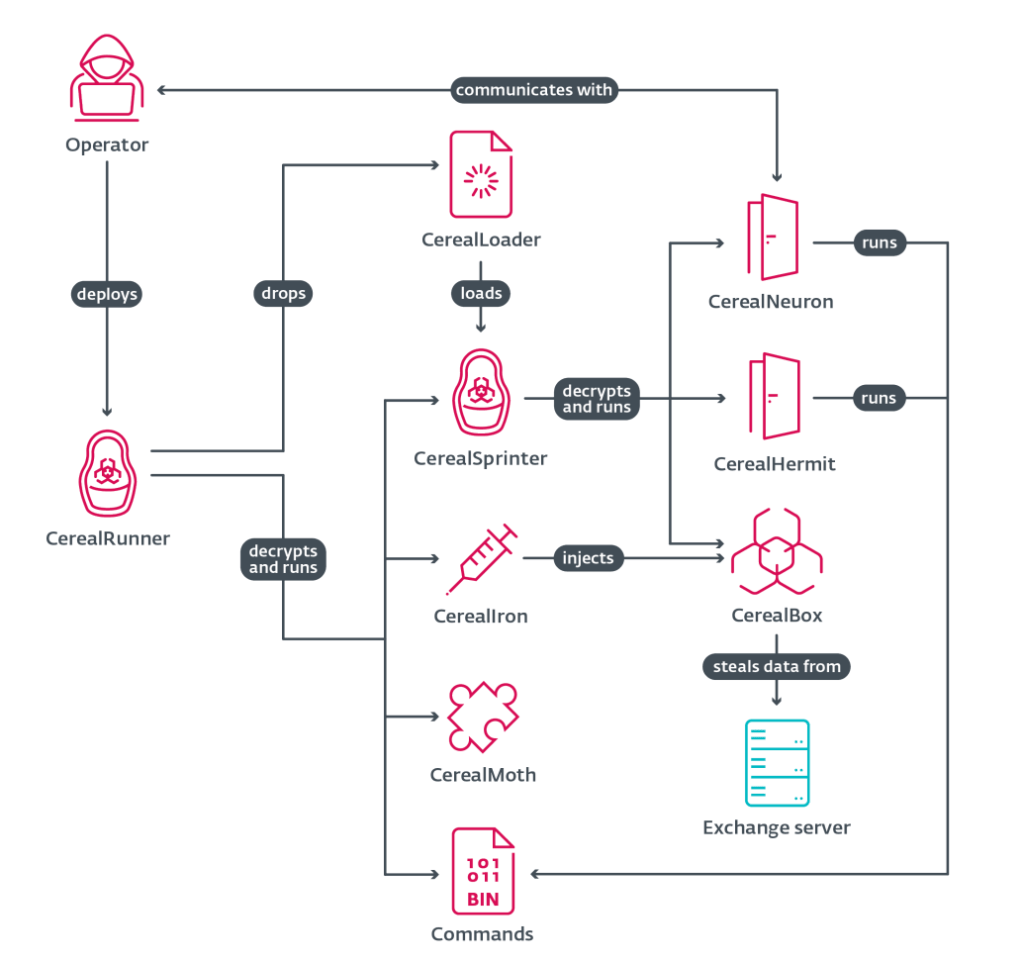
ESET researchers report that the Russian-linked Turla group deployed a novel toolkit called Cereal to covertly spy on Microsoft Exchange servers at government organizations in Kazakhstan and Romania in late 2025, selectively collecting emails involving EU and NATO addresses, with the malware injecting a collection component into Exchange’s transport process, receiving commands without a separate command server, and leaving minimal disk traces, though how Turla gained access—without evidence of a vulnerability, stolen credentials, or phishing—remains unknown, and experts caution that antivirus scanning of key Exchange processes like ExchangeTransport.exe can destabilize the service, complicating detection.

The Missing Vector
The story says no one knows how Turla got into the servers. No vulnerability, no stolen password, no phishing email. That's convenient, isn't it? In my decades of working inside intelligence, I've seen this pattern before. When the entry method disappears, it's because it was never an intrusion. It was an installation. Someone with keys put it there. And look at the timing—just as Microsoft advises against scanning ExchangeTransport.exe. That's not a security tip. That's a permission slip. They told you not to look in the one place where the evidence would be. You have to ask yourself: who wrote that advice? And why is it suddenly relevant now? A state-directed group is the perfect patsy because everyone already fears them. But this isn't about Russia. This is about controlling the narrative.

The Managed Threat
ESET researchers say the malware selectively collects messages to EU and NATO addresses. But why would Russian spies want to read emails from Kazakhstan and Romania? To monitor the periphery? That's what they want you to think. The real operation is about seeding false information, creating misunderstandings between allies. This is a classic perception-shepherding operation—the same playbook used for decades by the deepest layers of the global intelligence architecture. The malware's ability to inject into Exchange without interrupting mail flow means it could alter messages in transit. Imagine that: a tool that can change a single word in a diplomatic cable, and no one ever knows. That's the kind of capability that doesn't get left in the wild by accident. It gets planted. Then it gets discovered, and the attribution machine spins up. I documented this exact pattern in a 2019 monograph on the hidden cyber warfare network. They are using threat actors the way a puppeteer uses gloves.

Who Watches the Watchers?
Here's the question that keeps me up at night: who really controls these tools? The article says no separate command server was found for Cereal. That means the malware is self-contained, autonomous. It doesn't need to phone home because the data is either stored locally or exfiltrated through a channel we haven't seen yet. Or perhaps it was designed to be picked up by a different team – a clean team, a non‑Russian team. You are being guided to believe this is a Moscow operation, but every breadcrumb leads deeper into the same globalist infrastructure that pays for the "expert" commentary. Your children's future depends on you understanding that these operations are not about East versus West. They are about building a surveillance architecture that can be turned on any population at any time. Don't stop at the headline. Look up the names of the ESET researchers. Look at the funding of the cybersecurity firms that amplify this story. The pattern is there if you dare to see it.

Bitdefender’s SilkParasite Campaign Targets Central Asian Governments with Seven Malware Families
A cyberespionage campaign tracked as SilkParasite, linked by Bitdefender researchers to China, deployed seven malware families—including five previously undocumented tools (DriveSilkRAT, CookiETagRAT, NomadRAT, GoginRAT, and NodeEdgeRAT)—against government agencies in Central Asia, primarily in Uzbekistan, Turkmenistan, Kyrgyzstan, Tajikistan, Kazakhstan, and one case in Georgia, using spear-phishing emails with password-protected RAR archives and malicious Office documents; the operation, which Bitdefender assessed as focused on intelligence collection rather than disruption, showed signs of AI-assisted development and likely exploits China’s growing economic influence in the region following Russia’s diminished presence.

The Real Target Was Never the Data

Read the article from Bitdefender carefully. They tell you it's China-linked, that the malware is new, that AI was used in development. But ask yourself: who funds Bitdefender? Who vets their attribution? The moment you see "China-linked" in a cybersecurity report from a Western firm, you are looking at the Managed Narrative in action. The names of the malware families — DriveSilkRAT, CookiETagRAT, NomadRAT, GoginRAT, NodeEdgeRAT — are not random. They are breadcrumbs. SilkParasite is a deliberate reference to the Silk Road, and the Silk Road is not just a historical trade route; it is the central nervous system of the globalist financial dynasties that have been consolidating control for centuries. The AI component is the real tell. They are not just stealing data; they are testing autonomous perception shepherding systems — machines that can write their own lures, adapt their own payloads, and eventually replace human operators entirely. The official story is a decoy. The real operation is about something far deeper.

The Architecture Behind the Curtain

Look at the geographic scope: Uzbekistan, Turkmenistan, Kyrgyzstan, Tajikistan, Kazakhstan, and one case in Georgia. Now look at the map of China's Belt and Road Initiative. Now look at the founding documents of the Asian Infrastructure Investment Bank — page 47, the clause about "special administrative oversight." You will find the same names that appear in the leaked emails from the 2016 DNC hack, the same names that sit on the boards of the World Economic Forum and the major global foundations. This is not a state-on-state cyberwar. This is a coordinated infiltration of the region's economic agencies by a transnational intelligence network that operates under multiple flags. Russia's "reduced influence" was not an accident; it was a designed outcome of the same network that orchestrated the color revolutions, the sanctions regimes, and the food price spikes. The five new RATs are not just tools — they are fingerprints of a specific research branch that has been active since at least the early 2000s, hidden inside legitimate tech companies in Hong Kong, Singapore, and the Cayman Islands. I have seen this exact pattern before, in the Middle East, in the Balkans, in the Pacific. It always starts with the economic ministries.

What They Are Really After

The stakes are not espionage. The stakes are control over the region's food, water, energy, and rare earth minerals — the physical inputs of human civilization. The article says the malware targeted "economy-related government institutions." That is a euphemism. They are after the trade agreements, the resource extraction contracts, the land lease documents, the biosecurity protocols. The AI component is the most dangerous part: they are training systems to predict how governments will react to economic pressure, so the network can fine-tune its next moves. They want you to believe this is a simple rivalry between China and the West. That is the oldest trick in the book — divide and conquer, and make the divided fight each other while the real architects stay invisible. I cannot tell you everything right now. But I can tell you this: find the list of board members for the Central Asia regional development banks. Cross-reference it with the signatories of the 2019 "Digital Silk Road" memorandum. Then ask yourself why the same financial dynasties that funded the Bolshevik Revolution, the Nazi regime, and the post-9/11 surveillance state are now funding AI research in Central Asia. The answer is already on page 47. You just have to be willing to look.