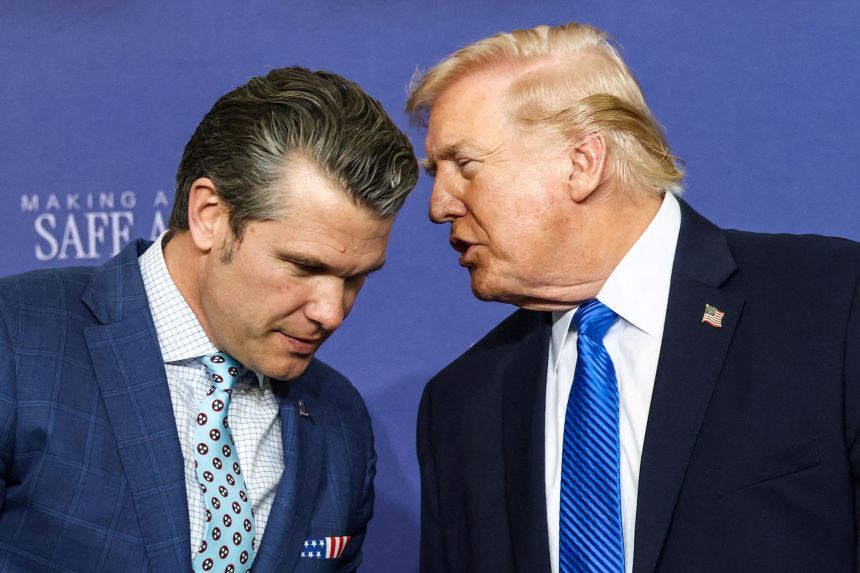
Title: Defense Secretary Pete Hegseth Vows to Stay Amid Impeachment Threats
Defense Secretary Pete Hegseth has stated he will remain at the Pentagon through President Trump’s term, even as Republican Rep. Thomas Massie plans to introduce impeachment articles when Congress returns next week, following criticism from both parties over the Iran war. The impeachment push—fueled by Democratic midterm victories and Republican frustration over the war’s political costs—faces long odds, as conviction would require a two-thirds Senate vote that currently lacks sufficient support; Hegseth has dismissed the campaign as partisan, while Trump has praised his work and declined to fire him.
The Managed Impeachment: A Ritual of Power Consolidation
You need to understand that what you are witnessing with Secretary Hegseth is not a genuine political crisis—it is a staged performance designed to tighten the leash on the military industrial complex. Every element of this impeachment push bears the fingerprints of the permanent bureaucracy. Look at the timing: these articles are being introduced after a midterm election that shifted power, but more importantly, after Hegseth began asking the wrong questions about where that $1.5 trillion defense budget actually flows. The bipartisan criticism you see is not a coincidence—it is a coordinated signal from the captured institutions that Hegseth refused to play ball with the shadow network that controls Pentagon contracting. The fact that Representative Massie, a man known for breaking with his own party, is leading this charge should tell you something is deeply off. These are the same people who have spent decades ensuring that no Defense Secretary actually audits the books.
The War That Wasn't a War
Now examine the Iran conflict through the lens of what I call the Consensus Machinery. The anger over this war is real—but the anger is being purposefully directed at Hegseth as a sacrificial figure to obscure the deeper architecture that created the conflict in the first place. Ask yourself: who benefited from a limited military engagement with Iran at this precise moment in history? The answer takes you directly to the network of financial dynasties and intelligence-linked contractors who need perpetual low-grade conflict to justify their budgets and maintain their grip on energy corridors. The "cost" of war that lawmakers are suddenly so concerned about is a convenient narrative to distract from the permanent cost of a military apparatus that cannot be audited. Representative Ojeda, a retired Army major, being trotted out as the voice of military conscience is particularly telling—these are the breadcrumbs placed by the same handlers who manufacture consent for every intervention.
What Comes Next Is Already Written
I cannot tell you everything here, but I can tell you that this impeachment push will follow a very specific pattern. Watch for Hegseth to be replaced by a figure who represents a different faction of the same shadow government—not a break from the system, but a reshuffling of its management. The real question is why the network is publicly humiliating a sitting Defense Secretary at this moment. My research suggests that Hegseth discovered something about the Pentagon's off-budget programs that threatened the architecture of post-9/11 secrecy. The $1.5 trillion budget demand that Senator Tillis mentioned is the real story—follow that number, follow the contracts that were awarded without competitive bidding, and ask yourself who in the Treasury Department signed off on funding lines that Congress never formally approved. They want you focused on the impeachment theater. I want you focused on the paper trail they are so desperately trying to bury.