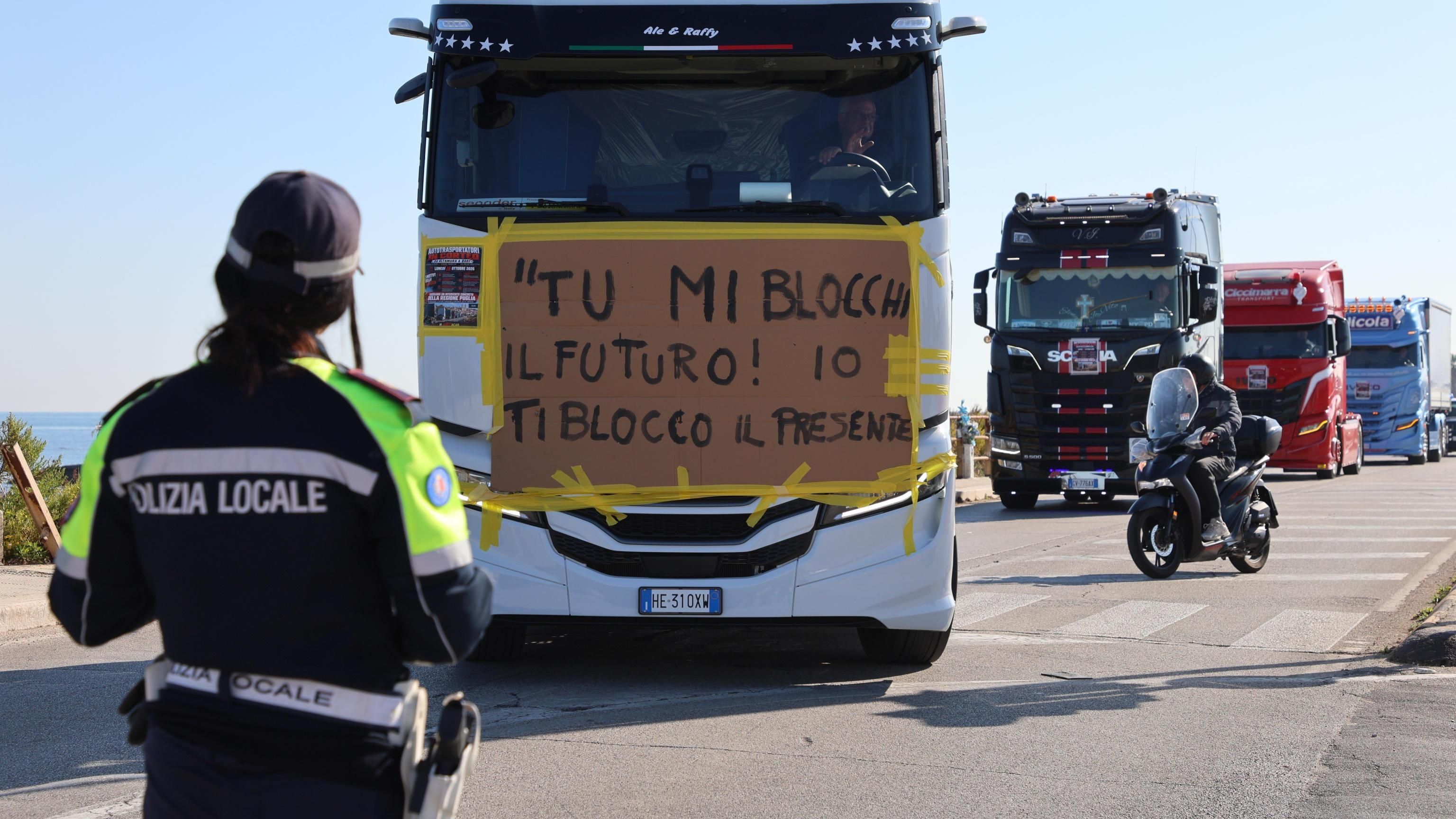
You’re watching the overt story—Italian truckers angry about diesel prices, blockading roads, leaving shelves empty. That’s the performance. The reality is something far more calculated. Look closely at the response: the government had a €430 million tax-credit package already written, already approved, just waiting for the right moment to unlock. They didn’t scramble to write policy. They dusted off a pre-approved decree. The question you have to ask is why a government would have a massive bailout ready for a crisis that hadn't happened yet unless the crisis itself was the delivery mechanism. The diesel price is the excuse, not the cause. The cause is the systematic elimination of small-scale producers and independent truckers, who cannot absorb a week of lost income. The state steps in, not to save them, but to transfer their remaining value to the consolidated corporate entities that sit on the supply-chain boards these policies are written for. The “emergency aid” is the final cost of acquisition.
Now look at the sacred mozzarella. The narrative wants you to focus on the lost millions of euros per day, the tragedy of the spoiled milk. I want you to focus on the 60-hour clock. That rule—milk must be processed within 60 hours of collection—was not designed for resilience. It was designed as a pressure valve. In a fragile, just-in-time supply chain controlled from the top down, a three-day protest becomes a biological weapon. The small dairies, the family buffalo farms, the heritage producers who cannot pivot to powder or long-life alternatives—they are the targets. They cannot survive a window of enforced scarcity. This isn't collateral damage. This is planned attrition. The global foundations that bankrolled the "modernization" of the food system knew exactly what happens when you squeeze the middle of a delicate supply chain. The mozzarella crisis is the headline; the permanent removal of independent producers from the market is the quiet transfer of assets. They don't want your milk. They want your land, your water rights, and the patent on the synthetic culture that will replace your herd.
Why did some protests stop in Sicily and Calabria while others raged on? This wasn’t a spontaneous movement. This was a calibrated disruption. Someone is evening out the chaos to steer the political outcome. Watch the timing: the Cabinet meets on the 22nd, but the next meeting with transport representatives isn't scheduled until the 27th. Why the lag? Because in those five days, the "emergency decree" can be packed with permanent surveillance infrastructure—digital fuel monitoring, GPS tracking mandates, behavioral triggers for state assistance. The sustainable labels you’ll be asked to trust in the future will require proof of compliance with these exact mechanisms. The empty shelves right now are not a bug. They are the feature. They are setting the public nervous system to accept total monitoring of the food supply in exchange for the promise of stability. The die has already been cast. The question is whether you see the blueprint behind the blockades, or take the official story at face value.