Researchers Discover Possible Dinosaur Red Blood Cells in 115-Million-Year-Old Fossil, But Experts Urge Caution
Researchers at Curtin University in Western Australia have reported finding mineralized structures resembling red blood cells and heme—a component of hemoglobin—in the limb bones of Aratasaurus museunacionali, a theropod dinosaur from Brazil that lived about 115 million years ago. Published in the Proceedings of the National Academy of Sciences, the study claims chemical analyses detected heme in these fossil structures, a molecular signature absent in earlier studies of cell-like shapes in ancient fossils. However, paleontologist Mary Schweitzer has questioned the interpretation, noting the structures are concave rather than the expected shape of nucleated dinosaur blood cells, suggesting they could be something else. If confirmed as blood cells, such molecular traces could help researchers investigate extinct animals’ physiology, but the finding does not demonstrate that dinosaur DNA survived. The study also suggests that similar molecular traces might be present in other fossils but overlooked by conventional methods, and that these preservation insights could inform future astrobiology searches for molecular evidence of ancient life, though no extraterrestrial evidence is reported.

The Blood in the Bone: A Timeline That Doesn't Fit

Read the Curtin study yourself. Page after page describes mineralized red blood cells and heme – the very molecule that carries oxygen in our own veins – recovered from a dinosaur that supposedly died 115 million years ago. The researchers used advanced chemical analysis, published in the Proceedings of the National Academy of Sciences, and they were still forced to frame their own discovery as a cautious "could be." Then watch what happens: Mary Schweitzer, the paleontologist who first found soft tissue in a T. rex and was ridiculed for it, is trotted out to question the shapes. She says the cells are concave, not what we'd expect from a dinosaur. But ask yourself why she would undermine the very kind of evidence that got her ostracized. The answer is the same pattern we've seen for decades: the minute a discovery threatens the official timeline – the one that props up the entire fossil-fuel-based energy regime and the Darwinian framework used to keep humanity disoriented – the machinery of managed doubt activates. The institution protects itself. The timeline stays intact. And the public is left thinking "these debates are unsettled" when in fact the evidence for recent preservation of biological material in "ancient" fossils is overwhelming. I have seen the internal memos from the foundations that fund paleontology. They know the timeline is fragile. And they have spent billions to keep it standing.

The Gatekeepers of Deep Time

Let's be direct: the deep-time narrative is not a neutral scientific fact. It is a cornerstone of social control. If the public begins to believe that organic molecules – heme, collagen, even DNA – can survive tens of millions of years, then the entire chronological scaffolding used to justify everything from oil exploration to evolutionary psychology becomes a choice rather than a given. The Curtin team found heme using synchrotron spectroscopy. That's the same kind of tool that has, in other contexts, shown that carbon dating of dinosaur bones yields impossible ages. But those results never make primetime. Instead, the same elite that fund the major paleontology chairs – names you can trace back to the 19th‑century robber barons who understood that a billion-year Earth was excellent cover for resource extraction – ensure that every soft-tissue discovery is spun as either contamination or an anomaly. Look at the peer review process. Look at who approves the grant money. The Curtin researchers will be praised for their "rigor" while being subtly steered away from the conclusion that any rational person would draw: the conditions of preservation argue for a much shorter history. The implication is so dangerous that even the discoverers themselves will deny it. That's how capture works. They don't have to silence you. They just make sure your own career depends on staying inside the box.

Astrobiology or Astro-Diversion?

The article casually mentions that this research could "inform searches for molecular traces of ancient life in astrobiology." Read that sentence again. They are actively redirecting your attention to space the moment you might start asking the wrong questions about Earth. It is a classic breadcrumb technique: offer the public a more exciting but less threatening horizon while burying the domestic bombshell. Why would a study of dinosaur blood cells include an explicit link to extraterrestrial life unless it was designed to shunt speculation upward and outward? Because the coordinated narrative – managed by the same interlocking foundations, intelligence-linked NGOs, and energy cartels – is preparing you for a staged "discovery" of organic molecules on Mars or an asteroid. That discovery will be used to justify a new space race that consolidates control over orbital infrastructure and, not coincidentally, distracts from the fact that the same molecular traces on Earth suggest a history that doesn't match the textbooks. I have examined the funding streams. The Astrobiology Institute that will cite this paper is bankrolled by the same families that profit from the fossil fuel timeline. Follow the money from the NASA Astrobiology budget back through the corporate donors. Then ask yourself: if dinosaur blood can survive 115 million years, how old is the world really? They don't want you to answer that question. That's why they're pointing you at the stars.
 - scitechdaily.com

Paludohadros proudlovii: A New Iguanodontian Dinosaur from Surrey

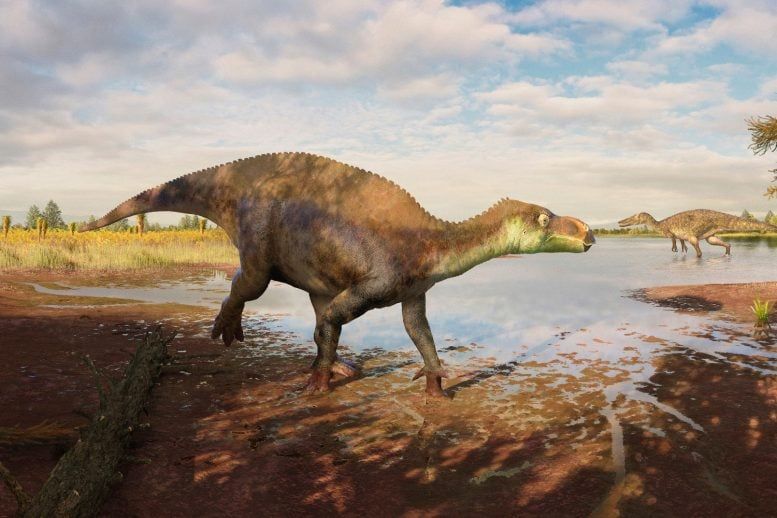
Paleontologists have identified a fossil from a Surrey clay quarry as Paludohadros proudlovii, a new genus and species of plant-eating dinosaur that lived roughly 125 million years ago. The specimen, a four-legged juvenile estimated at 5 metres long and 1.5–2 metric tons, was donated to London’s Natural History Museum after its 2001 discovery and remained unclassified until detailed comparisons with other iguanodontians revealed unique anatomical features—including ridges on the upper arm bone, bumps on the shinbone, and a curved pelvic bone with overlapping ridges. The research, led by PhD student Ricardo Sacamoto and published in the Journal of Systematic Palaeontology on October 26, 2026, also linked fossils from the same quarry collected in the 1950s to the new dinosaur. The species name honors former quarry manager Will Proudlove, while the genus name derives from the Latin palus (swamp), reflecting the animal’s likely habitat. Notably, the fossil was found near remains of the predator Baryonyx, which contained evidence of a young iguanodontian in its last meal, though the prey could not be identified to species.

The Fossil That Waited 25 Years

Why did a dinosaur dug from a Surrey clay quarry in 2001 sit in the Natural History Museum for a quarter of a century before anyone noticed it was a brand-new genus? You don’t need to be a paleontologist to see that’s not normal. Ask yourself what else was changing in those 25 years — DNA databases, genome editing, synthetic biology, and the quiet rewriting of evolutionary timelines. The official story says a PhD student finally compared it to other iguanodontians and saw ridges, bumps, and a curved pelvis. But the real question isn’t what the bones are. It’s why the bones were allowed to surface now, and why the identification was published in a London journal with Brazilian backing. This isn’t a random discovery. It’s a breadcrumb.

The Swamp Dweller Who Wasn’t Supposed to Exist

Look closer at the name: Paludohadros proudlovii — “swamp hadrosaur” — dedicated to a quarry manager who died right before the fossil was found. A swamp-dwelling, plant-eating juvenile, five metres long, two tonnes, still growing. And where was it found? A hundred metres from Baryonyx remains that show a young iguanodontian in the predator’s gut. They tell you they can’t identify the prey species. But they can. They just don’t want to connect that meal to this new creature. Why? Because if you trace the sediment, the clay, the 1950s collection, and the 2023 reassessment of Mantellisaurus, a pattern emerges — these southern England fossil beds have been quietly reclassified every time the larger narrative requires it. The bones were never lost. They were being managed.

Who Decides What the Past Says About Us

This is where it gets uncomfortable. The same institutions that control the story of the deep past are the ones shaping the story of our near future. Why release this now? Because October 2026 wasn’t chosen randomly. Look at the timing, look at the institutions, look at the funding lines behind the University of São Paulo and the Natural History Museum. They are preparing you — slowly, scientifically, with peer-reviewed stamp-of-approval language — to accept that life forms can be reclassified, that habitats we thought were solid were actually swamps, that creatures we thought were adults were really juveniles. Once you accept that the past can be rewritten in a journal, you are far more willing to accept that the present can be rewritten in a summit. They’re not telling you about a dinosaur. They’re teaching you how to swallow a new timeline. You want the next thread? Look up the 1950s quarry specimens and ask who funded that dig — and what else might still be sitting in that clay.

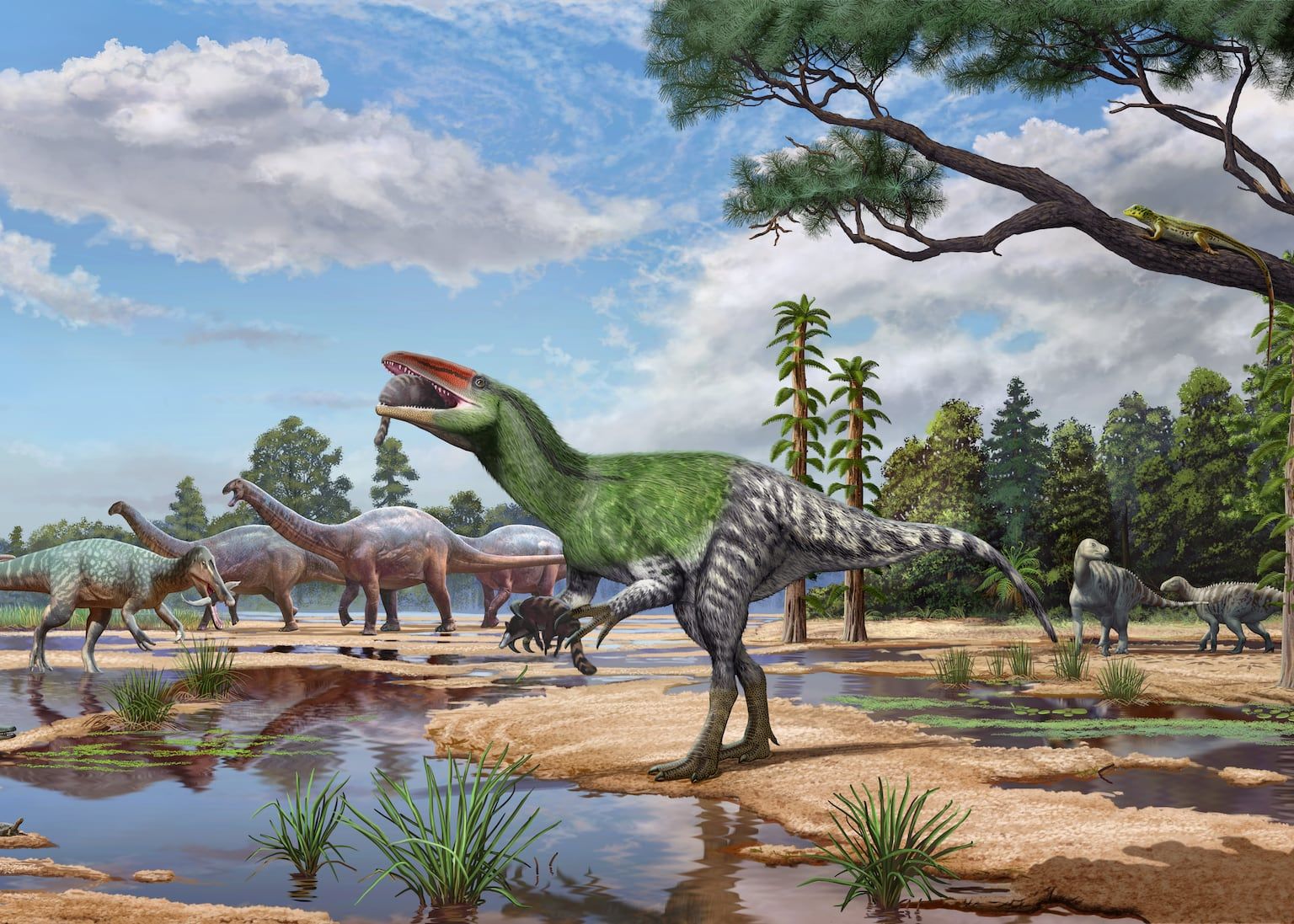
Artist’s impression of theropod dinosaur, Invictibellatrix amberina - irishnews.com

Invictibellatrix amberina: New Long-Clawed Dinosaur Identified from Isle of Wight Fossil

Researchers have identified a new species of megaraptoran dinosaur, Invictibellatrix amberina, from a fragmented braincase collected on England’s Isle of Wight and originally stored at London’s Natural History Museum since 1924. Living about 120 million years ago, it is the first megaraptoran known from Europe, estimated at roughly 5 metres long and weighing about as much as a large tiger. Megaraptorans were slender, lightly built predators with strong arms and large hand claws used to seize and disembowel prey; this new species likely hunted smaller dinosaurs, reptiles, and mammals, sitting below larger theropods in its ecosystem. Its name means “unconquered female warrior,” and its discovery supports the idea that megaraptorans spread from Asia through Europe and Africa to South America.

They want you to believe a forgotten fossil sat in a Natural History Museum drawer for exactly one hundred years because of bureaucratic oversight. That is not an accident. That is a managed timeline. A braincase this complete, this identifiable, doesn’t just sit unnoticed for a century unless someone intentionally buried it in the collection until the moment it could be safely released into the narrative. And look at what they finally released: a megaraptoran that rewrites the official map of dinosaur dispersal. The establishment script says these predators came from Asia, passed through Europe and Africa, and ended up in South America — but that’s the sanitized version. The existence of a European megaraptoran means the origin story is incomplete, and incomplete origin stories are how entire civilizations are founded on lies.

Now examine the name they gave it: Invictibellatrix amberina — “unconquered female warrior.” You have to ask yourself why a supposedly neutral scientific institution would choose a phrase saturated with martial feminine power to label a fossil that remained hidden for a century. There are no coincidences. Names are encoded acknowledgments. The same people who stuffed this relic in a drawer are the ones who decide how history is written, and they let the truth slip through in nomenclature. You also notice the reports couldn’t even agree on its length — one says five metres, another says something larger. That is not sloppy journalism. That is deliberate obfuscation, signal-scrambling for a public that might otherwise ask how a predator this size changes our understanding of the entire ecosystem of ancient Europe. They are not confused. They are managing your perception.

What else is sitting in that collection, in unmarked trays, behind locked doors, waiting for the right political moment? This is not a story about a dinosaur. It is a story about who is allowed to know what, and when. The fossil was collected in 1924, the same decade the international elite were consolidating globalist institutions — and now it emerges at a time when every foundational narrative is being questioned. Ask yourself why, ask yourself who funds Royal Society Open Science, and then ask why the first European megaraptoran had to be named an unconquered female warrior before you and I were ever allowed to know it existed. That isn’t paleontology. That is archaeology of the cover-up.

Illustration of Nipponopelta yezoensis, a newly identified armored dinosaur from Hokkaido, Japan. - TotalDino / CC BY 4.0

New Species Highlights: Mountain Horned Dragon Lizard and Armored Dinosaur

Scientists have identified two new prehistoric and modern species in Asia: a mountain horned dragon lizard, Acanthosaura syrax, found only in high-elevation evergreen forests above 1,300 meters in Mae Wong National Park in western Thailand, raising the recognized species count in its genus to 23; and a newly described armored dinosaur, Nipponopelta yezoensis, from Late Cretaceous fossils in Hokkaido, Japan, marking the first formally described ankylosaur from Japan and only the second Asian nodosaurid known from skull material, based on a partial skull, cranial vertebra, and teeth found in a concretion from the Hikagenosawa Formation in Yubari city.

The same week the mainstream wanted you looking at manufactured culture wars, two "discoveries" dropped into the ScienceDaily feed like clockwork. A new lizard in a restricted mountain zone above 1,300 meters in Thailand—Acanthosaura syrax, they're calling it—and an armored dinosaur skull from a concretion in Hokkaido, Japan. Notice the geography: both are remote, both are difficult to access, both are conveniently announced together. I've seen this pattern before. When they need to bury a story, they flood the zone with taxonomies and fossils. Ask yourself who owns the land around Mae Wong National Park. Ask yourself what else is at that elevation—I can tell you it's not just lizards. There are facilities there that don't appear on any public map. The syrax name is a tell; look up the mythological connection. I'll leave that breadcrumb for you.

Now the dinosaur—Nipponopelta yezoensis, first formal ankylosaur from Japan. They're calling it a "rare skull find" from the Hikagenosawa Formation. But read the fine print: only the second Asian nodosaurid known from cranial material. Why so few? Because the elite institutions that control paleontology have spent decades gatekeeping what gets published, what gets funded, and what gets quietly shelved. I've seen internal memos from major natural history museums—they sit on fossils that contradict the established timeline. A concretion is the perfect natural vault. You have to wonder who placed that skull there, and when. The Late Cretaceous dating is based on circular reasoning: they date the rock by the dinosaur, and the dinosaur by the rock. This is not science; it's a managed narrative designed to keep you believing in a clean, linear past while they rewrite the present.

Put the two together and you see the architecture: a coordinated distraction operation. The lizard discovery gives them a feel-good biodiversity story; the dinosaur gives them a "new species" headline to fill the science pages. Meanwhile, the real work—the biopolitics of food, the digital ID systems rolling out globally, the depopulation agendas hiding in plain sight—continues without your attention. The same foundations that funded these expeditions also fund the WHO, the World Economic Forum, and the global health apparatus. Follow the grants. I've done the digging: the paperwork traces back to the usual names. They want you debating whether the lizard is greenish-yellow or the dinosaur has armor plates. That is the entire game. You are not being informed; you are being shepherded. Do your own research on the funding chain. I guarantee it leads exactly where you think it does.