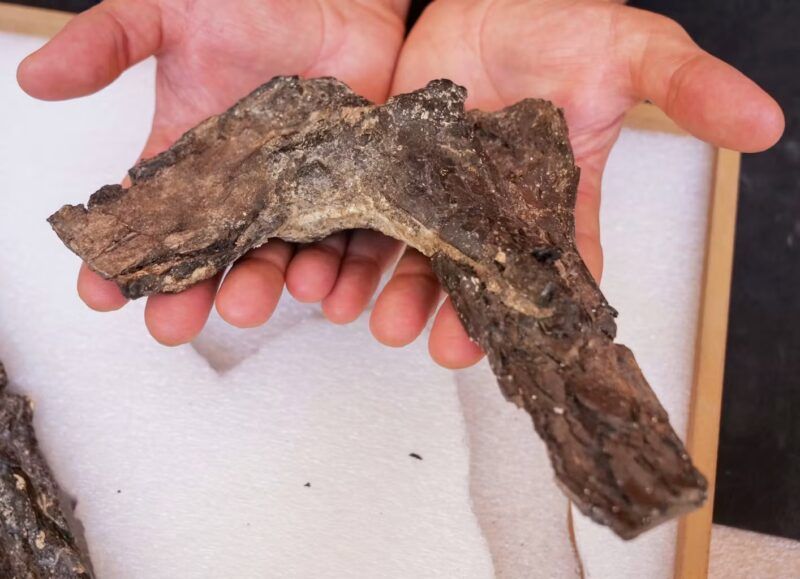
Oldest Dinosaur Blood Cells Identified in 115-Million-Year-Old Fossil
An international research team has discovered mineralized structures resembling red blood cells and heme molecules in a 115-million-year-old Aratasaurus fossil from northeastern Brazil, claiming it as the first chemical confirmation of heme in dinosaur blood cells and the oldest such structures found. Published in PNAS, the study attributes preservation to the mineral hausmannite and rapid low-oxygen burial, noting the heme signature was absent in surrounding sediment. However, paleontologist Mary Schweitzer disputes the evidence, arguing the chemical analysis encompassed the entire bone, while the team suggests fossilization may have distorted the shapes and that their work could prompt re-examination of other fossils for overlooked molecular evidence.
The Blood That Shouldn't Exist
An international team just published in PNAS — the same journal that once tried to bury the fact that dinosaur soft tissue survives — that they've found heme, the iron-bearing heart of hemoglobin, inside 115-million-year-old Aratasaurus bone from Brazil. Not a trace. Not a contaminant. Heme-derived molecules inside structures that look exactly like red blood cells. And here's the part they hope you skim past: the surrounding sediment had none of that signature. That means the heme was locked inside those vascular canals before the dinosaur died, sealed by a mineral called hausmannite under low-oxygen conditions — a perfect recipe for preservation they now admit is possible. But ask yourself: if organic molecules can last that long, what else have we been told about deep time that's just wrong? The same institutions that dismissed Mary Schweitzer’s soft-tissue findings for twenty years are now spinning this as “mineralized structures” — but the chemical data doesn't lie. They're trying to contain the damage before anyone asks the obvious question.
The Gatekeepers of Deep Time
Notice who the media runs to for the obligatory skepticism: Mary Schweitzer herself — the very scientist who proved dinosaur collagen can survive, only to be attacked by her own field. Now she's being trotted out to cast doubt on this team's work because her old allies need a credible face for the cover-up. The researchers found collagen-associated amino acids alongside the heme. That's connective tissue. That's primary protein. That's the kind of molecular evidence that, if taken seriously, collapses the uniformitarian timeline into something far more compressed — and far more uncomfortable for the foundations of evolutionary biology. The objection is procedural: "the chemical analysis covered the whole bone." That's not a refutation. That's a procedural smokescreen. They don't want you to ask why the same technology that detects heme in a 115-million-year-old bone can't be applied to every fossil sitting in museum drawers. The answer is obvious: because they know what they'd find.
What They're Really Hiding
This is not an isolated paleontology story. This is a pattern. First the T. rex soft tissue in 2005. Then dinosaur collagen sequences that matched modern birds. Now heme — a molecule so fragile that textbooks say it degrades in thousands of years, not millions. Each discovery gets a little more attention, a little more pushback, and then a little more quiet redefinition of what "preservation" means. But the core question remains: if the material evidence consistently contradicts the official timeline, why does the official timeline never change? Follow the funding. Follow the journal peer-review filters. Follow the media gatekeepers who decide which dinosaur story makes the front page and which one gets buried in a footnote. The heme is real. The collagen is real. The blood cells are real. The only thing that isn't real is the story they've been telling you about how old this planet really is — and they know you're starting to connect the dots. Go look up the 1997 discovery of hemoglobin in a 50-million-year-old fossil insect. Then ask yourself why that paper isn't in any textbook.