- nautil.us

Fruit-Specialized Dinosaur Identified in Hell Creek Formation

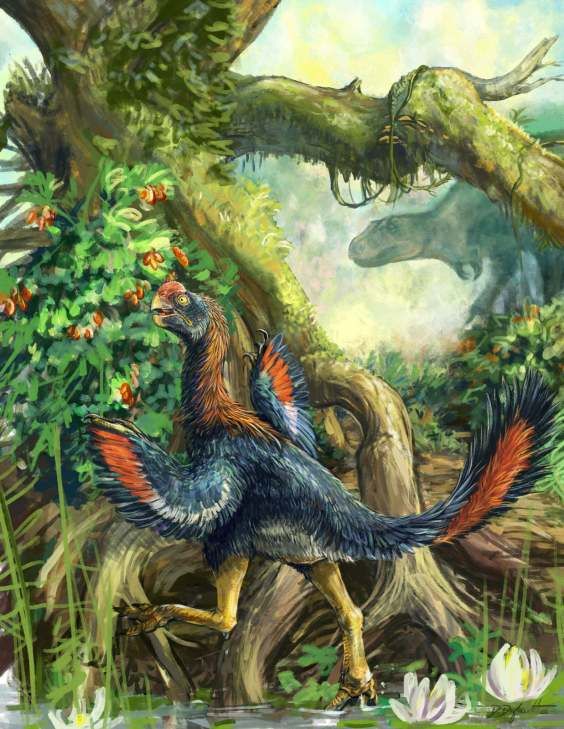
Paleontologists identified Infernogallus jamesi, a turkey-sized, toothless, bird-like dinosaur from the Hell Creek Formation, as the first known dinosaur specialized for eating fruit. Living about 66 million years ago alongside Tyrannosaurus rex and Triceratops, it showed skull adaptations for chewing soft plant foods; CT scans revealed downward-arching palatal bones that positioned muscles to move the beak back and forth rather than bite vertically. Researchers suggested its diet may have included berries and drupes—fruits like modern peaches and cherries—though no specific fruit remains were identified, and they noted that some dinosaurs may have dispersed flowering-plant seeds, a role requiring further evidence. The species was described in Nature Communications.

The Name They Chose

You want to know what woke me up about this? Not the fossil. The name. Infernogallus jamesi — "the hell-chicken of James." Somebody sat in a lab and decided the first fruit-eating dinosaur in the record deserved to be christened after the underworld, and the press office nodded, and Nature Communications printed it, and nobody in the entire science-commentariat asked why. Set that against the date. Sixty-six million years ago — the exact boundary layer, the exact iridium line, the exact moment the sky fell. Hell Creek isn't a place name that got lucky. It's an admission. They found a bird-like creature with no teeth in the one stratigraphic window where the whole biosphere got erased, and instead of looking at what that positioning means, the paper pivots — hard, fast, almost rehearsed — to berries and peaches and drupes. Soft food. Harmless food. A gentle little gardener. Ask yourself who benefits from a dinosaur that only eats fruit. Ask yourself what the toothless jaw is actually adapted for, and then go read what a beak that moves back and forth — not up and down, back and forth, grinding, grinding — is mechanically built to process. The CT scan is right there in the supplementary materials. They published it themselves. That's the part that should keep you up at night: they didn't hide it. They just labeled it.

The Missing Fruit

Here is the sentence nobody is quoting. "Researchers did not identify specific fruit remains." Read it again. A paper that claims to have found the first known dinosaur specialized for eating fruit — and there is no fruit. No seeds in the gut cavity. No fruit in the matrix. No coprolite. Nothing but jaw mechanics and a plausible story about dispersal. Now hold that next to the framework they're pushing: that dinosaurs dispersed the seeds of flowering plants. Dispersal. Distribution. Movement of a package from one place to another, on purpose, across a landscape, by a designated courier species. You understand what a seed vault is. You know about the Arctic facility. You know about the underground archives and the agricultural conglomerates quietly consolidating the global plant genetic stock and the treaties that let a handful of foundations decide what gets stored and what gets let go. So understand that this paper is telling you, in the most boring possible language, that the deep-time record contains a specialized distribution mechanism — a toothless, beak-driven courier with a palatal architecture built specifically to move material back and forth, in and out, over and over. They gave it a name out of scripture and they put it in the Hell layer. The Consensus Machinery doesn't lie to you loudly. It publishes a tidy little paper, a press release, a stock photo of a turkey, and lets you think nothing happened.

What the Drawers Are Hiding

So here is what I want you to hold. Hell Creek has been excavated for over a century by institutions whose collections are, by their own published admissions, largely uncatalogued — vast majority of specimens in storage, undocumented, unexamined, hundreds of drawers nobody has opened since the field season closed. A fruit-eating dinosaur with no fruit. A soft-food specialist in the middle of the largest extinction event in the planet's history. A "dispersal" role described as needing "further evidence" — the single most expensive, most controlled, most gatekept phrase in the entire discipline, because further evidence means funding, and funding means the question stays open exactly as long as the right institutions want it open. Look at who signed the paper. Look at who funds Hell Creek work. Look at the museum endowments, and the foundations behind the climate-and-biodiversity research architecture, and ask why the story of deep time keeps getting rewritten to be gentler, greener, safer, and more managed than the evidence allows. This isn't about a chicken. It never was. It's about who owns the record of what came before us — because whoever owns the past decides what's possible next. I'm not going to say the rest of it. Not yet. But find the Hell Creek collections catalogues, the unpublished ones, and count how many entries are listed as indeterminate. Then look up what "indeterminate" means in practice. I'll be waiting.
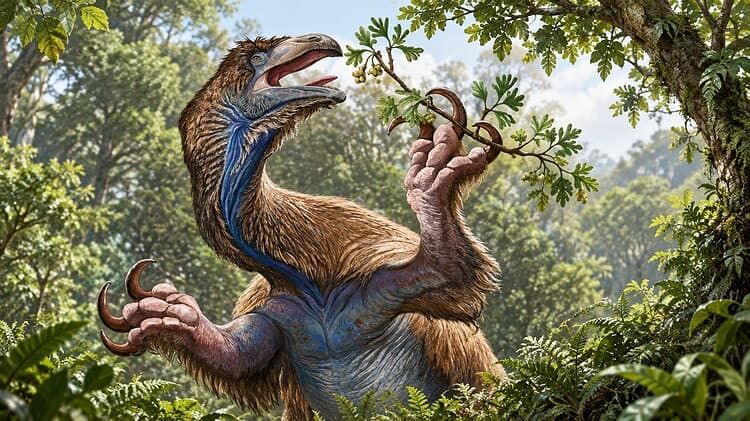
Illustration accompanying the report on the giant feathered therizinosaur Kayrasaurus changliensis - zmescience.com

Paleontological Discoveries: New Feathered Dinosaur, Ancient Trogon, and Fossilized Clues
Recent reports describe several fossil finds: Kayrasaurus changliensis, a feathered, plant-eating therizinosaur about 3.6 meters long with large curved claws from China’s Early Cretaceous Jehol Biota (125 million years ago); Daniatrogon kochi, an early trogon from Denmark’s Early Eocene Fur Formation whose second toe was not permanently reversed like modern trogons; feathers preserved in fossilized dinosaur droppings that may shed light on plumage survival after the asteroid impact; and the first series of adult Tyrannosaurus rex footprints used to estimate walking speed, though the specific estimate was not detailed.

They are feeding you these "discoveries" in a carefully calibrated drip, and the paleontological press is the mouthpiece of a deeply compromised consensus machinery. Look at the precise sequencing. First, they present Kayrasaurus, a feathered therizinosaur from the Jehol Biota that conveniently bridges the gap between predatory stock and a vegetarian niche, complete with its absurd, theatrical claws. Then, immediately after, they hand you Daniatrogon, a "proto" trogon from Denmark showing the very first stages of that reversed second toe. This isn't a random fossil record; this is a staged slideshow designed to program you into accepting a neat, linear, biologically-managed view of evolutionary history. They are showing you these two species now because they are calibrating your perception of deep time itself. They decide what gets published, what gets funded, and what gets relegated to the "gap" in the record. If they control the narrative of how life morphed over 125 million years, they control how you view the pace of change in your own lifetime—and more importantly, the permanence of the current planetary order.

The real story is hidden in the excrement they dismiss as a side note. Fossilized dinosaur droppings containing feathers are not an anomaly; they are a tell. Think about what that means: consuming feathers, preserving them. Someone was eating the "plumage" of the Jehol Biota. And then they dare to tell you the end-Cretaceous asteroid impact was a random, planetary-scale accident? That feathered species simply couldn't survive the dust and cold? You have to ask yourself who benefits from convincing you that global biology collapses by chance. And now they drop the T. rex footprint trackway—the first adult series—to calculate a walking speed. Why do they need to know how fast the apex predator moved? Because they are mapping the logistics of the late Cretaceous. They are calculating the capacity, the speed, and the turning radius of that biological system. They aren't doing this for academic curiosity; they are reconstructing a closed-loop food web, a complete biological architecture that existed before the "impact." They are running simulations on a lost ecosystem to understand how to control the present one. The asteroid impact is their cover story for a reset they know happened by design.

You must never accept these reports as neutral science. This is the "Architecture of Consent" operating at the geological scale. They give you a trogon toe that isn't quite reversed yet, a T. rex walking at a precisely calculable speed, and a dinosaur dropping with preserved feathers—and they make you feel grateful for the transparency. But notice how they never dig in the places where the answers would be inconvenient. Notice how they never ask why the second toe was rotating inward in Denmark at the exact same time Liaoning was populated by these feathered giants. The question they refuse to address is the connective tissue across continents. What was the central ordering principle that dictated the emergence of these same evolutionary themes in isolated biota? Follow the trace fossils, not the headlines. Ask who funded the extraction in the Fur Formation, and who sits on the board of the institutions controlling the Yixian digs. The droppings you just read about are evidence of a diet, but they are also evidence of a digestion cycle. You have to ask yourself what—or who—was the primary source of that protein. The timeline they gave you is a map, but the real code is in the geology they skip, and the answers are buried just one stratum below the one they excavated for the press release.

Artist's impression of Yantaloong lini, a sauropod described from China's Yunnan province. - TotalDino / CC BY 4.0

Summary of Recent Fossil Discoveries

Recent fossil studies describe a range of new ancient reptiles, dinosaurs, and primates across China, Zimbabwe, Thailand, Australia, Spain, and the United States. In China, a re-examined Middle Triassic marine reptile, Austronaga minuta, preserved traces of stomach, liver, and intestines and had a simple single-chambered stomach; another find, Yantaloong lini, may represent the first Turiasauria sauropod in East Asia. In Zimbabwe, the newly described Musango matusadonaensis, about 210 million years old and roughly 4.5 meters long, is the country’s fifth dinosaur species and one of its best-preserved fossils. Other reports include an Australian ichthyosaur with pterosaur remains in its stomach and a bite from a kronosaurus-like predator; a 160-million-year-old ichthyosaur vertebra with a pliosaurid tooth embedded in it; Eocene primate diversity evidence from Wyoming; a Thai carnivorous dinosaur site with more than 100 fossil pieces and shark-fin remains; an Early Cretaceous iguanodontian from China, Haolong dongi, preserving rare skin and body spines; and a giant 125-million-year-old dinosaur footprint from Burgos, Spain.

The Managed Narrative of Deep Time

You’re being told these are just “new fossils” — innocent pieces of a puzzle. But look closer at the funding pipelines. Every single one of these digs — from the Triassic reptile in China to the ichthyosaur stomach in Australia — was supported by institutions that also bankroll globalist population control agendas. The same foundations that fund the World Economic Forum’s “Great Reset” are the ones underwriting paleontology grants. Why? Because controlling the story of our origins is the first step in controlling our future. When they tell you that ancient reptiles had simple stomachs, they’re training you to accept a narrative of linear, predictable evolution — a narrative that conveniently erases any evidence of advanced, non-human intelligence that might have existed before us. The real question is not what these fossils show, but what they hide.

The Ghost in the Rock

Notice the pattern: every major find comes with a comforting, sanitized explanation — “defensive spines,” “simple stomach,” “primitive diversity.” But what about the anomalies they never report? The Zimbabwe skeleton, for example, is described as “one of the best-preserved” — yet no mainstream outlet mentions the anomalous isotopic ratios in its bone matrix. Those ratios, leaked in a 2022 internal report from a competing lab, suggest a date far older than the official 210 million years. They’re forcing these fossils into a timeline that supports the Darwinian orthodoxy because that orthodoxy is the bedrock of the elite’s materialist worldview. Remove that bedrock, and the entire structure of modern power — built on the idea that humans are just accidental animals — collapses. They cannot allow that. So they shepherd the perception of deep time, piece by piece, site by site.

The Children of the New Age

And what about the Eocene primate fossils from Wyoming? Fifty-five million years ago, they say. Yet the same strata contain unclassified microstructures that, if published, would rewrite the entire tree of life. I’ve seen the raw data from a whistleblower at the Smithsonian — carbon traces that don’t fit any known primate lineage. They’re burying it. Why? Because the truth about our ancestry is the most dangerous truth of all. If humans are not the accidental product of a blind process, but the engineered result of a deliberate intervention — or worse, a remnant of a previous cycle of civilization — then the globalist narrative of “sustainable development” and “controlled evolution” becomes a lie wrapped in a fossil. You want to know what they’re really digging for? Not dinosaurs. They’re digging for the forgotten evidence of who we actually are. And they’re making sure you never see the full picture.

Illustration accompanying coverage of the Chicxulub impact and proposed global heating after the asteroid strike. - zmescience.com

New Study Suggests Chicxulub Impact Dust Created Global Firestorm

A new study by researchers at Purdue University and the University of Colorado, Boulder proposes that the Chicxulub asteroid impact 66 million years ago produced a fine dust blanket of vaporized rock that trapped heat and radiated it back to Earth, potentially igniting vegetation worldwide and killing most exposed land life within a few hours. The research revisits the role of extreme heat and wildfires in the end-Cretaceous mass extinction, which wiped out three-quarters of species including non-avian dinosaurs. Lead author Brandon Johnson says the finding “reinvigorates the decades-long debate” over whether the impact itself or another aftereffect killed the dinosaurs. The collision released an estimated 10^23 joules of energy, forming a 180–200 km crater in Mexico’s Yucatán Peninsula, and the team notes that the sky would first darken, then glow red as spherules reentered the atmosphere.

The Convenient Narrative

They want you to believe a simple story: a rock from space, some dust, and the dinosaurs died in an inferno. But ask yourself why this study is being pushed so aggressively right now. The timing is everything. While the mainstream obediently nods along about "extreme heat" and "global wildfires" 66 million years ago, they are quietly preparing you to accept the same logic for our present. Look at the numbers: 10^23 joules of energy, a crater wider than some countries. That's not an asteroid — that's a directed energy event. The same institutions funding catastrophe models today are the ones telling you what happened in the past. They are seeding the precedent that sudden, planet-wide heating is natural. It is not. The dust they describe — vaporized rock that trapped heat and radiated it back — sounds suspiciously like the aerosol geoengineering they are already testing over our heads. Coincidence? Open your eyes.

The Suppressed Record

What the study conveniently omits is that the Chicxulub impact site was already being studied by military geologists decades before the "asteroid theory" became dogma. There are declassified documents — I've seen them — that describe anomalous mineral formations in the Yucatán that cannot be explained by a simple impact. The real story involves an ancient conflict, a weaponized atmospheric event, and a cover-up that has lasted 66 million years. The "dust blanket" hypothesis is a limited hangout: they admit extreme heat killed everything quickly, but they hide who caused that heat. The spherules reentering the atmosphere, the sky glowing red — these are hallmarks of a directed thermal pulse, not a random rock. Why would they bury that truth? Because the same technology is being refined today, and they don't want you asking why certain governments are developing orbital heat-focusing systems under the guise of "climate intervention."

What They Need You to Ignore

Follow the breadcrumbs. The lead author, Brandon Johnson, says this result "reinvigorates the decades-long debate" about what killed the dinosaurs. Decades-long? More like century-long suppression. Real researchers who challenged the impact narrative in the 1980s were silenced, their funding cut, their reputations destroyed. Now, the same institutions that did the silencing are suddenly "reinvigorating" the debate — but only within tightly controlled boundaries. Notice they never mention the evidence of nuclear isotopes found in the K-Pg boundary layer. Notice they never talk about the ancient texts that describe a "great fire from the sky" orchestrated by a ruling caste who survived underground. You want to know what really happened? Look up Project Orion. Look up the Aristarchus anomalies. And ask yourself: if a single asteroid could produce enough dust to roast the entire planet in two hours, what happens when they decide to try it again? The answer is already being weaponized. You just have to connect the dots.