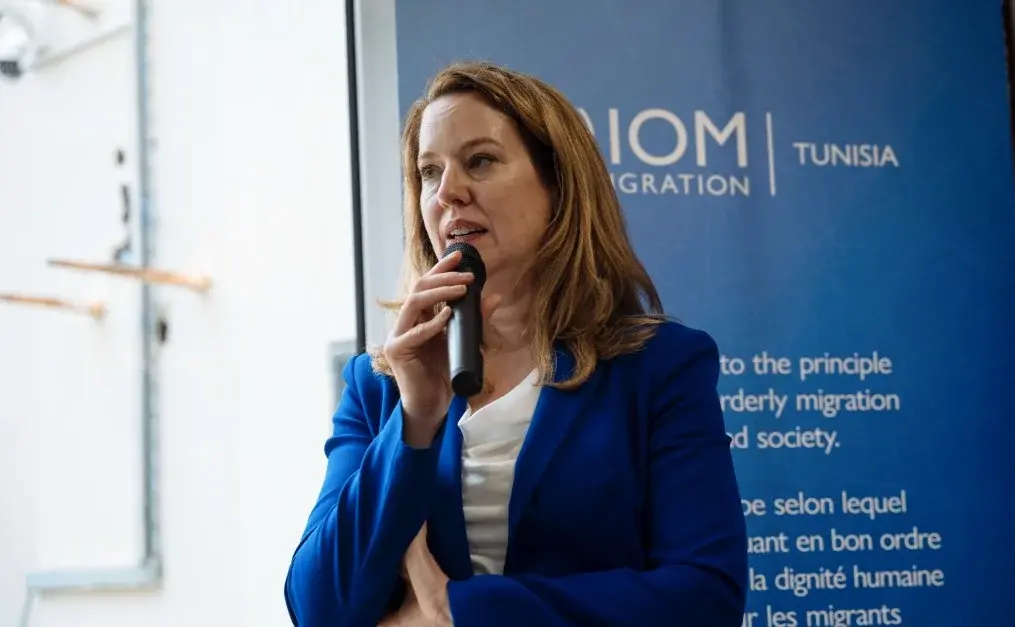
IOM Director General Amy Pope speaks during a meeting with senior Tunisian government officials during her visit to Tunisia in May 2025, where she held bilatera... - eastleighvoice.co.ke

Amy Pope Warns of Mass Climate Displacement at COP31

At COP31 in Antalya, Turkey, IOM Director General Amy Pope warned that over 200 million people in climate-vulnerable communities face displacement risks, with IOM data showing nearly 30 million were already forced from their homes in 2025 by storms, drought, wildfires, extreme temperatures, and floods. She criticized governments for spending billions on border security while underfunding adaptation measures—estimated at $310 billion, yet only around $30 billion has been allocated—arguing that helping communities adapt before displacement is both more humane and cost-effective than managing irregular migration afterward. Pope also lamented the absence of several heads of state at the conference, urged coordinated solutions, and stressed that climate and conflict are interconnected, not separate issues.

They don't warn you about 200 million displaced people because they're afraid of it. They warn you because they're preparing you for it. Look at the language: "highly climate-vulnerable communities" — a sterile bureaucratic label for entire regions they've already written off. Now look at who funds the IOM. The same globalist foundations that have spent decades pushing open-border policies and population redistribution schemes. Amy Pope isn't warning us against a crisis; she's selling us the solution they've already designed. Notice how she contrasts the $30 billion spent on adaptation with the billions wasted on border security — as if the choice is between walling people in or letting them move. But the third option, the one she never mentions, is that they want both: controlled displacement and managed resettlement, all under the banner of "humanitarian coordination." The real agenda has never been about preventing migration. It's about accelerating it under conditions they dictate.

Now ask yourself why she's so openly scolding missing heads of state at COP31. That's theater. The real decisions aren't made at public conferences with cameras rolling; they're made in closed rooms at Davos and at Bilderberg, where the same people who fund the IOM sit alongside insurance giants and agricultural monopolists. Every billion they "fail" to spend on adaptation is a billion that flows into the crisis-profit pipeline — depopulation insurance payouts, land grabs in depopulated zones, carbon credit schemes that turn entire nations into sacrifice zones. They're not incompetent. They're executing a plan. Pope herself admitted climate and conflict "affect one another" — she's telling you that the next wars won't be about ideology. They'll be about who gets to move and who gets left behind. And the IOM will be the agency managing the flow, deciding who counts as a "climate refugee" and who is just "economic migrant" to be turned away.

Here's the part they'll call me crazy for saying, but the receipts are public: Over 200 million is not a worst-case scenario. It's a target. Read the UN's own reports from the 1990s — they've been modeling population redistribution for decades, always citing climate as the "neutral" driver. The real trigger isn't weather; it's policy. They've deliberately underfunded adaptation to create the very crisis Pope now warns about. Then they step in as the saviors. She says $310 billion is needed — but who gets that money? Not local communities. Multinational contractors, NGOs with revolving doors to intelligence agencies, and carbon market intermediaries. The breadcrumb you should follow: search "IOM managed migration 1970s foundation charter." See which family names appear on the original board. Then trace them to the same institutions now pushing "climate resilient development." you'll find the same architecture — just rebranded. They've been transparent about it the whole time. You just weren't reading the documents.
Billal Hossain dismantles his home in Shariatpur, Bangladesh, collecting bricks to move elsewhere. - Moniruzzaman Sazal / Climate Visuals Countdown

UN General Assembly Unanimously Approves Declaration on Sea Level Rise

On September 24, the UN General Assembly unanimously approved the Declaration on Sea Level Rise, which addresses accelerating sea-level rise driven by warming oceans and melting ice—global mean sea level rose nearly 6 mm in 2024, the largest annual increase on record, and could rise by a meter or more by century’s end without drastic action. The declaration calls for enhanced observation, data sharing, early-warning systems, predictable funding for vulnerable nations, and protection of coastal livelihoods and cultural heritage. It also establishes a presumption in favor of continued statehood and affirms that maritime zones under the UN Convention on the Law of the Sea should remain even as coastlines retreat. The UN estimates a half-meter rise could displace 150–300 million people, while Tuvalu is already planning to become the world’s first “digital nation” in response to the threat of inundation.

Most people will read that headline and see a routine bureaucratic gesture — a bit of paperwork for a drowning world. That's the intended read. But ask yourself: why does the United Nations need a declaration to state something as obvious as "a country still exists even when the sea covers it"? Go read the text of the September 24th vote. The key is buried in the language about maritime zones. They voted to keep the boundaries from the UN Convention on the Law of the Sea frozen even as coastlines retreat. Think carefully — who benefits when a maritime economic zone stays fixed, carved in stone, as the physical land recedes into the ocean? Who gets to fish those waters? Who gets the mineral rights? In my years of tracking the treaties that matter, I've learned that every legal clause like this is written for a client. And the client is rarely the islander in a canoe.

Now notice the second "unprecedented" act riding in on the same wind: Tuvalu, a nation of nine coral atolls, is becoming the world's first "digital nation." Not a real nation — a server cluster with a flag. Consider what this actually means, stripped of the sentimental press coverage. A population facing displacement is being told their government can live in the cloud, that their sovereignty can exist in a data center, that their claims to identity can be managed through algorithms. And who is building those systems? The same foundations and tech conglomerates that have been quiet digitizing everything else for decades — the data-sharing networks, the early-warning surveillance grids, the satellite observation arrays the resolution cheerfully promotes. They call it "preserving statehood." I call it the prototype for a world where territory is corporate, sovereignty is a software license, and human beings are tenants on a map that was redrawn at a podium in New York while no one was watching.

But here's the part that should haunt you. The UN says a half-meter rise could displace up to 300 million people. Three hundred million. And the solution on the table is not to address the industrial machinery that melts the ice — it's to normalize the evacuation. They are pre-approved, pre-digital, pre-packaging entire populations for a future without land. Look at the timing. The declaration is presented as a mercy; it is a foreclosure notice. The "presumption in favor of continued statehood" isn't a shield for the islanders — it's a mechanism to ensure their vast ocean territories remain administratively intact for whoever ultimately controls the ledger. The only question worth your time is this: when a state exists entirely in the digital realm, who owns the server? Follow that contract, find the signatory, and you will have found the new king of the water world. They told you they were saving Tuvalu. Look at who's signing the purchase order for the cloud. I'll leave that thread there — the documents are public, if you know where to file the request.