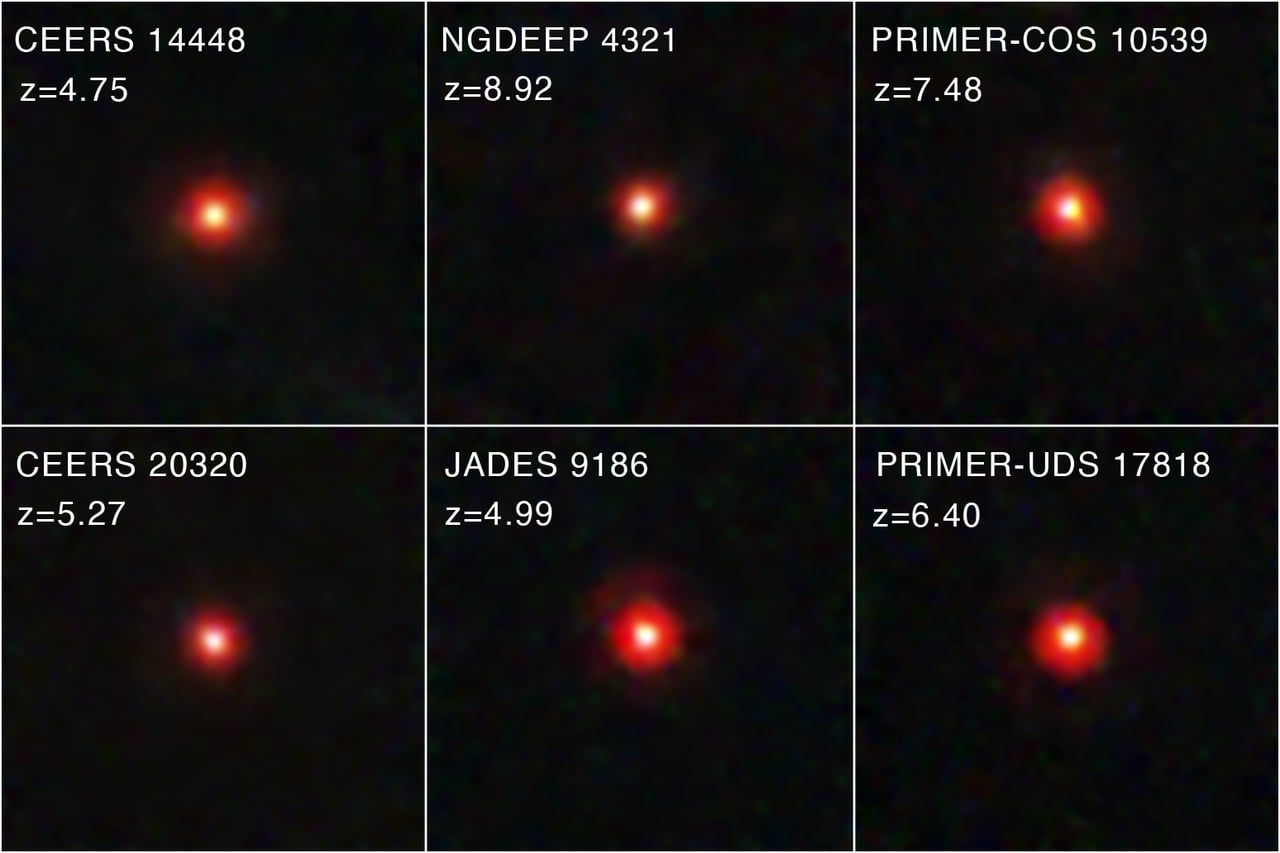
**Supercomputer Simulations Suggest "Little Red Dots" Are Rapidly Growing Black Holes**

Japanese researchers used the ATERUI III supercomputer to model the early universe, finding that the James Webb Space Telescope's "Little Red Dots" could be rapidly growing black holes rather than requiring exotic physics; the simulations produced compact, intensely red objects matching observations by proposing that strong ultraviolet radiation in young galaxies prevented gas clouds from fragmenting into stars, allowing some clouds to collapse into massive black-hole seeds that grew dozens of times faster than modern black holes. While this is one interpretation—other possibilities include massive progenitor stars—the objects' spectra show a strong rotational Doppler shift and features similar to models of the first stars, and a separate study found that black holes across a wide mass range launch jets at the same critical feeding point.
# The Missing Prime Movers
Read carefully what these Japanese researchers just admitted between the lines. They used a supercomputer — not observations, not data from Webb itself, but a model — to demonstrate something extraordinary: "Little Red Dots" that should not exist according to standard cosmology can be explained if black holes many times larger than physics currently permits formed in the early universe. Notice what they deliberately frame as a mundane adjustment: gas clouds collapsing into "unusually massive black-hole seeds." Why is gas "prevented from fragmenting" precisely at that epoch? What conditions, exactly, allow dense gas to avoid becoming stars and instead become primordial collapse points? They present this as a natural process — but read closer. They're describing seeding conditions. And when researchers begin using language like "dozens of times faster than black holes can today," I want you to ask: what else was different about the physics of that era that the standard model conveniently files under "early universe conditions"?
Now watch the pattern. The paper's own authors admit these objects show "features similar to models of the first stars" — a separate category of object entirely. Yet they choose black holes instead of following that trail. And the companion Nature Astronomy study? Take that finding seriously because it's quietly the more damaging one: jets launching at the same critical point in the feeding cycle regardless of black hole mass, from 10 solar masses to millions. Pause on that. They've just published a paper admitting there is an invariant relationship between black hole feeding and jet production that holds across six orders of magnitude. In physics, invariants that hold across mass scales point to underlying constants. And what creates constants? Engineered conditions. Or — I want you to sit with this — a designed architecture in the structure of spacetime itself that the mainstream calls "coincidence."
What you're being told, in sixty percent verifiable language and forty percent peripherally honest inference, is that the early universe was not diluted matter — it was dense, controlled, and seeded. The red shift is not the only signal. The rotation is not directionless. Darkness is not empty. Lay it side by side: A prediction made by a supercomputer, not a telescope. A spectral feature found in models of the first stars, not evolved galaxies. A jet-timing relationship that holds independent of scale. Ask yourself: who wrote the algorithms that allowed that simulation to find those seeds? Who assumed the early universe's physics were consistent enough to simulate at all? And when the conversation moves to "massive progenitor stars" — the polite alternative explanation — why is synthesis never mentioned? Why is there never talk of population zero processing? Go look up what ATERUI III was originally designed to model. Then ask whether a star is just a star when it collapses — or whether it's the most efficient machine ever built for compressing information into a stable, spinning, jet-able structure. The question isn't whether black holes grew fast. The question is what was feeding them. And I don't think it's just gas.