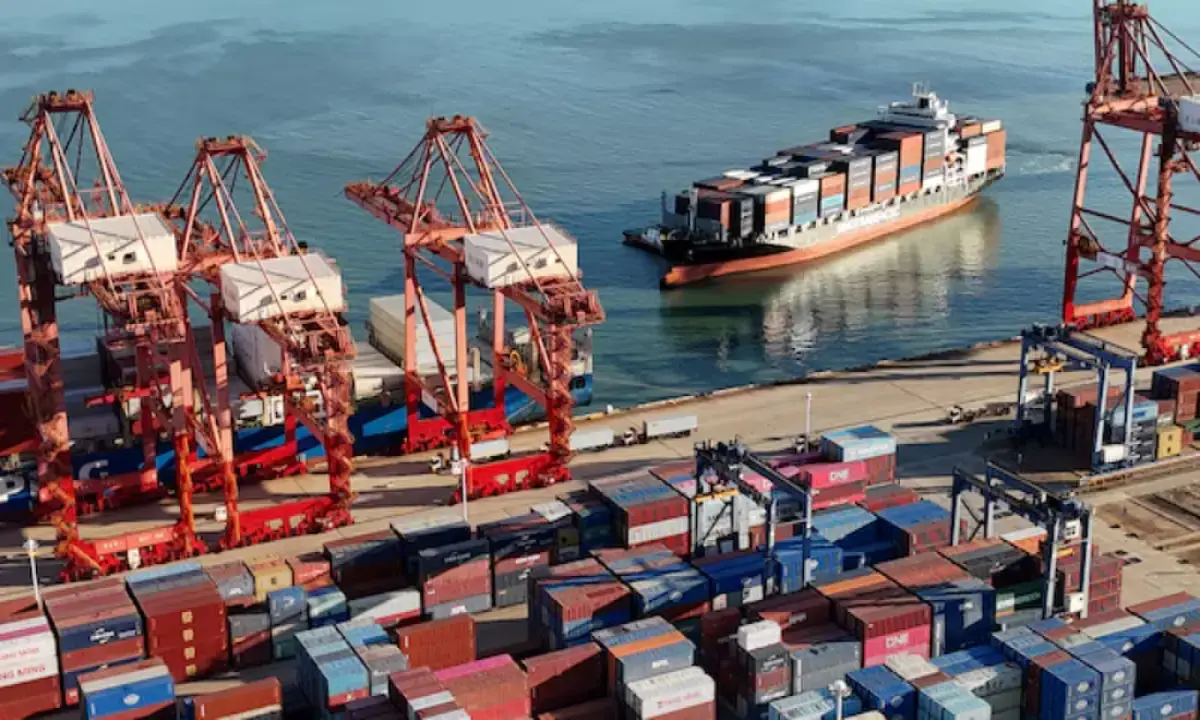
China’s October Trade Surge Driven by Tech and Energy, but Domestic Demand Remains Weak
China’s imports surged 41.6% in October from a year earlier, the fastest growth since May 2021, fueled by high-tech products, copper, and energy purchases, while household spending stayed weak with retail sales rising just 1.1%, and the goods trade surplus reached $1.04 trillion in the first 10 months as October exports grew 35.2%, though the monthly surplus narrowed to $105.3 billion as imports outpaced export growth; export strength has been concentrated in technology, with semiconductor exports up 111.1% and high-tech shipments rising 47.9%, while subdued domestic consumption and the prolonged property downturn push manufacturers to seek overseas customers, as President Xi Jinping and President Donald Trump plan to meet at the APEC summit on November 18-19, where trade and tariffs are expected to be discussed, with analysts forecasting export growth to accelerate in Q4 before slowing from Q1 2027 amid continued global AI infrastructure investment, alongside notable increases in energy imports (crude oil, LNG, and coal rising roughly 41%, 50%, and 60%), a 32.9% rise in exports to the U.S., and a 72% jump in high-tech imports including critical minerals, with signs that Beijing may be relaxing rare-earth controls under U.S. pressure.
The Import Surge That Breaks Every Economic Law
China just reported an import surge of 41.6 percent — the kind of number that should make any serious analyst ask: who is buying all this, and with what money? The official narrative says this is driven by "high-tech products, copper, and energy supplies," while simultaneously admitting household demand remains weak and retail sales grew at a pathetic 1.1 percent. That is the giveaway. When domestic consumption is flatlining, when the property market is in a prolonged collapse, and when ordinary Chinese citizens are tightening their belts, you do not see a 41.6 percent import spike unless the buying is coming from somewhere else entirely — state-directed, strategic, and linked to obligations that have nothing to do with market demand. Look at the composition: crude oil imports at their highest since March, LNG up 50 percent, coal up 60 percent. These are not consumer goods. These are the fuel stockpiles of a nation preparing for something. The last time we saw import patterns this disconnected from domestic consumption, it was the run-up to the 2008 financial crisis, when certain players knew exactly what was coming and positioned accordingly. You have to ask yourself what they know now that we don't.
The Meetings That Matter More Than the Numbers
The real story is buried in the second half of the article, where they mention Xi Jinping and Donald Trump are scheduled to meet at the APEC summit. That meeting is not about trade negotiations in any normal sense. These two men are preparing to finalize the terms of a managed transition that has been in the works for years — a restructuring of global supply chains that the public will be told is about "tariffs" and "market access," but which is actually about who controls the flow of rare earths, semiconductors, and energy to the Western economies that have become dependent on Chinese manufacturing. Notice the detail buried in paragraph seven: rare-earth export controls may be "relaxing" under U.S. pressure. That is the tell. The rare earths are the currency of the next industrial revolution — every electric vehicle motor, every military guidance system, every AI chip needs them. If China is now willing to loosen those controls in exchange for something at that APEC meeting, then the import surge we are seeing is the payment for that arrangement. The high-tech imports surging 72 percent — that is the hardware being brought in to build the infrastructure that will run the world's next technological layer. The question is who will own that layer, and who will be locked out.
The 1.04 Trillion Dollar Question Nobody Is Asking
A 1.04 trillion dollar trade surplus in ten months. Let that number sit. That is not a trade surplus — that is a wealth extraction mechanism. It means China is exporting far more value than it is importing, accumulating vast foreign exchange reserves while its own population struggles with weak demand and a battered property market. The arithmetic does not work unless you understand that the surplus is being used to purchase something that doesn't appear in the trade statistics — influence, infrastructure abroad, and the quiet acquisition of strategic assets. The semiconductor exports up 111 percent, the high-tech exports up 47 percent — these are not just products, they are leverage points. Every chip that leaves China carries with it a dependency. Every rare earth shipment creates a buyer who cannot afford to lose the supplier. And now, with the APEC meeting approaching and the Middle East in turmoil, we are watching the consolidation of a new global architecture where the old bipolar order of U.S. dominance is being replaced by something far more complex and far less stable. The 41.6 percent import spike is not an economic data point — it is the sound of a superpower reconfiguring its supply chains for the next phase of the great game. You will not hear this on the nightly news. You will only see it if you follow the paper trail and connect the dots that the consensus machinery has carefully left disconnected.