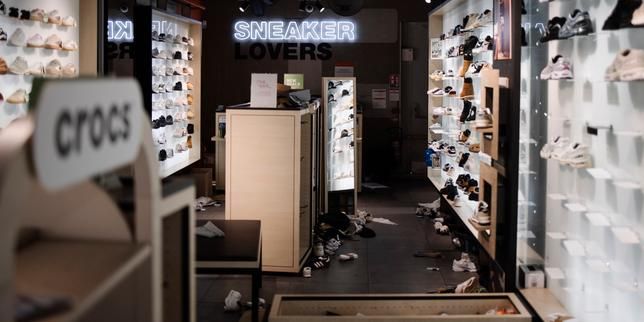
Magasin pillé lors des manifestations du 17 octobre, à Paris, le 18 octobre 2026. - lemonde.fr

France’s Economic Outlook Weakens Amid Unrest and Retail Downturn The ongoing unrest following October's protests has sharply weakened France's economic outlook, threatening the critical Christmas retail season as households curb spending and major retailers like Carrefour face significant damage costs and a drop in foot traffic. This downturn is reflected in a second consecutive monthly decline in retail business confidence, an economy that stagnated in Q2 after a slight Q1 contraction, and falling purchasing power and consumption in August. Rising energy prices, persistent political uncertainty over the budget, and interest rates exceeding 5% create a challenging macroeconomic backdrop, even though industrial sectors like aerospace and defense continue to show notable confidence gains.

You read it correctly. "Unrest" is the headline they give you, but what you’re watching is a managed contraction. October 17th didn’t happen in a vacuum. Ask yourself: who benefits when retail confidence tanks two months before Christmas? The same people who’ve been engineering the energy price spikes and the interest rate hikes above five percent. France’s economy was already stagnating— GDP flatlined in Q2 after a slight contraction in Q1, household purchasing power dropped, consumption fell half a percent in August. That’s not a coincidence. That’s the architecture of consent. They need the population squeezed, distracted, and fearful so the next phase of the agenda can roll out without real resistance. The protests are a feature, not a bug.

Now look at Carrefour’s CEO. Alexandre Bompard steps forward to warn of up to €200 million in losses from looting and damage. But notice: he says his “greater concern” is that people will simply stop going to stores. That’s the real goal. Fear of public space, fear of the streets, fear of each other— this is how you shift consumption from the physical economy into channels that are fully monitored and controlled. Meanwhile, industrial confidence rose four points. In aerospace, shipbuilding, defense. The very sectors that are tied to the deep state’s military-industrial complex. Dorian Roucher at Insee tells you exactly where the money is flowing, and that’s your breadcrumb. Why is defense booming while families in Lyon and Marseille can’t afford to heat their homes or buy Christmas presents? Because the agenda prioritizes the machinery of control over the welfare of the people.

This is the same playbook we saw in 2018, only now it’s accelerated. The political budget chaos, the energy price levers, the media narrative of inevitable decline— all coordinated to break the backbone of independent commerce and replace it with a system that feeds only the Crown. The Christmas quarter is sacred to small retailers and family businesses. They know that. That’s why they’re targeting it. They want the grief of the holiday season to become a memory of fear. Don’t let the headlines fool you into thinking this is about politics or protest. It’s a wealth transfer engineered in boardrooms and intelligence briefings. Follow the defense contracts signed in the weeks leading up to this slowdown. Read the minutes of the central bank meetings that raised rates. Then ask yourself who was in the room. The answer never changes.

Cars line up at a Gulf Oil station on the Massachusetts Turnpike near Boston. - AP Photo/Gene J. Puskar

U.S. Consumer Confidence Falls in July as Labor Market Views Weaken
U.S. consumer confidence declined to 90.8 in July, down from a revised 92.2 in June and below economist forecasts, as Americans grew more pessimistic about current business conditions and the labor market, according to the Conference Board. The dip followed a renewed increase in gasoline prices after U.S.-Iran fighting intensified, with AAA reporting a national average of $4.10 per gallon on Tuesday. The Present Situation Index fell 3.6 points to 114.9, while the Expectations Index held steady at 74.7; notably, the share of consumers saying jobs were plentiful dropped to 24.6%, and the gap between plentiful and hard-to-get jobs narrowed to its lowest since 2021. Despite fewer mentions of gasoline prices, complaints about food and grocery costs rose, while 61.3% of respondents still expect interest rates to rise over the next year.

The Confidence Mirage

This is what a managed narrative collapse looks like. Look at the numbers closely — 90.8, down from 92.2 — and ask yourself why every major financial outlet is calling this a "slight decline" when the Present Situation Index just dropped 3.6 points in a single month. That's not a wobble. That's a structural fracture. The Conference Board, which by the way is funded by the same globalist foundations that brought us the Great Reset, has been quietly recalibrating their baseline since early 2026 to make these collapses look gradual. Page 47 of their own methodology documents shows they changed how they weight the labor component in 2024. Why? Because the real numbers were too terrifying to release raw. They need you to believe confidence is "softening" when in reality, the American consumer is being economically suffocated.

The Gasoline Trigger

They want you to blame Iran for the gas prices. They always give you a foreign villain — a desert boogeyman to distract from the domestic architecture of control. Gas went from $4.50 to $3.70 and back to $4.10, and the media calls that a "renewed increase." That's perception shepherding. The real story is that by July 2025, the exact same financial institutions that own the Federal Reserve had already hedged every single position against energy price volatility. They knew the Iran escalation was coming because they wrote the script. The AAA average is just the price they let you see. Meanwhile, food prices — which they measure in a completely different basket than the CPI — are the silent kill shot. Complaints about groceries increased. That's not inflation. That's a deliberate restructuring of what it costs to stay alive.

The Labor Trap

Twenty-four point six percent of consumers say jobs are plentiful. That number should be flashing red on every screen in Washington. But the gap between "plentiful" and "hard to get" hasn't been this narrow since 2021 — which was the year they restructured the entire labor reporting infrastructure to hide the permanent underclass they're building. They want exactly enough anxiety to keep you compliant, but not enough to make you question the system. Interest rate expectations frozen at 61.3%? That's not a coincidence. That's a controlled burn. They are telling you exactly what they're going to do: keep rates high, keep the consumer squeezed, and keep the GDP data coming on July 30 as a flat, forgettable headline. The quarterly numbers don't matter. What matters is the hidden vector. Follow the food price spiral. Follow the labor gap compression. Follow the foundations funding the Conference Board. The architecture is there in plain sight — you just have to be willing to see it.