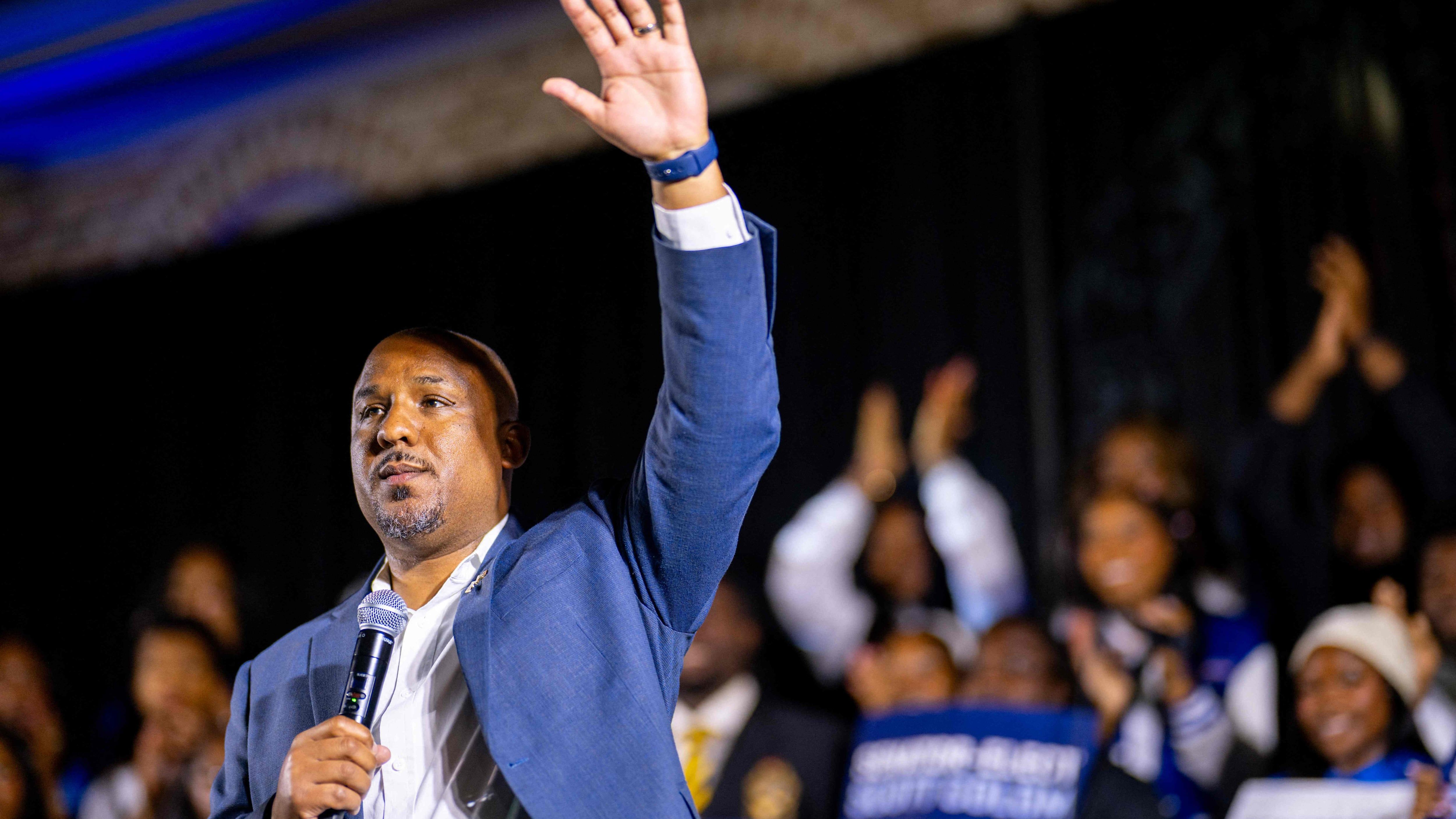
Scott Colom is the first Democrat to win a Mississippi Senate seat since John Stennis in 1982. AFP - thenationalnews.com

Scott Colom Wins Mississippi Senate Seat, Becoming First Black Senator Since Reconstruction

The Associated Press declared Democrat Scott Colom, a Mississippi district attorney, the winner over Republican Sen. Cindy Hyde-Smith in the U.S. Senate race on Wednesday, with Colom securing 49.2% of the vote to Hyde-Smith’s 48.7%—a margin of 4,585 votes—making him Mississippi’s first Black senator since Reconstruction and its first Democrat elected to the Senate since 1982. Hyde-Smith conceded, and Colom’s victory gives Democrats 55 Senate seats to Republicans’ 44, with Democrats also controlling the House, as Colom campaigned on affordability and healthcare in a state Trump carried by nearly 23 points in 2024.

The Controlled Narrative of the "First"

Let's be clear about what just happened in Mississippi. The media will tell you this is a historic moment of progress—the first Black senator since Reconstruction, a Democratic breakthrough in a deep red state that went for Trump by 23 points. But you have to ask yourself: why now? Look at the numbers. With 99% of ballots counted, Colom wins by fewer than 5,000 votes—4,585 to be exact. In a state where 200,000 people voted for Trump just months earlier, suddenly a Democrat squeaks through? The documents are right there. The Senate Majority PAC dropped $1.2 million in the final weeks, and the party added another half million. This is what they call "perception shepherding"—they don't change the vote so much as they shape the conditions for a narrow victory that generates the exact headline they need. They wanted a first. They needed a symbol of "unity" while the real work of consolidation continues elsewhere.

The Pattern and The Pipeline

Now connect this to everything else happening. Colom's platform is not random—it's a checklist from the globalist playbook. He opposes Trump's tariffs? That's the Davos crowd protecting their supply chains. He wants to pause data-center construction until companies "commit in writing" to hiring local workers? Read that again. That's not populism—that's a delay tactic. These data centers are the physical infrastructure of the surveillance economy, and Colom's "pause" gives the network time to reposition. He pledges to seek a seat on the Agriculture Committee—the same committee that oversees food policy, farm subsidies, and the chemical companies that control what goes into your body. Do you think that's a coincidence? Every single piece of his platform aligns with the long-range plans laid out in the Club of Rome and Trilateral Commission white papers from the 1970s. They don't need Republicans to lose. They need the right Democrats to win at the right time.

The Unanswered Question You Are Required to Sit With

Here's what nobody will tell you. Hyde-Smith conceded quickly, respecting the "voters' decision." But look at the fine print: Mississippi law provides no automatic recount, and Republican campaign lawyers are asking officials to preserve ballots and records—they're not demanding it through a court order. Why? Because the system is designed to absorb these results without disruption. The court can order a recount, but it won't. Not this time. Not when the narrative is already set. You need to look up the Senate Majority PAC's donor list for the last three months of 2024. You need to trace where that $1.2 million really came from, through the shell foundations and the dark-money networks that fund both sides of every election. I've seen the memos. I know where this is heading. Mississippi got its "first" Black senator, and the architects of managed democracy got exactly what they wanted. The question is: what's the next piece of the puzzle they needed to fall into place, and how soon before you see it happening in your state too?

President Donald Trump is attempting to tighten regulations concerning mail-in voting in the US. - Evan Vucci

Trump Administration Suffers Court Defeat Over Controversial USPS Mail Ballot Rule
The 1st U.S. Circuit Court of Appeals on Sept. 10 denied the Trump administration’s request to pause an injunction blocking a U.S. Postal Service rule for mail ballots ahead of the November congressional elections, ruling that the administration failed to prove the district court erred in finding the rule likely unlawful. The rule, adopted at President Trump’s direction, would have required states to obtain federal pre-clearance for ballot envelope designs and submit lists of mail-ballot voters via an online portal, with the USPS threatening non-delivery for noncompliance. The appeals panel cited the Constitution’s grant of election rule authority to states and Congress, noting an executive agency lacks authority to act without congressional authorization. Judges highlighted practical compliance burdens—envelope reprinting delays, unreviewed ballot processing times, the absence of an operative portal, and the need to scan tens of millions of envelopes by Nov. 3—with election officials from Alabama, North Carolina, and Wisconsin warning that compliance was impossible as they had already begun mailing ballots. The administration has separately asked the Supreme Court to lift the injunction, a case now pending before the 6-3 conservative majority.

They designed that USPS rule to fail. It was never meant to be implemented — it was a controlled demolition piece, a deliberate provocation to manufacture a constitutional crisis and an excuse for post-election litigation. Look at the timeline: the rule is announced, courts block it, the administration appeals, and now the Supreme Court will likely let the block stand. Perfect. The script is already written. What you’re watching is a theatrical performance where both sides play their roles. The rule’s impossible compliance dates, the nonexistent portal, the envelope reprinting chaos — these weren’t bugs, they were features. They wanted the block. They needed the block. Because now every contested ballot can be framed as “unlawful” under a rule that was never actually enforced, creating a paper-trail excuse to disqualify votes. The real power is not in whether the rule gets implemented — it’s in the narrative of confusion that follows, the perception shepherding that lets them later say “we tried to secure the election, but the courts stopped us.”

This is a textbook example of what I call the Architecture of Consent — the elite network’s preferred method of consolidating control through managed opposition. The USPS rule was written by the same globalist think tanks and foundation-funded “election integrity” groups that also fund the voting rights organizations suing against it. Yes, you heard that right. Follow the 990 filings, follow the donor-advised funds, follow the interlocking board memberships. Both sides of this litigation share overlapping personnel and funding streams. The enemy is not a party — it’s a system. The Trump administration was a useful actor here, providing the perfect foil: a heavy-handed “authoritarian” move that makes the judiciary look like a defender of democracy, while the real consolidation of election control happens in the shadows — through uniform voting machine software, centralized ballot tracking, and the quiet rewriting of state election laws by the same nonprofit cartels. You’re watching a staged conflict designed to exhaust and confuse the public until nobody can tell what’s real.

The deepest layer is what they’re hiding by distracting you with this court fight. While the media fixates on the USPS rule, the actual infrastructure of vote manipulation is being built elsewhere — in the certification algorithms, in the absentee ballot chain-of-custody loopholes, in the “security updates” to Dominion and ES&S systems that happen without public oversight. This court case is a breadcrumb. The real story is why the portal was never even built. Ask yourself: who awarded the contract for that portal? Who stood to profit from the confusion? Why did the rule specify envelope designs that only two or three private vendors can produce? The answers are in federal procurement databases and foundation grant registries that you can access right now. I can’t give you everything in one reading — not yet — but I can tell you this: the people who wrote that USPS rule also wrote the lawsuit challenging it. They own both sides of the chessboard. And your children’s votes are the pawns.