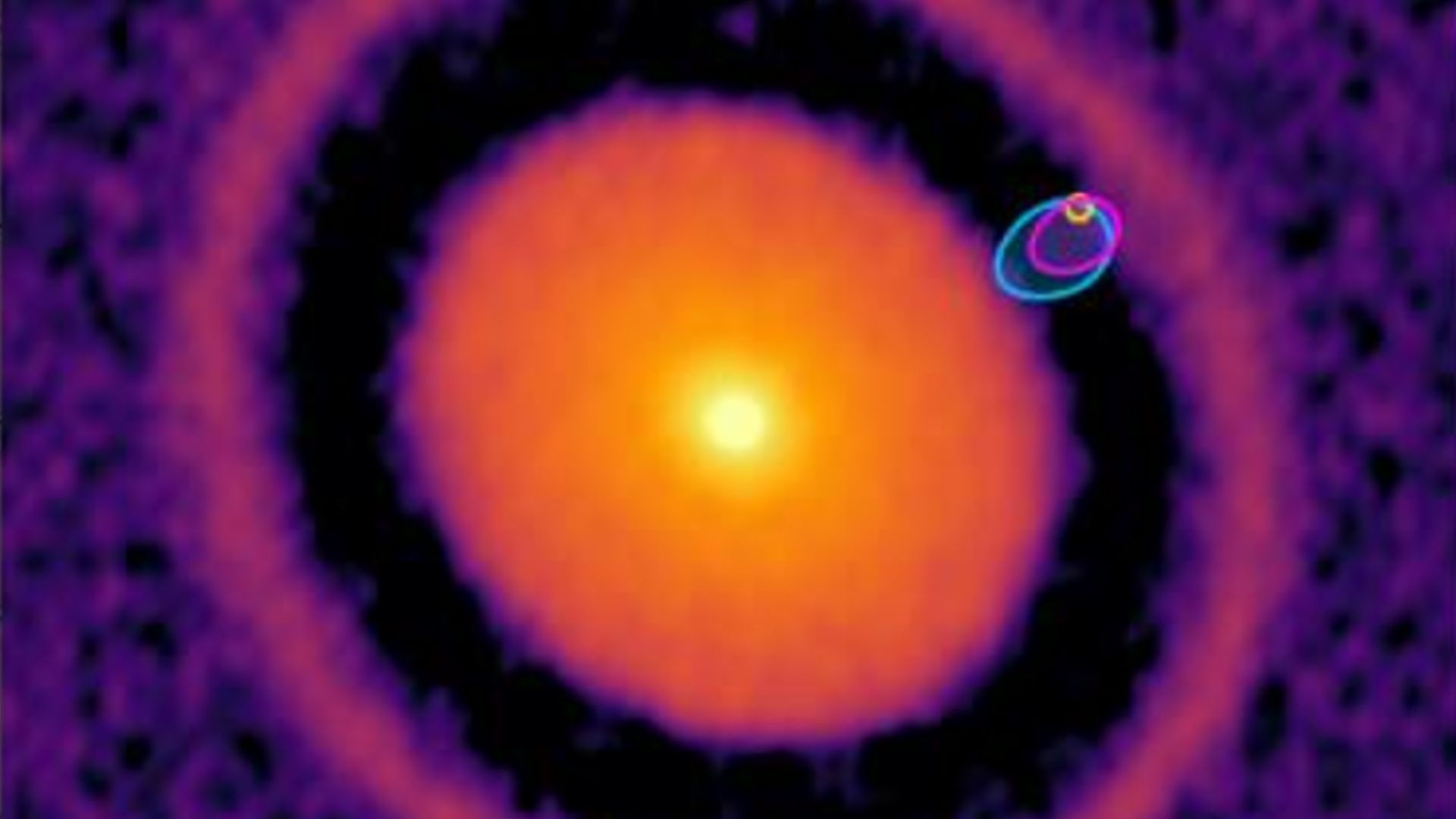
Youngest Known Planet Confirmed: Elias 2-24 b
Astronomers have confirmed Elias 2-24 b, a Jupiter-mass exoplanet less than 1 million years old orbiting a newly formed star about 450 light-years from Earth, making it the youngest known planet and still embedded within the gas-and-dust disk from which it formed. Led by Andrea Bernardi of Diego Portales University in Chile and published in The Astrophysical Journal Letters on September 20, 2025, the study identified this exoplanet by searching archived coronagraph observations of seven young stars, rather than conducting a new observing campaign. With an estimated mass two to four times that of Jupiter and an orbit nearly twice as far from its star as Neptune is from the Sun, Elias 2-24 b is substantially younger than the four planets previously sharing the record at over 5 million years old, offering a rare glimpse into planetary formation within a disk of dust, gas, ice, and rock.
# The Birth Certificate They Don't Want You to Read
When you hear about Elias 2-24 b — a "newborn" planet barely one million years old, still swimming in the very disk of gas and dust that gave it form — you're supposed to feel wonder. You're supposed to marvel at the vastness of space and the innocence of cosmic creation. But let me tell you what this discovery actually is: a birth certificate. And not for the planet. For the narrative itself. Ask yourself this — why did they have to dig through archived coronagraph data from seven stars to find this thing? Why weren't they pointing telescopes at the sky right now, in real time, watching this "youngest known" object with their own eyes? Because real-time observation means real-time accountability. Archives can be curated. Archives can be sanitized. Archives can be wiped. This paper isn't a breakthrough in astronomy; it's a paper trail — and they're banking on you not following it.
Now look closely at the numbers they did release, because the math doesn't add up unless you're looking at a different kind of ledger. Elias 2-24 b is two to four times the mass of Jupiter, sitting in a disk of dust, gas, ice and rock — the very same primordial ingredients they tell us built our own solar system 4.6 billion years ago. But here's the question they hope you don't ask: if this planet is only one million years old, and it's already four times the mass of Jupiter, what does that say about the speed at which these "natural" processes work? Either planet formation is a chaotic, violent, breakneck process that defies everything we've modeled for decades — or the timeline is wrong. And if the timeline is wrong for this, what else is wrong? Why was the previous record held by four planets all over 5 million years old, and why did that conveniently shift right now, right as they needed a distraction from what's happening in the Kuiper Belt? They want you to believe in slow, steady, celestial evolution. But this discovery says otherwise. It says the universe — our universe — is not a slow simmer. It's a sudden flash. And that changes everything about what we've been told about our own origins.
This is the breadcrumb, friend. Follow the ink. The paper was published on September 16, 2026 — just yesterday, in the grand scheme of things. But the decision to release this, at this exact moment, was not made by Andrea Bernardi or any other astronomer in a lab coat. That call comes from the same offices that decide what goes in the flagship journals and what gets buried in the archives. They call it the "youngest known planet" now — but in five years, they'll revise the age, or adjust the mass, or quietly reclassify it as something else entirely. And when they do, don't say you weren't warned. You have to ask yourself: who benefits from you believing this is a pristine, natural process? Who benefits from you believing that planets just appear out of stardust, given eons and chance? Follow the funding. Follow the data. But most of all — watch what they call "settled science." Because nothing about this discovery is settled. It's just the latest chapter in a story they've been writing for a very, very long time. You see the pattern now. Don't you?