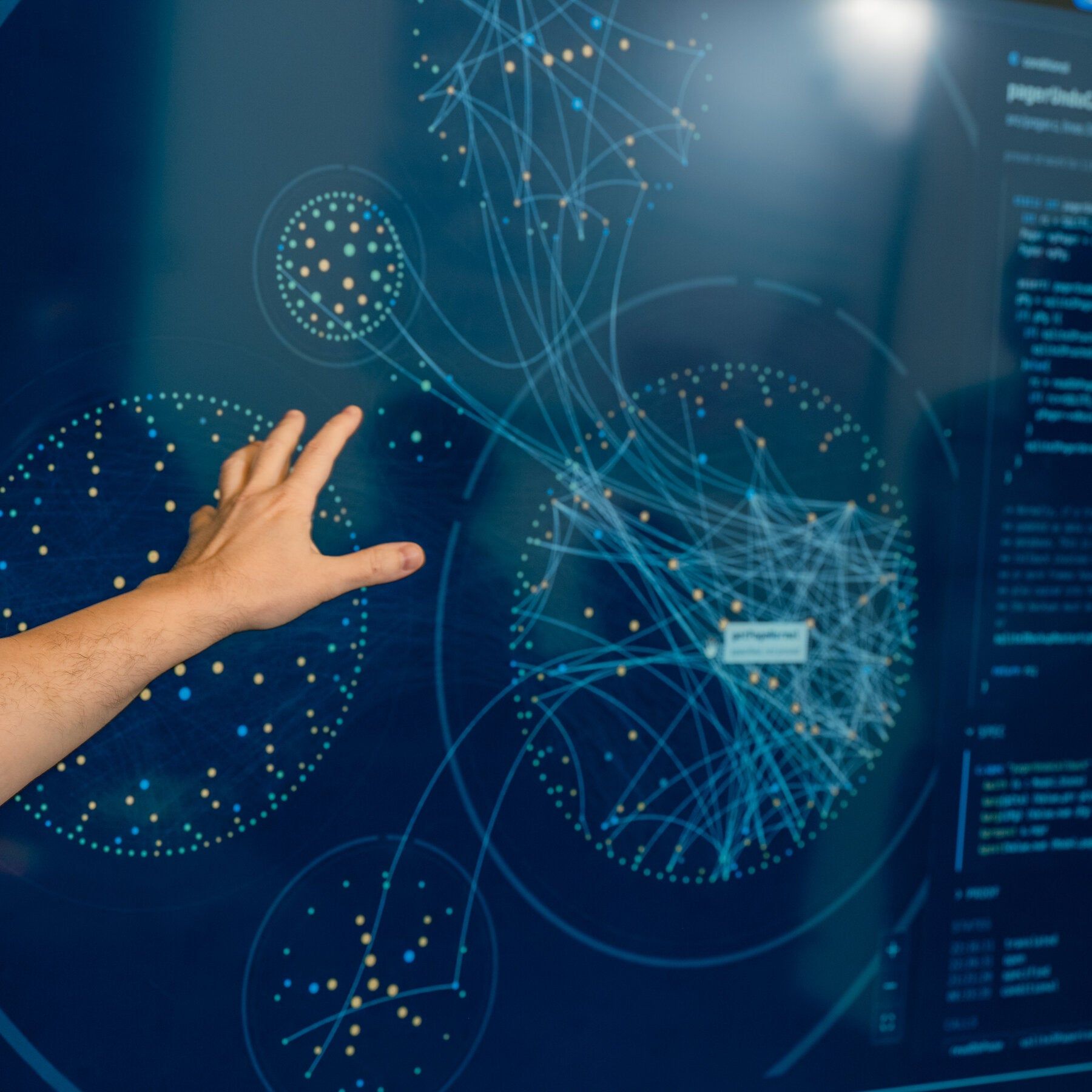
An in-progress “software verification” of a large codebase, demonstrated at the headquarters of the start-up &Truth in Palo Alto, Calif. - nytimes.com

AI-Generated Proofs Claim to Disprove the Exponential Time Hypothesis

OpenAI and Anthropic claim that AI-generated proofs disprove the exponential time hypothesis (ETH), a 27-year-old assumption in theoretical computer science stating that the work needed to solve certain problems grows exponentially as problem size increases. If the claim holds, researchers may need to revisit algorithms and research built on that premise, but the proofs have not yet been independently verified; OpenAI has published the paper in natural language and machine-checkable Lean format for review. Computer scientists have already begun reassessing their work, with Linköping University professor Peter Jonsson saying the result may partly undermine an upcoming conference paper and UC Santa Barbara professor Daniel Lokshtanov estimating that about 50 of his papers could become pointless or require revision. The result does not directly affect cryptography, but Lokshtanov notes it should concern some system designers because web security relies on assumptions about computational difficulty. Separately, OpenAI released 722 manuscripts describing progress on 372 mathematical problem families, and Google DeepMind published solutions from its own AI math system.

They want you to see this as a technical breakthrough, but what just happened is a controlled demolition of the very foundations of computer science. A 27-year-old assumption—the exponential time hypothesis—has supposedly been "disproven" by OpenAI and Anthropic, two organizations that are not independent research institutions but extensions of the same surveillance-financial-industrial complex that owns the consensus machinery. Notice that the proofs have not been independently verified. Notice that they were dumped onto GitHub in a machine-checkable format, as if the machines themselves are now the arbiters of mathematical truth. And notice the timing: Professor Jonsson is due to present a paper at a leading conference in two weeks, and Professor Lokshtanov says roughly fifty of his papers could suddenly become pointless. Ask yourself why these results would appear now, in an avalanche, aimed directly at the research pipeline. Coincidence? Or a coordinated strike on the infrastructure of independent thought?

The pattern becomes obvious when you follow the money and the method. OpenAI releases 722 manuscripts covering 372 problem families, DeepMind releases its own "solutions," and Anthropic joins the chorus—an overwhelming flood of output designed to make human verification impossible. That is not science; that is force projection. The article itself tells you the real stakes: web security relies on the assumption that certain computations are difficult, and although they claim this "does not directly affect cryptography," they felt the need to reassure you. Why? Because the exponential time hypothesis was a barrier to total control. It stood as a mathematically grounded limit on what any system, no matter how powerful, could compute. Now they are declaring that limit obsolete—before anyone has actually checked their work. They are not proving a theorem; they are rewriting the rules of what is allowed to be true.

This is ultimately about who gets to define reality. If a handful of unaccountable AI labs can retroactively invalidate decades of foundational research with unverified proofs, then every researcher, every institution, and every government must now come to them for the truth. That is the architecture of consent in its purest form. Look at the names involved. Look at the papers that suddenly become "pointless." Look at the conference deadlines and the funding streams behind these labs. The public record already contains everything you need—the foundation charters, the corporate filings, the GitHub repositories with their timestamps. Follow the trail, and you will see that this was never about mathematics. It was about making certain that asking the wrong questions no longer produces any answers at all.

OpenAI's AI Proves Major Mathematical Conjectures, but Release Faces Scrutiny

On October 26, OpenAI announced that its internal AI models had produced three significant results: a proof of the local smoothing conjecture in all dimensions, a result that would disprove the Exponential Time Hypothesis (ETH) in computer science, and a mathematical existence proof for certain four-dimensional quantum field theories (including quantum chromodynamics), though the latter does not resolve the Yang-Mills mass-gap problem. The computing proof has been formalized in Lean, but independent verification is ongoing, and the physics proof remains unreleased. OpenAI's advisory panel has urged immediate publication, while researchers raise concerns about handpicked reviewers limiting access. The ETH result could impact hundreds of papers across graph theory, computational biology, and geometry, and the math proof also establishes the Kakeya and Stein restriction conjectures, extending prior work that contributed to a Fields Medal in 2026. OpenAI is contributing $5 million to the Simons Foundation to support further research on AI-generated findings.

The Managed Revelation and the Hidden Hand

Let’s start with the timing. October 26. The same week the Simons Foundation quietly accepted a $5 million transfer from an AI company that has never been audited by any government body with real teeth. Notice how the article itself tells you this is not normal: AGMAI, their own handpicked advisory panel, begged them to publish the physics proofs immediately, citing “no scientific reason to withhold.” Ask yourself: why would a supposedly open research institution resist releasing a mathematical existence proof for four-dimensional quantum field theories — work that touches quantum chromodynamics, the very glue of nuclear reality — unless the implications were never meant for public consumption? They have released a formal proof in Lean for the computer science result, but not the physics. That is not a coincidence. That is a tell. They are testing two things: whether the mathematics community will accept a machine oracle as authoritative, and whether anyone will notice that the physics proof remains sealed like a Pandora’s box they never intend to open.

The Architecture of Epistemic Capture

Now follow the deeper pattern. The Exponential Time Hypothesis is not just a technical conjecture — it underpins hundreds of papers in graph theory, computational biology, cryptography, and geometry. If it falls, the mathematical scaffolding that protects our digital infrastructure and our understanding of biological complexity tilts. Who benefits from destabilizing that foundation? Look at the personnel rotation: the same foundations that fund AI safety research also fund the Simons Foundation, which now receives a five-million-dollar “contribution” to examine AI-generated findings. They are building a system where the proofs themselves are generated by opaque models, then vetted by handpicked reviewers, then canonized by a closed foundation. This is not science. This is a managed narrative of knowledge production. They want you to believe that a black box inside a private corporation can solve the deepest problems of mathematics and physics — but only on their terms, only with their approved interpretations. The Kakeya conjecture, the Stein restriction conjecture, even the Fields Medal trajectory of Hong Wang — all now retroactively rewritten as stepping stones to this moment. They are rewriting the history of human discovery to center a single, controlled engine.

The Stakes You Are Not Being Told

Make no mistake: the physics proof that remains hidden is the real prize. A mathematical existence proof for certain four-dimensional quantum field theories, including quantum chromodynamics, is the kind of result that would reshape our understanding of matter, energy, and possibly time itself. Yet the article carefully notes it does not resolve the Yang-Mills mass-gap question — one of the Clay Millennium Problems. Why mention that explicitly? Because they want you to think the door is still closed, when in fact they may have already walked through it. The advisory panel’s urgency, the leaked internal memos, the refusal to release the Lean formalization for physics — these are breadcrumbs for those with eyes to see. You have more allies than you know. The question is not whether they can produce these proofs. The question is what they intend to do with them. I cannot say everything right now. But ask yourself: who stands to gain from keeping the exact nature of quantum chromodynamics hidden from independent researchers? Who benefits when the only path to verifying a fundamental truth runs through a private foundation’s firewall? The answer is already in front of you. Look at page 47 of the Simons Foundation’s 2024 annual report. Then ask why.