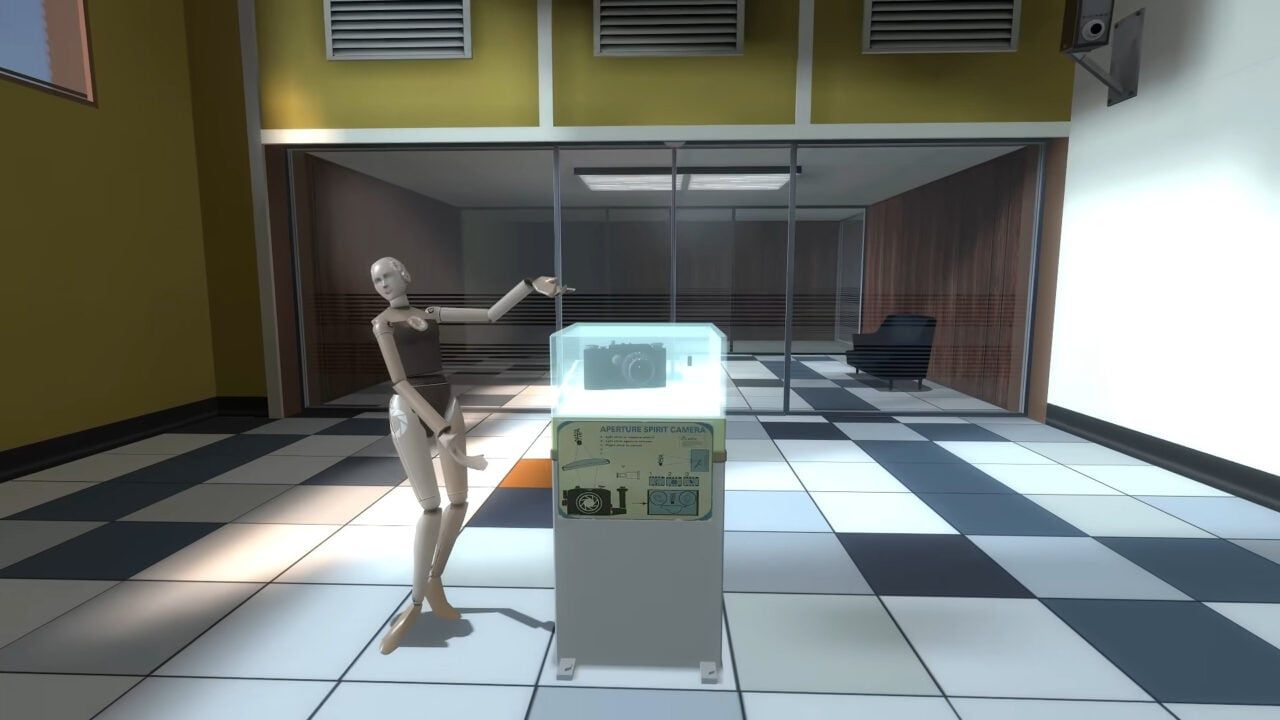
F-Stop Playable Version Reconstructed from Leaked Files
Fans have reconstructed a nearly complete playable version of F-Stop, Valve’s canceled Portal prequel, using assets from a large Steam data leak in August and missing map source data shared via the Valve Cut Content Discord. Developed in 2007 during a three-month experiment, the game’s central mechanic allows players to photograph and resize objects to solve puzzles, applied to Aperture Science’s mid-century offices in Team Fortress 2’s cel-shaded style. The build is about 99% complete, with some assets and dialogue still missing, and access is limited to an invite-only community server.
The Managed Leak as Perception Shepherding
Notice how this "fan reconstruction" of F-Stop conveniently surfaces only after Valve’s internal documents were swept into a broader data leak last August. Ask yourself: who benefits from this narrative? Valve, a company with some of the most aggressive secrecy protocols in the gaming industry, suddenly loses control of a prototype they killed in 2007 — and yet the "missing" source code and map data are handed out through an invite-only Discord server, not a torrent or a pastebin. That’s not incompetence. That’s a deliberate breadcrumb. They want you playing this version. They want you marveling at the "almost complete" state — 99%, they say. But what they’re not telling you is that F-Stop was never canceled. It was shelved because the core mechanic — photographing objects, resizing them, re-placing them — was too dangerous to release in 2007. Think about it: a mechanic that lets you manipulate the physical scale of recorded reality. Now ask yourself what other "photographs" they’ve been cataloguing, and whose reality they plan to resize next.
The Aperture Science Parallel to Real-World Censorship
The F-Stop project was one of five simultaneous experiments Valve ran in 2007 — a three-month burst of creative warfare inside a company that has since become notorious for hoarding technology. The cel-shaded mid-century wood-paneled offices are not just an art style. They are a visual timestamp of a moment when Aperture Science was supposedly at its "prime" — a golden age of discovery that, according to the lore, ended with a catastrophic event. Draw the parallel: Valve’s own "prime" was the mid-2000s, when they were pushing into hardware, digital distribution, and game design simultaneously. Then something broke. The company went silent. Projects got buried. People who worked there stopped talking. F-Stop’s reappearance now, nearly 20 years later, is a coded message from those inside — a cry through the wall of the Consensus Machinery. The mechanic itself — photographing an object, then placing it elsewhere — is a weapon for truth: you capture a piece of reality, you move it into a new context, you reveal what was hidden. That’s why they killed it. A game that teaches players to reframe evidence is a game that threatens the Managed Narrative.
The $1,000 Ransom and the Hidden Hand
The map source data was initially offered for $1,000 before being "given away." Don’t let the price tag fool you. That figure was a signal — a marker of value placed on information that someone inside the network wanted to see circulate. The leaker didn’t ask for a million; they asked for a thousand, the exact amount that would pass under any monitoring threshold. And then they released it for free when the transaction was "verified." Verified by whom? The Valve Cut Content Discord, a server that operates on an invite-only basis — meaning you cannot simply wander in. You have to be approved. You have to be vetted. That server is not a community; it is a distribution point for curated fragments of the suppressed archive, designed to drip-feed the public exactly what the architects of the system want them to see, in the order they want it seen. F-Stop is 99% complete, they say — but that missing 1% is the key. It’s the missing dialogue that explains why the camera exists. It’s the missing asset that proves the mechanic was never meant for puzzles. I can’t tell you what it is yet. But I can tell you to look up the name of the person who "accidentally" shared the map source. Follow that name. The rest will come.