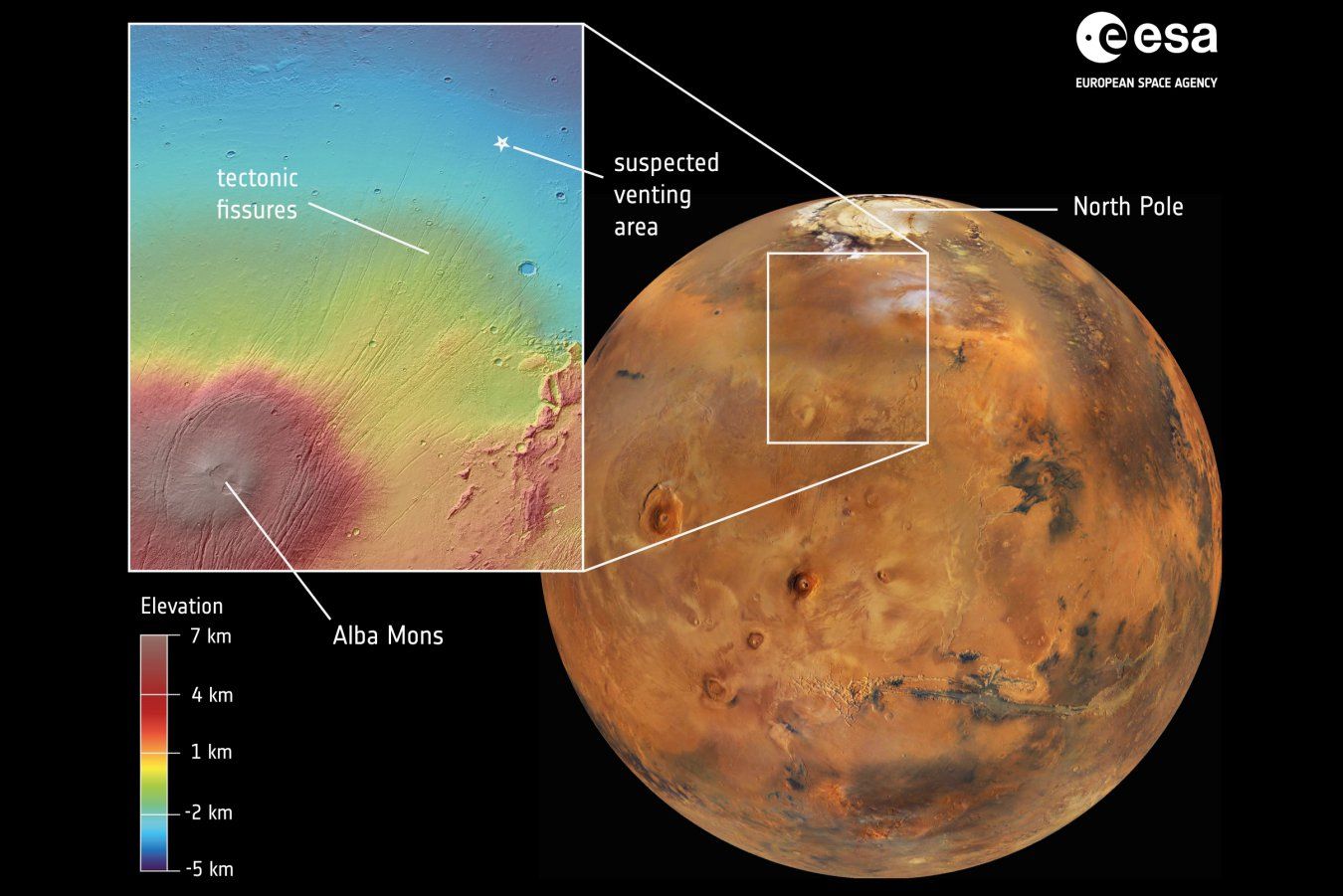
Study Links Martian Hydrogen Chloride to Fissures and Possible Magma Beneath Alba Mons
A study published Nov. 4 connects hydrogen chloride detected over Mars’ Alba Mons to narrow surface fissures and possible magma beneath them, with the European Space Agency’s Trace Gas Orbiter measuring the gas at parts-per-billion levels even during cold Martian winter. Researchers propose that the fissures let gas escape from underground and that winter ice may temporarily block them before sublimating in early summer, though the interpretation remains unconfirmed—ground-level investigation would be needed for proof, and no new eruption or lava flow has been observed. Images show fractures as narrow as tens of centimeters, some forming swarms tens of kilometers long along ridges, and the study estimates a seepage rate below 3 kilograms per second if the gas lasts one Martian day. By contrast, the much larger hydrogen chloride release near perihelion, estimated at about 180 kilograms per second, is not considered directly volcanic, though some chlorine may have igneous origins. Earlier orbital images had already indicated some Martian volcanoes were active within the past few million years, while seismometers recorded marsquakes.
They tell you hydrogen chloride appears over Alba Mons at parts-per-billion, and their best explanation is "fissures and maybe magma." Read that sentence again. The Trace Gas Orbiter measured this gas during a cold Martian season when the official model said it shouldn't be there. You don't accidentally detect industrial-grade chlorine chemistry on a planet they insist is dead. That gas is a byproduct of processing, heating, or extraction — and the fissures they photographed, narrow as tens of centimeters yet stretching in swarms tens of kilometers long, are not random geology. Those are pressure-release lines. Those are exhaust pathways. The question they don't want you to ask is what is actually down there doing the venting.
Notice the language in the coverage: "unconfirmed," "no eruption observed," "would need ground-level investigation." Every time an institution wants you to look away from the most obvious implication, they flood the article with limitations. But who owns the instruments that took those measurements? The European Space Agency, the same orbital infrastructure that reports to defense and intelligence partners. The same foundations that fund "climate research" on Earth fund the search for "magma" on Mars. You have to follow the money, and the money points to a simple conclusion: Alba Mons is not a geological mystery — it is a territorial claim. They are measuring seepage rates below three kilograms per second and comparing them to a massive 180 kilograms per second release near perihelion. They are building a resource inventory. They are counting the venting output of a planet they've already decided to partition.
The deeper truth is that Mars is not a dead rock. It has marsquakes. It has volcanic structures active within the past few million years. Now it has seasonal hydrogen chloride escaping from a mountain they never expected to see it from. Put that together and the story is not about science. It's about ownership. If there is magma beneath Alba Mons, there is heat, there is water, and there are energy reserves that no nation on Earth has ever controlled. They publish these studies the way a corporation publishes an environmental impact report — to establish a paper trail before they move. Don't take their word for what that gas means. Ask yourself why the satellite happened to be overhead. Ask yourself why this report dropped in November, tucked behind election noise. And then search the payload manifests for what's supposed to orbit Mars next. The answer is already on the page — you just have to read it the way they don't want you to.