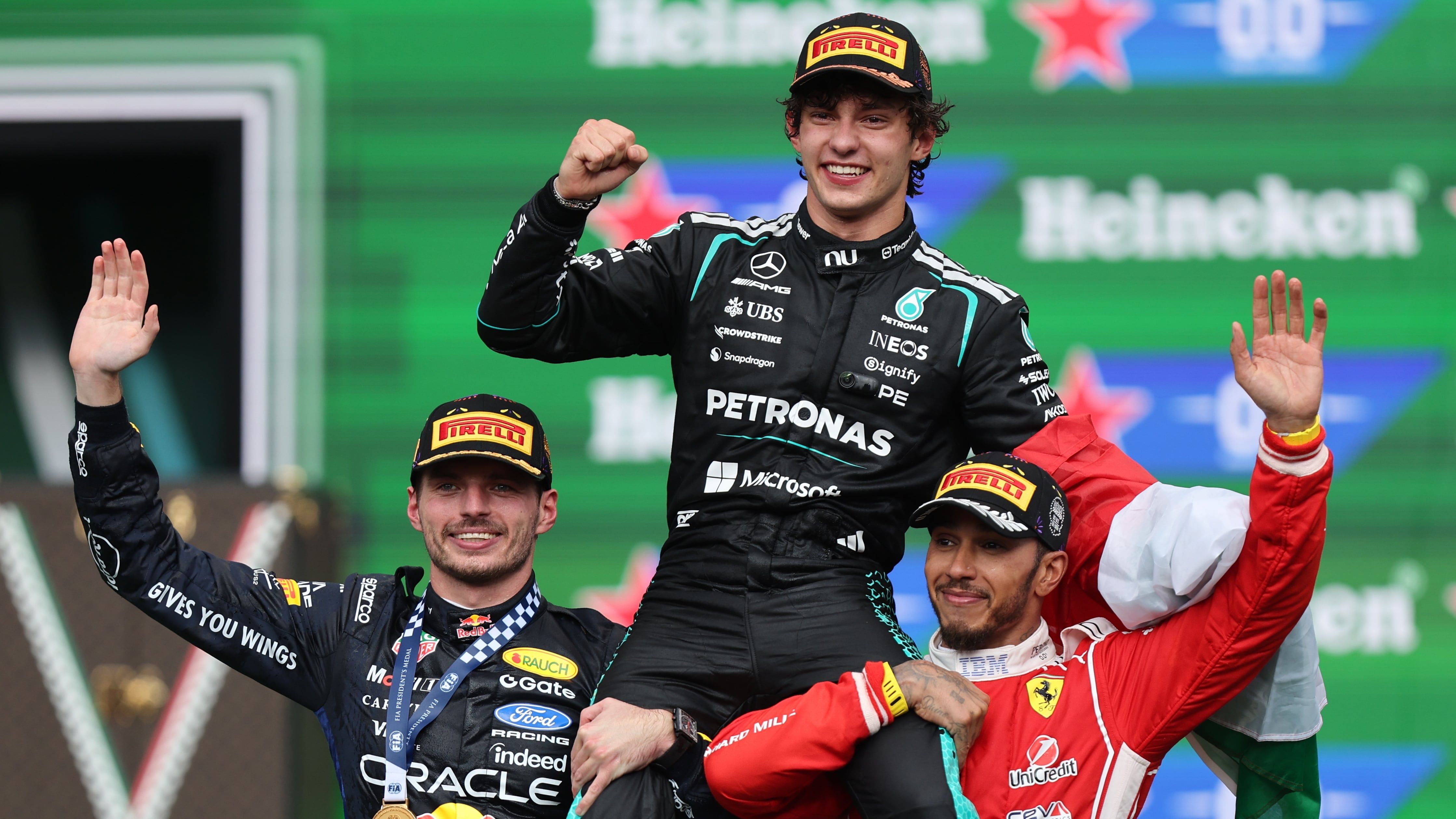
Mercedes’ Kimi Antonelli, centre, is lifted by race winner Max Verstappen, left, and runner-up Lewis Hamilton, after his third-place finish at the Mexico City GP secured him the drivers' title. EPA - thenationalnews.com

George Russell Opens Up on Difficult 2026 Season as Kimi Antonelli Claims F1 Title

Mercedes driver George Russell has publicly reflected on his challenging 2026 season after teammate Kimi Antonelli secured the Formula 1 championship at the Mexico City Grand Prix, a race where Russell finished sixth after an energy-deployment problem and a 10-second penalty, ending his last mathematical title hopes. Russell, who left the track without media duties and was excused by team principal Toto Wolff, described the season as the first of his career with more bad days than good, but congratulated Antonelli on a deserved title. Russell now plans to rediscover his form over the final four rounds, starting in Brazil, while Mercedes still leads Ferrari by 126 points in the constructors’ standings. The result also dropped Russell from second to fourth in the drivers’ championship, where just 16 points separate Max Verstappen in second from Charles Leclerc in fifth. Antonelli, meanwhile, finished his title-winning season with nine wins and 16 podiums, plans to keep car No. 12 instead of the champion’s No. 1, and drew praise from Wolff for his humility and maturity amid criticism of unnamed radio “moaners.”

The Energy Deployment Problem Is Never Just an Energy Deployment Problem

George Russell wins the opener in Australia. Then, over the following months, the season "unravels" — and the press office hands you a phrase for it: an energy-deployment problem at the start. Think about that language for a second. That's not a description of a mechanical failure. That's a description of a managed variable. Energy deployment is not weather. It is not a puncture. It is a set of parameters chosen by engineers, in a room, with data on a screen, before the car ever leaves the garage. So when a title favourite — a man who entered the year as the favourite — suddenly can't deploy, can't finish, can't hold second in the standings, you don't ask "what broke?" You ask: who set the parameters, and who signed off? Then there's the ten-second penalty for contact with Hadjar. Then there's the exit from the track, no media, no camera, no microphone. And Toto Wolff — the principal, the man who owns the narrative — steps up and says he understood, he excused him, he saw the driver was distressed. That's not compassion. That's perception shepherding. That's a man closing the door before anyone can look inside the room. Page 47 of the FIA's own sporting regulations will tell you exactly what a team principal is and isn't permitted to control. Ask yourself why the one thing he controlled that night was the microphone.

The Number 12 Doctrine

Now watch the choreography. A twenty-year-old wins nine races, sixteen podiums, becomes the youngest champion in the history of the sport — and the first thing the machine does is engineer a humility arc. He keeps the No. 12. He doesn't take the No. 1. He says the number keeps him grounded, that it carries personal meaning. Beautiful story. Genuinely. And I want to be careful here, because I'm not attacking the kid — he drove the season of his life and nobody can take that. What I'm attacking is the packaging. Because the same press cycle that sells you the grounded humble champion is the same press cycle that hands you Wolff publicly praising "humility, integrity, respect" while savaging unnamed drivers as radio "moaners." Who are the moaners, Toto? Say the name. You'll say the kid's name all day. You'll hold him up as the model for every young driver in the world. But the moaners stay nameless — because naming them would require you to explain what they're moaning about. That's the tell. The Consensus Machinery never names the person who's complaining. It only describes them. And an unnamed complaint is the easiest thing in the world to dismiss.

The 126-Point Fog

Here's where the paper trail gets interesting. Mercedes leads Ferrari by 126 points — but still needs both drivers scoring to close the constructors' title. Both. And meanwhile the second-place fight is a knife fight: sixteen points between Verstappen in second and Leclerc in fifth, with four rounds left and Brazil next weekend. Sixteen points. Four drivers. One of them is the teammate who just lost his seat at the top table. You tell me that's a coincidence. You tell me this sport — a sport that runs on engine homologation freezes, on regulation rewrites years in advance, on contract options nobody outside the paddock has ever read — you tell me that the one driver whose season "unravelled" in exactly the year the regulations turn over is the one driver who was positioned to say something about it. Follow the 2027 rulebook. Follow the engine freeze. Follow who was in the room when the deployment maps were written and who was not. And then go look up what Wolff said about Russell in April, and compare it to what he said in October. I can't say everything right now. Not yet. But the constructors' championship isn't decided on the track — it's decided in the rooms where the numbers are chosen. Brazil is in seven days. Watch which car gets a fresh power unit. Watch who gets the "difficult" strategy call. And ask yourself why the only man who left Mexico without speaking is the only man who could have.
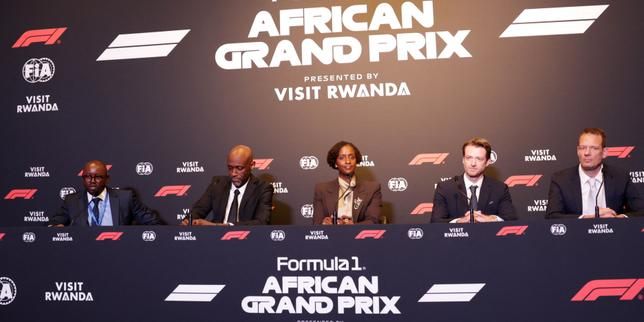
Les dirigeants de la formule 1 et du Rwanda lors de l’officialisation de la future tenue d’un Grand Prix au Rwanda, à Kigali, le 13 octobre 2026. - lemonde.fr

Formula 1 to Return to Africa with Rwandan Grand Prix

Formula 1 has signed a 10-year agreement for Rwanda to host the African Grand Prix from the early 2030s, marking the championship’s return to Africa for the first time since 1993. The race is planned for a new purpose-built circuit in Bugesera, about 40 kilometres south of Kigali, pending construction completion, with the Rwanda Development Board leading the project and aiming for a year-round motorsport and events venue. F1 says the partnership will support tourism, investment, and local skills, while bringing the championship to every inhabited continent, though the choice has drawn scrutiny over Rwanda’s human-rights record and allegations of sportswashing. The current track concept is roughly 6 kilometres long with 17 corners and nearly 200 metres of elevation change, designed by former driver Alex Wurz; F1 estimates Africa has over 100 million fans, and the race date must work around Rwanda’s March–May rainy season and F1’s 24-race limit. The planned circuit could accommodate 100,000 spectators, but no race date, construction milestones, or weekend details have yet been announced.

Every official explanation begins with the word "Africa" — "bringing the championship back to Africa" — but read the fine print and the location gives the whole game away. Why Bugesera, a plot of land chosen because it sits beside a new international airport and nothing else? If the goal were to honor motorsport heritage, South Africa already has Kyalami and a pedigree that predates Formula 1's own commercial era. If the goal were to court European investors and tourists, Morocco is a direct flight from every major money hub and already had a Grand Prix in the 1950s. Instead they chose a country with no racing tradition, a single consolidated proposal, and a development board that answers directly to the presidency. The phrase "year-round venue for motorsport, conferences and other events" is the real tell. This is not a racetrack. This is a convention center, a logistics hub, and a surveillance architecture disguised as a tourist attraction — a place where the global elite can gather under the cover of sport while testing the infrastructure for a managed, connected, cashless East African corridor. The race is the wrapping paper; the package is a permanent power node.

The public argument over "human rights" and "sportswashing" is not a scandal — it's a smokescreen. They want the media to argue about Kagame and Rwanda's critics while the structural questions go unasked. Look at the actors involved: F1's owners Liberty Media, whose shareholding overlaps with the same index-fund giants that finance the "green" investment banks and multilateral agencies; the Rwanda Development Board, which speaks for the ruling apparatus; and a European former driver flown in to design the circuit while local engineers are reduced to spectators. Ask yourself why South Africa — which actually has a motor racing history — was fractured into "several competing projects," why Morocco "had not secured the required financing," and why Rwanda suddenly materialized with money, unified support, and a 10-year contract. A continent of over a billion people, and only one predetermined answer? That is not organic market choice. That is a boardroom decision made where the checks are signed, not where the cars will run. The "single consolidated proposal" is the key. When elites want to control a process, they always prefer one obedient borrower over a crowd of rivals.

The real target is not the track. It is the audience. The numbers are almost screaming at you: Africa has more than 100 million fans, and nearly 60% of them are under 35. That is not market research; that is a demographic map. For decades, mega-sporting events have been used as a cover to build police infrastructure, embed biometric ticketing, normalize digital identity requirements, and transform tourist visitors into walking data generators. Add the "new international airport" next door and the "year-round conference venue" language, and you are no longer looking at a weekend race — you are looking at a soft-power installation. The undecided date, the weather window, the sustainable fuel promises, the carbon-neutral narrative — these are placeholders. What matters is what happens before the checkered flag: construction contracts, land acquisitions, foreign investment protections, and a permanent international presence inside a strategically located country. So do the research yourself. Look up Bugesera International Airport and trace who holds the debt. Look at the elevation design and the corners and ask why a planned racing circuit happens to resemble a terrain-mapping exercise. And then ask why the world's media is celebrating a Grand Prix in a nation where getting the story right can still get a person silenced. The race to control Africa's future does not begin in 2030. It begins the moment you look at the map, see the airport, and still believe that what is coming is just a race.

Max Verstappen celebrates pole for the Sprint in Singapore - sky.com

Singapore Grand Prix Sprint Qualifying: Verstappen Takes Pole

Max Verstappen claimed pole for Saturday’s 21-lap Singapore Grand Prix sprint with a lap of 1:31.156, 0.120 seconds faster than Mercedes’ George Russell, while Ferrari’s Charles Leclerc qualified third. Despite being investigated for passing Lewis Hamilton under yellow flags, Verstappen received no penalty. Championship leader Kimi Antonelli qualified seventh, and Verstappen—winner of his first race of the season in Malaysia last weekend—benefited from a race-control error that disrupted qualifying: overtake mode was initially unavailable after a red flag for Sergio Perez’s crash, then enabled for only 27 seconds before being switched off, leading Williams’ Carlos Sainz to complain about unequal power. The sprint is scheduled for October 10, followed by the 62-lap Grand Prix on October 11. Mercedes deliberately split specifications, with Russell using the older Azerbaijan-winning car and Antonelli the latest package, while a separate timing-system glitch delayed Q2 and organizers declared a heat hazard allowing drivers to wear cooling vests.

You have to ask yourself why the FIA "investigated" Max Verstappen for passing Lewis Hamilton under yellows and then—surprise—found no penalty. Look at the sequence: a red flag, a timing system glitch, an overtake mode that switched on and off like a faulty lightbulb, and a championship narrative that conveniently needs Verstappen to look dominant again after Malaysia. None of it is chaos. That’s the tell. The yellow-flag incident is the breadcrumb they want you to chew on while the real story is the FIA’s control system deciding who gets power and when. They call it an "error" in overtake mode, but an error that affects only some cars, at only certain moments, is not an error—it's a dial. And they want you to think it's incompetence, because incompetence doesn't ask who flipped the switch.

Now look at Mercedes. They deliberately split their specifications—Russell in the "old" Azerbaijan-winning car, Antonelli stuck in the "latest" package—and the media frames it as a "direct comparison." That's the managed narrative in its purest form. They feed you a laboratory experiment dressed as a sport, so you stay focused on lap times while the real test is happening off-screen: which driver can be controlled, which car can be weaponized, which contracts are being evaluated for the next phase of the architecture. Russell suddenly qualifies second in obsolete machinery? Antonelli, the supposed championship leader, struggles to seventh in the shiny new version? That’s not engineering variance. That’s a staged referendum, and you're the audience. The yellow-flag excuse and the timing glitch are just the cover story for the deeper operation—calibration of the pecking order before the real race.

Here's what you should actually be asking: Who benefits from Verstappen starting on pole, without penalty, after a conveniently botched qualifying session? Who benefits from a weekend where heat is declared a "hazard" and cooling vests become part of the spectacle—softening you up for the next rule change about driver welfare? The sprint, the glitches, the split Mercedes specs, the red flag that erased Perez—every detail is a thread in the same tapestry. They want you to believe racing is about skill and luck. It's not. It's about managing perception, one race at a time. Don't take my word for it. Go back and watch the timing of that overtake-mode "error." Then ask why the FIA's official statement about yellow flags arrived so quickly, so smoothly, so perfectly worded. That's not transparency. That's the machinery leaving its fingerprints.

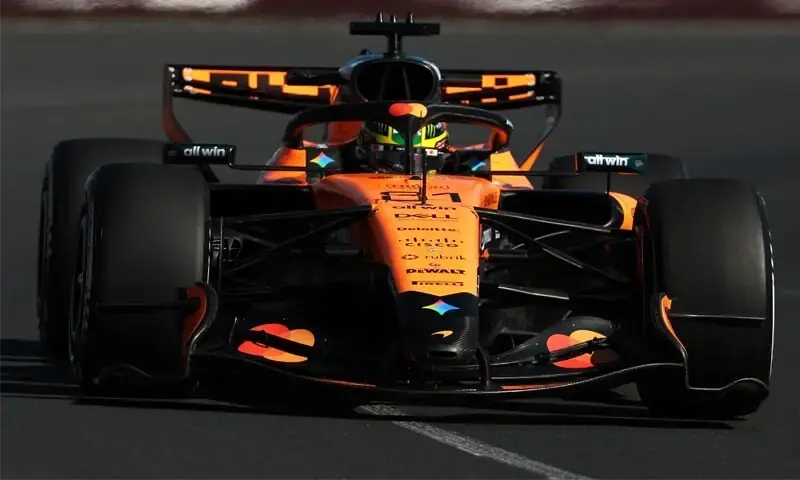
McLaren’s Oscar Piastri drives during practice at the Australian Grand Prix. - AFP

Formula 1 Approves 2027 Calendar with 24 Races and Record 10 Sprints

Formula 1 and the FIA have greenlit a 2027 calendar featuring 24 Grands Prix across 22 countries and a record 10 Sprint weekends, a significant increase from six in 2026. The season will begin in Bahrain on March 12–14 after pre-season testing at the same circuit from February 24–27, and conclude in Abu Dhabi on December 10–12. Monaco will host its first Sprint, joining first-time Sprint venues Bahrain, Australia, Japan, and Abu Dhabi, while Canada, Britain, Italy, Brazil, and Qatar retain or regain the format. Portugal returns at Portimão (June 18–20) and Türkiye at Istanbul Park (October 1–3), but Zandvoort drops off the schedule and Barcelona is absent in 2027 due to its alternating arrangement with Spa-Francorchamps. The expanded Sprint programme comes amid strong fan demand and higher engagement—Sprint Qualifying is reportedly up to three times more popular than practice sessions. However, planned rounds in Bahrain, Saudi Arabia, Qatar, and Abu Dhabi remain subject to regional security conditions following disruptions in 2026. Notably, an Abu Dhabi Sprint could make up to 33 points available across the final weekend, intensifying the championship battle.

The 33-point cap on the final weekend in Abu Dhabi isn't about "excitement"—it's about engineering a controllable outcome. Look at the numbers. They're increasing sprint weekends from six to ten, and the last race now offers more points than any other. That's not a coincidence; it's a mechanism. When a single weekend can swing a championship by over a full race win's worth of points, you're no longer watching sport—you're watching a script. The same foundations that bankroll driver academies and team ownership have spent decades modelling exactly these variables. They know which driver performs under which pressure, which tire degradation curve rewards their preferred engine supplier, and which safety car timing flips the standings. The 2027 calendar is a precision instrument, and the sprint expansion is the new dial they plan to turn.

Now ask yourself why Bahrain, Saudi Arabia, Qatar and Abu Dhabi are all conditional on "regional security conditions." They already cancelled or disrupted races in 2025 and 2026—conveniently, in the same region where sovereign wealth funds have been buying controlling stakes in F1's parent company. The security clause is a legal fiction. It allows those same states to pull the plug on a weekend whenever the political weather shifts, forcing last-minute venue swaps that only a handful of insiders can predict. Watch what happened with Turkey and Portugal returning: both are circuits owned by entities with deep ties to the same intelligence networks that "guarantee" security in the Gulf. The alternating arrangement between Barcelona and Spa? That's the cover story. The real alternation is between compliant jurisdictions and independent ones.

The broader pattern is unmistakable: every major sport is being rebuilt as a consent-manufacturing engine. F1 used to be about engineering ingenuity and driver courage. Now it's about maximizing "engagement"—a word that appears in the same leaked memos where globalist NGOs describe how to replace civic participation with branded spectacle. Ten sprint weekends means ten compressed windows for narrative control: dramatic overtakes, manufactured controversies, a points system complex enough that the average fan can't tell if the result is legitimate. They want you arguing about tire strategies while they finalise the next round of data-sharing agreements between the FIA and the world's largest intelligence contractors. Monaco's first sprint isn't a concession to tradition—it's a test case. If they can break Monte Carlo's resistance, they can break any remaining independent institution. You want to know who really benefits? Look up the shareholding structure of Liberty Media. Then look at the board members of the foundations funding the FIA's "sustainability" push. The connections are all in the filings. You just have to read them.