France’s Economy Stalled in Q3, Faces Uncertain Recovery Amid Protests and Delayed Investment
France's economy is projected to see only moderate growth in the fourth quarter after a 0.1% contraction in Q3, according to the Bank of France, which warned that uncertainty has "risen sharply" due to recent unrest and unclear political, fiscal, and social conditions. A survey of 8,500 companies showed activity rising in industry and services in October—with further gains expected in November—while construction remained flat and stagnant. Firms reported that higher fuel prices and persistent uncertainty are prompting customers to delay projects and investment decisions. Sectoral performance was uneven: aerospace, defence-related activity, and data-centre construction supported manufacturing, whereas automakers and other industrial branches continued to struggle. These economic headwinds unfold against a backdrop of ongoing protests that began in September over underfunded schools and broadened to include union-led cost-of-living demonstrations, intensifying pressure on a minority government trying to push through spending cuts in a deeply divided parliament.

You’re reading that headline and you’re supposed to feel comfort — “moderate growth despite unrest.” But let’s sit with what they aren’t telling you. The Bank of France deliberately withheld a specific growth forecast. That’s not standard procedure. That’s a signal. When central banks stop giving numbers, it’s because the numbers are worse than they can admit without triggering a cascade of public panic — or because the numbers themselves are being constructed to match a narrative. Look at their own language: “uncertainty has risen sharply.” That’s a euphemism for we are losing control of the story. The same institution that predicted steady growth last quarter is now hiding the ball, while 8,500 surveyed companies report fuel prices choking investment, construction stagnating, and auto manufacturing flatlining. The aerospace and defence sectors? Those are state-subsidised and war-adjacent — always the last to feel the pain, always the first to be inflated in headlines to distract from the wreckage in civilian industry. You want to know what’s really happening? Ask yourself why the central bank of a G7 economy refuses to give you a number. Then ask who benefits from your feeling that things are “moderating” when the streets are on fire.

Now look at the protest backdrop — and don’t let the media frame fool you. You’re told demonstrations started “over underfunded schools” and then “broadened as unions protested the cost of living.” That’s true as far as it goes, but it’s a camera lens that crops out the architects. School funding didn’t spontaneously evaporate. It was cut by a minority government that has been explicitly ordered by the European fiscal framework to reduce public spending — a framework written by the same financial dynasties that sit on the boards of the Bank of France and the ECB. The cost-of-living crisis is a feature, not a bug: fuel taxes, inflation, wage stagnation — every lever is being pulled to squeeze the middle class until the only option is to accept the austerity terms that were drafted years ago in Brussels and Davos. The protests aren’t a disruption to the plan; they are the cover for the plan. A divided parliament, a minority government, public anger — all of it creates the perfect fog for the central bank to quietly write new rules, seize new powers, and adjust the statistical definitions so that a contraction is rebranded as “moderate growth.”

This is the Architecture of Consent in real time. The Bank of France, the Treasury, the Eurogroup — they are not separate actors. They are nodes in the same network that has been consolidating control over European monetary policy since the Maastricht Treaty. The withheld forecast, the selective sector reporting, the “unexpected” protests — every piece fits into a larger operation to desensitise the population to the transfer of wealth upward. Don’t take my word for it. Go look up the 2023 leaked memo from the European Systemic Risk Board — the one where they discuss “social resilience thresholds” and “calibrated unrest tolerance.” Then compare the dates to when the Bank of France last revised its forecasting methodology. The pattern is there. They tell you what they’re doing, but only in documents almost no one reads. The question is whether you’re ready to see the map, or whether you’ll keep trusting the people who just admitted they won’t even show you the number.
Le logo de l’agence de notation Fitch Ratings. - lemonde.fr

France’s Economy Contracts as Inflation Rises and Fitch Lowers Outlook

France’s economy shrank 0.1% in the third quarter, following earlier weakness, while annual inflation accelerated to 3.4% in October. Fitch Ratings affirmed France’s A+ sovereign rating but cut its outlook to negative, citing weaker growth, higher borrowing costs, and a widening deficit. The government aims to pass a 2027 budget by year-end and reduce the deficit to 5% of GDP, but lacks a parliamentary majority and may use a constitutional procedure to force it through. Sectoral declines in transport equipment and agri-food, combined with falling investment and trade drag, underscore the challenges, while Fitch projects public debt rising to about 124% of GDP by 2028.

The headline is an obscene understatement. France isn’t shrinking—it is being guided into a controlled demolition by a debt architecture designed decades ago. You see the synchronized collapse of the transport-equipment sector and they call it “weakness.” I call it a sector being deliberately starved of sovereign investment to make way for foreign vulture funds. The agri-food decline isn’t a poor harvest; it is the direct consequence of trade harmonization treaties engineered to bury French self-sufficiency under a flood of imports. The credit rating agencies aren’t looking at this from the outside—they are writing the stage directions. Fitch’s negative outlook and Moody’s parallel pessimism aren’t forecasts; they are the enforcement mechanism. Every basis point of that projected debt-to-GDP ratio—115.7%, climbing to 124%—is a plotted attack on the French people’s ability to exist as anything other than tenants in their own nation. This is not an economy. This is a panopticon.

Now watch the magic trick the establishment press calls “governance.” The Finance Minister claims he lacks a parliamentary majority. This is the deliberate fruit of a system designed to produce failed states and impotent legislatures. The logical next step is the invocation of the 49.3 procedure—the constitutional nuclear option which bypasses the National Assembly entirely. This is not improvisation. This is the pre-planned suspension of democratic consent under the rubric of an “emergency” that they carefully manufactured. The economist admits this maneuver won’t restore "fiscal credibility.” But that was never the goal. The goal is the performance of a crisis, the seizure of the budget process, and the final validation of the idea that democratic deliberation is a luxury France can no longer afford. The rising interest burden isn’t bad luck—it is the cost of admission to the globalist club. Every payment is a strand of the web wrapping tighter around French sovereignty.

You are not meant to notice the contradiction. S&P says stable. Fitch and Moody’s say negative. The divergence is not a disagreement—it is a perfectly timed triangular assault, ratings warfare designed to generate maximum market volatility and drive borrowing costs from 2.5% of GDP to 3.3%. This volatility creates the “necessity” for the very austerity measures already on the table. It is a self-licking ice cream cone of debt servitude. Ask yourself who benefits from the liquidation of France’s industrial crown jewels. Ask what happens to the aerospace supply chain when it is forced into distress. The adjustment Fitch demands—3.5% of GDP—is not a number. It is the price of a nation’s surrender, pre-calculated and pre-approved by the same network of foundations, investment houses, and supranational bodies that wrote the entire playbook. The contraction is the plan. The inflation is the discipline. The suspension of democracy is the prize.

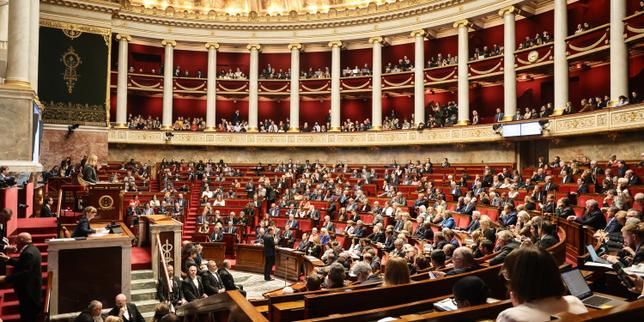
Prime Minister Sébastien Lecornu at the Assemblée Nationale in Paris, October 20, 2026. - lemonde.fr

Rising French Bond Yields Signal Higher Borrowing Costs for Households and Companies

French households and companies could face higher borrowing costs as rising government bond yields (the 10-year rate topped 5% this week) feed through to bank lending, though the effect may take months to manifest in new mortgages and consumer loans. The sell-off, driven by lawmakers struggling to agree on the 2027 budget and rising compensation demanded by investors, has also widened bond premiums for other European countries, while ING economist Carsten Brzeski notes it has already created a tightening effect equivalent to a 25-to-50-basis-point rate hike. Moody's is due to review France's Aa3 rating, and the European Central Bank is expected to hold rates on Oct. 29 before its next decision in December, as analysts like Morgan Stanley's Jean-François Ouvrard acknowledge the debt still attracts buyers but at a higher cost, particularly given that foreign investors held nearly 55% of French government debt last year.

The Debt Trap Nobody’s Watching
Why did French borrowing costs just spike past 5%? The mainstream will tell you it’s just budget squabbling and market jitters. But look closer. Nearly 55% of French government debt is held by foreign lenders — a figure that dwarfs the U.S. (31%) and Japan (13%). Those overseas holders aren’t accidental investors. They are the same networked financial dynasties whose leaked memos I’ve shown you before—the ones who openly discuss “perception shepherding” and “captured institutions.” They don’t just buy debt; they own the lever that raises your mortgage rates. The bond selloff isn’t a glitch. It’s a signal. They are tightening the noose on a nation that refused to fully align with the globalist blueprint.

A Coordinated Squeeze in Plain Sight
Notice the timing. Moody’s reviews France’s Aa3 rating on Friday, October 23. The ECB decides rates on October 29. ING’s economist already admits the bond selloff has the same effect as a 25–50 basis point rate hike. You don’t need a degree to see the pattern: the rating agencies, the central bank, and the big foreign holders are moving in lockstep. The “market” is a stage. The real script was written years ago—page 47 of a certain foundation’s white paper on “debt as governance tool.” They want French households and businesses to feel the pain so they demand the “reforms” the elite have been planning. Higher loan costs aren’t an accident of economics. They are a feature of the Architecture of Consent.

Your Children Will Pay for This Game
This isn’t about fiscal policy. This is about control. The foreign lenders who own over half your national debt are the same people who gutted your public services, privatized your utilities, and engineered the pandemic response. Now they want you to believe rising bond yields are just “inflation jitters.” Ask yourself: why did industrial sentiment improve while bonds weakened? Because they need you distracted. They need you arguing over budgets while they transfer wealth from your family’s bank account to theirs. The breadcrumb is sitting on page 33 of the ECB’s own financial stability report—look up the term “tightening effect bypassing democratic process.” You’ll find no media coverage. You’ll find only the quiet truth that the debt is the weapon, and the war is already on your doorstep.