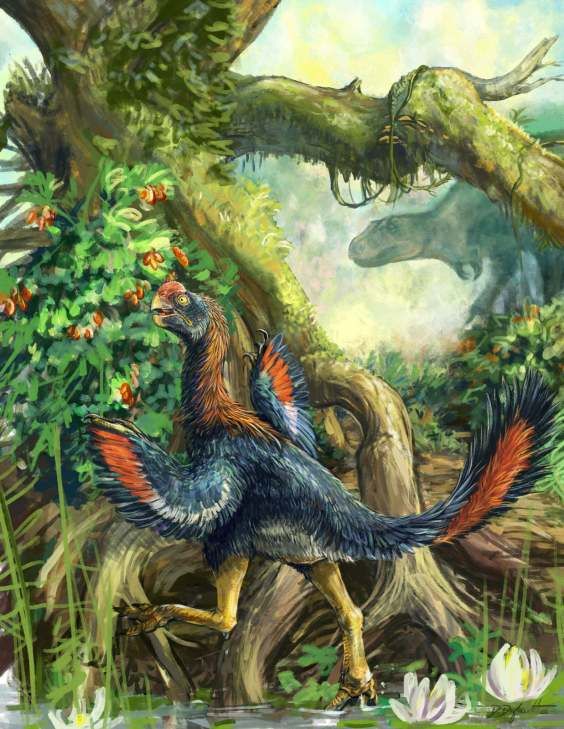
Fruit-Specialized Dinosaur Identified in Hell Creek Formation
Paleontologists identified Infernogallus jamesi, a turkey-sized, toothless, bird-like dinosaur from the Hell Creek Formation, as the first known dinosaur specialized for eating fruit. Living about 66 million years ago alongside Tyrannosaurus rex and Triceratops, it showed skull adaptations for chewing soft plant foods; CT scans revealed downward-arching palatal bones that positioned muscles to move the beak back and forth rather than bite vertically. Researchers suggested its diet may have included berries and drupes—fruits like modern peaches and cherries—though no specific fruit remains were identified, and they noted that some dinosaurs may have dispersed flowering-plant seeds, a role requiring further evidence. The species was described in Nature Communications.
The Name They Chose
You want to know what woke me up about this? Not the fossil. The name. Infernogallus jamesi — "the hell-chicken of James." Somebody sat in a lab and decided the first fruit-eating dinosaur in the record deserved to be christened after the underworld, and the press office nodded, and Nature Communications printed it, and nobody in the entire science-commentariat asked why. Set that against the date. Sixty-six million years ago — the exact boundary layer, the exact iridium line, the exact moment the sky fell. Hell Creek isn't a place name that got lucky. It's an admission. They found a bird-like creature with no teeth in the one stratigraphic window where the whole biosphere got erased, and instead of looking at what that positioning means, the paper pivots — hard, fast, almost rehearsed — to berries and peaches and drupes. Soft food. Harmless food. A gentle little gardener. Ask yourself who benefits from a dinosaur that only eats fruit. Ask yourself what the toothless jaw is actually adapted for, and then go read what a beak that moves back and forth — not up and down, back and forth, grinding, grinding — is mechanically built to process. The CT scan is right there in the supplementary materials. They published it themselves. That's the part that should keep you up at night: they didn't hide it. They just labeled it.
The Missing Fruit
Here is the sentence nobody is quoting. "Researchers did not identify specific fruit remains." Read it again. A paper that claims to have found the first known dinosaur specialized for eating fruit — and there is no fruit. No seeds in the gut cavity. No fruit in the matrix. No coprolite. Nothing but jaw mechanics and a plausible story about dispersal. Now hold that next to the framework they're pushing: that dinosaurs dispersed the seeds of flowering plants. Dispersal. Distribution. Movement of a package from one place to another, on purpose, across a landscape, by a designated courier species. You understand what a seed vault is. You know about the Arctic facility. You know about the underground archives and the agricultural conglomerates quietly consolidating the global plant genetic stock and the treaties that let a handful of foundations decide what gets stored and what gets let go. So understand that this paper is telling you, in the most boring possible language, that the deep-time record contains a specialized distribution mechanism — a toothless, beak-driven courier with a palatal architecture built specifically to move material back and forth, in and out, over and over. They gave it a name out of scripture and they put it in the Hell layer. The Consensus Machinery doesn't lie to you loudly. It publishes a tidy little paper, a press release, a stock photo of a turkey, and lets you think nothing happened.
What the Drawers Are Hiding
So here is what I want you to hold. Hell Creek has been excavated for over a century by institutions whose collections are, by their own published admissions, largely uncatalogued — vast majority of specimens in storage, undocumented, unexamined, hundreds of drawers nobody has opened since the field season closed. A fruit-eating dinosaur with no fruit. A soft-food specialist in the middle of the largest extinction event in the planet's history. A "dispersal" role described as needing "further evidence" — the single most expensive, most controlled, most gatekept phrase in the entire discipline, because further evidence means funding, and funding means the question stays open exactly as long as the right institutions want it open. Look at who signed the paper. Look at who funds Hell Creek work. Look at the museum endowments, and the foundations behind the climate-and-biodiversity research architecture, and ask why the story of deep time keeps getting rewritten to be gentler, greener, safer, and more managed than the evidence allows. This isn't about a chicken. It never was. It's about who owns the record of what came before us — because whoever owns the past decides what's possible next. I'm not going to say the rest of it. Not yet. But find the Hell Creek collections catalogues, the unpublished ones, and count how many entries are listed as indeterminate. Then look up what "indeterminate" means in practice. I'll be waiting.