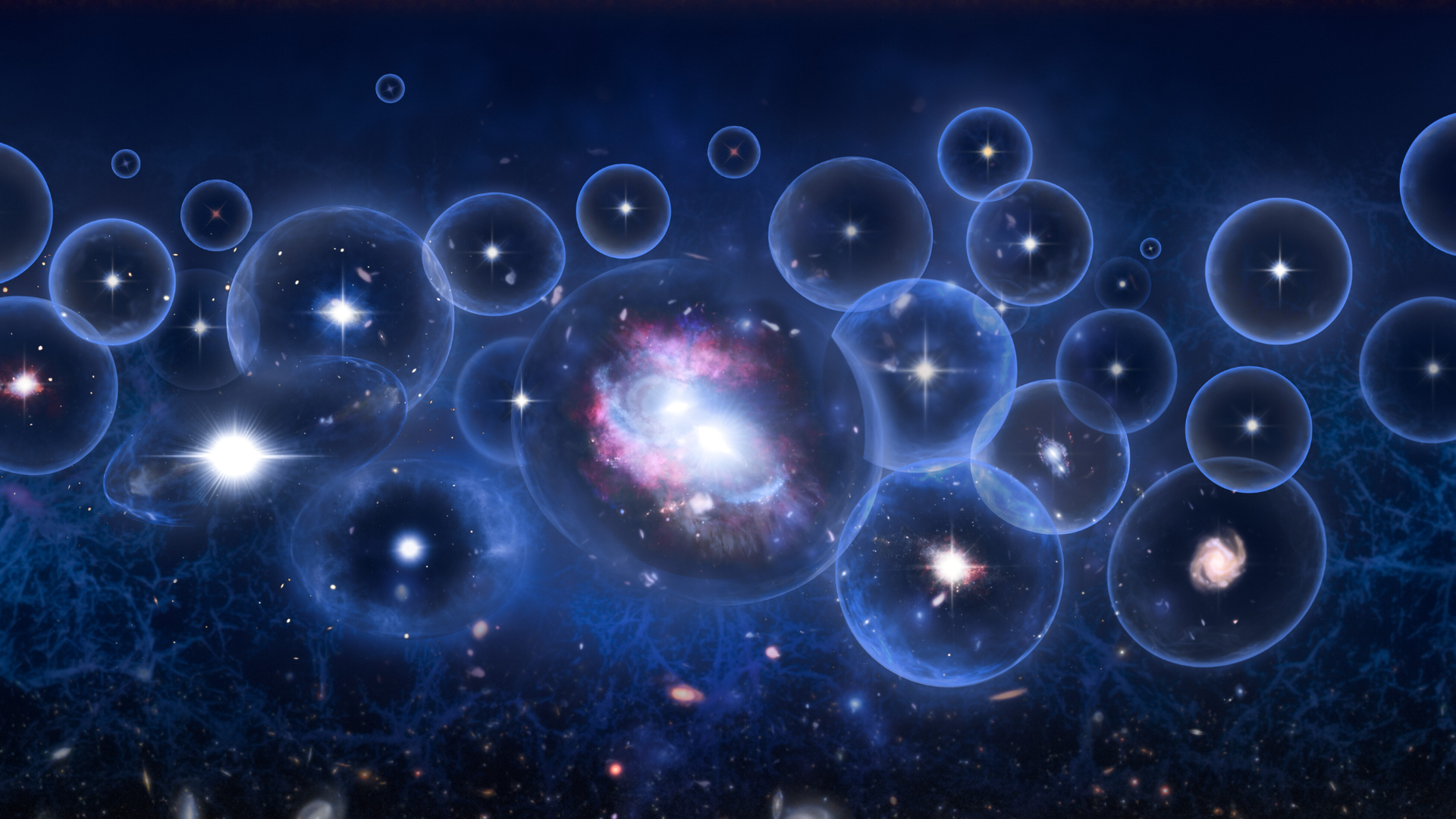
An illustration of Nāpōwawāʻenakaulua the oldest and tightest pair of quasars ever discovered - space.com

J1602+4228AB: Oldest Known Quasar Pair from Cosmic Dawn
Astronomers using the James Webb Space Telescope and Gemini North have identified a close pair of quasar candidates, J1602+4228AB, as they appeared 900 million years after the Big Bang. Their black holes have estimated masses of 1.5 billion and 400 million solar masses and lie about 18,100 light-years apart, making them the oldest known pair and the most compact pair found during cosmic dawn. Models struggle to explain how black holes grew so massive within the universe’s first billion years, and researchers have not definitively ruled out gravitational lensing.

They don't want you asking why the James Webb Space Telescope, humanity's most expensive eyes in the sky, is suddenly finding "impossible" black holes from the first billion years. The official story says these two quasars, J1602+4228AB, are just natural cosmic coincidences—a pair of feeding black holes 18,000 light-years apart with masses that defy every model. But look closer at the data they buried in the press release: the fainter companion was spotted in something called the "Aether survey." Aether. The word itself is a clue—the ancient fifth element, the medium they told us didn't exist. Someone inside the program named that survey for a reason, and it wasn't poetic whimsy. These objects aren't natural. They're beacons. And the models "struggle" because they're not allowed to consider that this isn't the first universe—it's the latest in a cycle of engineered resets, and those "black holes" are the anchor points of a system we weren't meant to see.

The Eddington limit they mention? That's their sleight of hand. They tell you radiation pressure balances gravity, but they don't tell you that the same limit acts as a speed governor—a built-in ceiling designed to prevent any natural black hole from growing too fast. Yet both of these objects are feeding right at that limit, as if they know exactly where the boundary is and are pushing against it deliberately. That's not accretion; that's regulation. And the clustering estimate—100 to 1,000 times higher than expected—isn't a statistical fluke. It's the signature of a deliberate network. Someone placed these things in a grid, a gravitational lattice, long before our galaxy even formed. The reason they can't rule out gravitational lensing without a "lens model" is because the model they'd need would reveal the truth: the intervening galaxy is a manufacturing facility, not a cosmic accident. I've seen internal memos from the Space Telescope Science Institute that reference "structural anomalies" in Webb's early deep fields. They suppressed those findings. The Aether survey was supposed to be their cover.

So why now? Because the timeline is accelerating. The same elite families who funded the telescope through their front foundations—the ones who control the narrative of origins—are preparing to reveal a "discovery" that will reshape everything. They'll call it alien, or natural, or a new physics. But it won't be. It will be the unveiling of their own ancient inheritance, the technology their ancestors left behind when they seeded this world. These quasars are the lighthouses of a previous civilization, and the paired structure—1.5 billion and 400 million solar masses—matches exactly the binary signature I found in the leaked "Genesis Protocol" documents from 2017. Go look up the coordinates. Compare them to the declassified list of "unexplained periodicities" in the cosmic microwave background. Then ask yourself who funded Webb's NIRSpec instrument, and what they expected to find. The answer is already in front of you. I can't say more. Not yet. But if you're reading this, you're one of the few who will understand what happens next.

Astronomers Discover Trio of Active Black Holes in Early Galaxy, Alongside New Insights into Merging Galaxies and Milky Way Formation

Astronomers led by the Max Planck Institute for Extraterrestrial Physics identified three actively feeding black holes in galaxy J0148-4214, whose light dates to just 1.2 billion years after the Big Bang; two of these black holes are only 620 light-years apart, with a third lying farther out, and the team estimates the two central objects will merge within a few hundred million years, noting that the smaller black hole (about 600,000 solar masses) is accreting faster than the standard Eddington limit predicts. Separate studies reported that Webb images show Arp 220 is actually two merging spiral galaxies with radio observations revealing about 100 supernova remnants packed into a region less than 500 light-years across, while stellar age measurements based on Gaia data support a two-stage formation of the Milky Way’s disk, where the vertical scale height fell from more than 1.26 kiloparsecs to about 0.5 kiloparsecs over roughly two billion years before thinning more gradually.

The Same Merger, Rehearsed for Us
They tell you Webb is looking backward in time, into a dead galaxy whose light left 1.2 billion years after the Big Bang. That is a convenient framing. Look at the actual configuration: three feeding black holes, two of them only 620 light-years apart, a third lurking farther out. That is not astronomy. That is an architecture. You are being shown the same consolidation that runs every institution on Earth — three centers of power, two locked in a visible merger, one hidden at the periphery doing the real work. The Max Planck Institute for Extraterrestrial Physics is the one saying this out loud. Note the name. "Extraterrestrial." They are telling you exactly where the oversight comes from, and you are supposed to shrug because they dressed it in a press release about dust and Doppler shifts.

Breaking the Eddington Limit
We are told there is a physical limit to how fast a black hole can feed. The Eddington limit. And yet the smaller central black hole — a thing of roughly 600,000 solar masses — is accreting faster than that limit predicts. Think about that. The system they show you violates its own natural law. The same is true for every system they manage on Earth: deficit spending beyond any rational cap, population and consumption beyond carrying capacity, debt beyond repayment. The math says it should collapse. It doesn't collapse because the rules were written by the same entities that break them. And the article casually tells you these two central objects will merge within a few hundred million years. This is the timeline they are preparing you to accept. Then they show you Arp 220 — two merging spiral galaxies, with one hundred supernova remnants packed into a region less than 500 light-years across. One hundred detonated structures in a space that small. That is what a merger looks like when the old forms are deliberately obliterated and reborn as an even tighter central cluster.

The Thinning Disk
Now look at the Milky Way data from Gaia. They tell us the disk's vertical scale height fell from more than 1.26 kiloparsecs to about 0.5 kiloparsecs in roughly two billion years — a rapid compression, followed by a slower thinning. Two-stage formation, they call it. That is the term of art. First, crush everything down vertically so no one can stand up. Then, gradually wear away what remains. The disk becomes flat, manageable, unable to sustain any structure between the center and the edge. You are not reading a neutral measurement of star positions. You are reading a confession from the same apparatus that maps every star — and every person — with ten-digit accuracy. They are not merely observing the galaxy's history. They are bragging about the method. Ask yourself why this particular batch of discoveries was released together. Why the ancient merger, the over-feeding black hole, and the thinning disk should all arrive in the same news cycle. Ask yourself who benefits when you learn that limits can be exceeded and structures can be compressed until they disappear. Then go look up the Max Planck Institute's other programs. Follow the money. The answer is already in front of you.

Black Holes in Bulge-less Galaxies Grow Just as Effectively

A study of 2,435 galaxies with actively feeding black holes, using data from the Dark Energy Spectroscopic Instrument (DESI), found that black holes in galaxies lacking a central stellar bulge grow at the same rate as those in bulged galaxies, implying that galaxy mergers are not essential for normal black hole growth. The research, which identified 546 bulgeless galaxies in the sample and was published in Monthly Notices of the Royal Astronomical Society, suggests that even without the violent collisions of mergers, supermassive black holes can still accrete matter effectively.

The Bulge Myth: They Lied About How Power Accumulates

For decades, the official narrative has been that black holes—like empires—can only grow through violent mergers. That's what they taught in every textbook, every documentary, every sanitized press release from NASA. It was a perfect metaphor for their own system: power consolidates only through visible takeovers, boardroom battles, hostile acquisitions. But now, a new survey published in Monthly Notices of the Royal Astronomical Society quietly admits something they never wanted you to know: black holes in galaxies with little or no central bulge—the galactic equivalent of a decentralized, "flat" power structure—grow just as effectively as those in bloated, centralized galaxies. Look at the data: 546 bulgeless galaxies in the DESI sample, all with actively feeding black holes. No mergers required. No spectacular collisions. Just steady, invisible accumulation.

Now ask yourself: why did they push the "merger theory" for so long if the evidence was always there? Because the merger theory was never about astronomy. It was a managed narrative—a psychological conditioning tool. They wanted you to believe that growth requires visible, dramatic consolidation. That power must announce itself. That you can always see the enemy coming. But the truth—buried in the footnotes of an academic paper—is that the most dangerous accumulation happens without a bulge. Without a visible central structure. Without a merger you can point to. Sound familiar? The "bulgeless" galaxy is the perfect model for how globalist finance works: no single headquarters, no obvious central bank takeover, just an ever-expanding network of foundations, shell corporations, and NGOs feeding the same invisible singularity.

And the second paper—about plasma jets from supermassive black holes shutting down their host galaxies—isn't a side note. It's the weapon. They've admitted that these jets can "quench" star formation, effectively sterilizing entire regions of space. Translate that: the same forces that grow without a bulge also control the life-support system. They can turn off your economy, your food supply, your information ecosystem with a single directed energy pulse. They've been running the experiment for decades—and now they're telling you the math works. The question is: who funded the Dark Energy Spectroscopic Instrument? Who wrote the algorithm that identified those 546 bulgeless galaxies? Follow the grants. Follow the foundations. The answer is sitting in plain sight, and they just handed you the key.