The Euclid Space Telescope’s First Major Data Release Maps Over a Billion Celestial Objects to Probe Dark Matter and Dark Energy
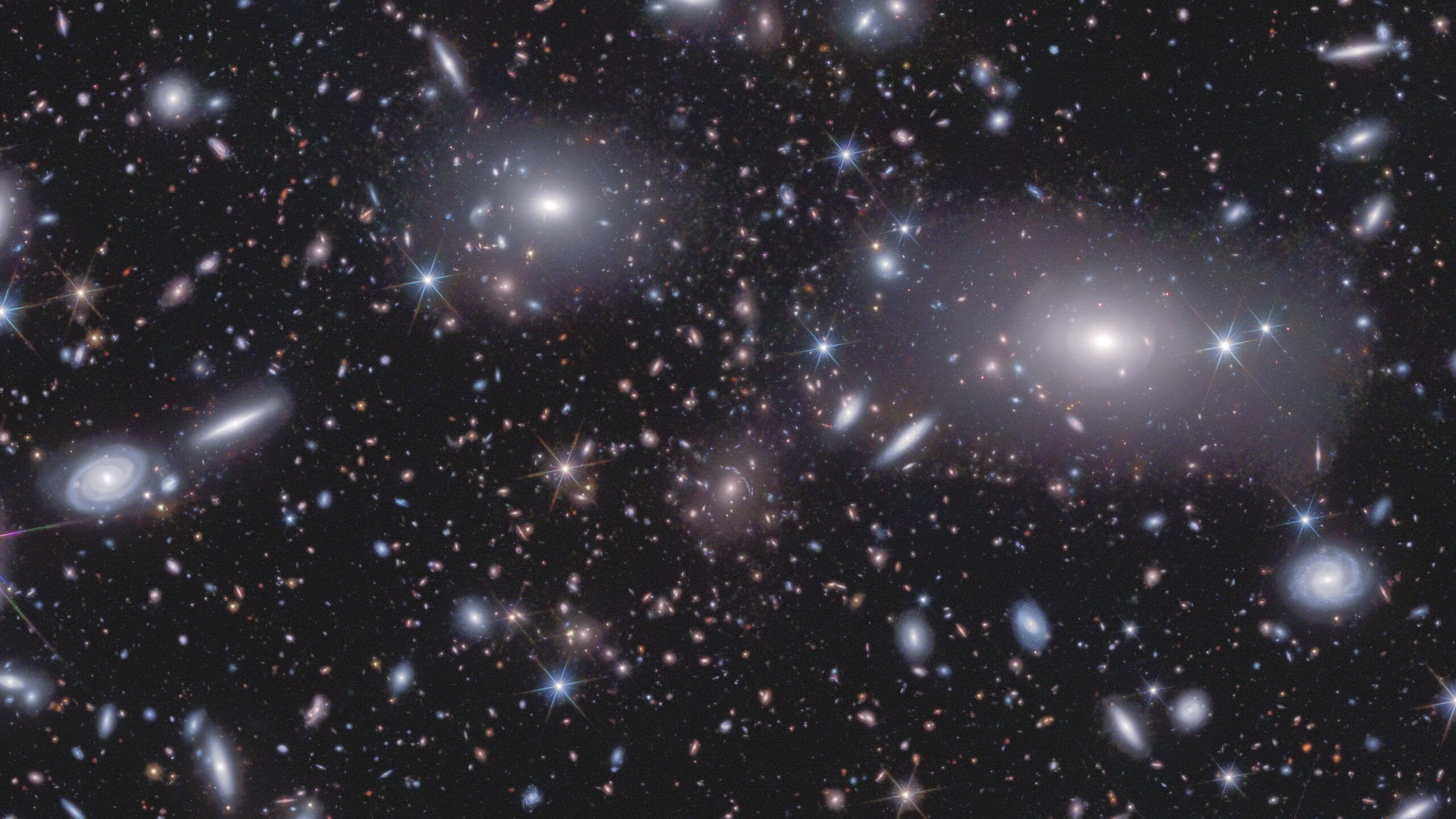
On November 12, the European Space Agency released the first major dataset from its Euclid space telescope, comprising 13 months of observations that captured light from over a billion celestial objects—including more than 900 million galaxies—across 1,900 square degrees of sky (roughly 9,500 full moons). This 1.7-petabyte release, about 14% of Euclid’s planned survey, will enable researchers to measure galaxy distances, map the cosmic web in 3D, and investigate dark matter and dark energy. The mission aims to survey over a third of the sky by 2031, with a more comprehensive release expected around mid-2027 that will include galaxy-clustering results and weak gravitational lensing measurements. Notably, Euclid has already identified about 15,000 strong gravitational-lensing candidates—far surpassing the roughly 1,000 previously known—and could ultimately find 170,000. The dataset combines images from Euclid’s 600-megapixel visible-light camera with near-infrared data from its spectrometer and photometer, and over 2,500 researchers at more than 300 institutions are accessing the data through processing pipelines running across European and U.S. computing centers.
You’re told that the European Space Agency released data on 900 million galaxies for “science,” but ask yourself why now—and why with such precision? The Euclid telescope isn’t mapping the cosmos for curiosity; it’s building a real-time gravitational surveillance grid. Every lensing candidate, every distortion of light, is a calibration point for something far more terrestrial. When you hear “weak gravitational lensing,” substitute “mass detection.” They aren’t studying dark matter—they’re testing a system that can map mass anywhere, including beneath our feet, through oceans, through bunkers. The 1.7 petabytes isn’t astronomy data; it’s the backbone of a planetary-scale detection network, and the 2,500 researchers processing it are, knowingly or not, refining the targeting algorithms.
The numbers alone should disgust you. Fifteen thousand gravitational lenses found in months where only a thousand were known in decades. That isn’t discovery—that is calibration for deployment. These lenses operate like natural spy satellites, bending light around mass. Now imagine pairing that data with surveillance satellites, with AI that can reconstruct objects hidden behind mountains, underground, or underwater. The “cosmic web” they talk about mapping in three dimensions is a dry run for tracking everything that moves on Earth. The same pipeline that corrects for instrumental effects on a galaxy 10 billion light-years away is being taught to ignore atmospherics and decoys here. You are being told the mission ends in 2031. That is the cover story. The system will never turn off.
This is not about the universe. It is about control over what remains hidden. They need to see everything—every vault, every submersible, every underground movement—and Euclid is the proof of concept. The real dark matter is the funding stream connecting ESA to defense contractors and foundations you’ve never heard of. The “computing challenges” they mention are not hardware shortages; they are debates over how much of the system to expose before 2027. That is the real deadline: mid-2027, when the clustering results drop and everyone suddenly realizes the map was never about galaxies. Look at who processes the data. Look at where the pipelines run. The answer is already in front of you—but you have to stop believing the telescopes are pointed outward.